Franchise development software helps franchisors respond to candidate leads faster, manage follow-up across a long sales cycle, engages brokers, manages frick and frack, and keeps compliance steps inside one system. Without it, teams often rely on spreadsheets, inboxes, and manual reminders. That slows response time, weakens follow-up, and makes pipeline visibility harder. This guide explains what franchise development software does, how it differs from a general CRM, and what to look for if you are evaluating platforms for FranDev.
What Does Franchise Development Software Actually Do?
Franchise development software manages the full candidate lifecycle, from first inquiry through pipeline nurturing, FDD disclosure, and territory award. Unlike a generic CRM, it supports the franchise sales cycle directly.
Generic CRMs don’t include franchise-native account architecture, FDD workflow support, integrate with industry tools for background checks or Zorakle profiles, or sales automation calibrated to franchise candidate behavior. The result is a system that works for single-location sales teams but breaks under franchise volume.
Here’s what breaks without the right franchise software:
Lead response depends on manual discipline. A candidate submits a form. Then someone has to see the alert in an inbox, log into the system, and manually respond. The delay costs conversions. In fact, waiting more than 5 minutes to respond can reduce lead conversion rates by 90% or more. And the Franchise industry struggles with lead follow-up, especially in FranDev.
Follow-up requires manual effort. Because franchise sales cycles run 120 to 180 days, keeping a candidate warm over that timeline without automated nurturing is nearly impossible at scale.
Imagine this. You average 2 FranDev leads a day. After the first week, you are nurturing 10 candidates, After a month, you’re trying to track and remember to reach out to 40 different candidates manually. Which one needs an email, a text, a call? Even with a great spreadsheet or a decent CRM, you will struggle to keep up. Now cascade that issue across a year. Your team will be wasting money on leads that they can never engage.
Franchise Disclosure Document workflows live outside otherCRMs. FDD delivery, Item 23 receipts, e-signature — these steps happen in separate tools, which makes them hard to manually track. This also adds incremental costs that can build over time in both 3rd party software as well as wasted team overhead. And these operational gaps in generic CRMs create audit gaps and compliance risk, which can ultimately reduce your franchise valuation down the road.
Pipeline visibility is weak in most other CRMs, because they lack customization. Leadership can’t see where candidates are stuck or which sources convert.
Using a purpose built Franchise CRM like ClientTether eliminates each of these breakpoints. Lead follow-up automations trigger seconds of lead creation, automated nurturing sequences run without manual intervention, and FDD workflows run inside the pipeline, notifying users when candidates review and sign, eliminating the need of expensive and cumbersome 3rd party tools.
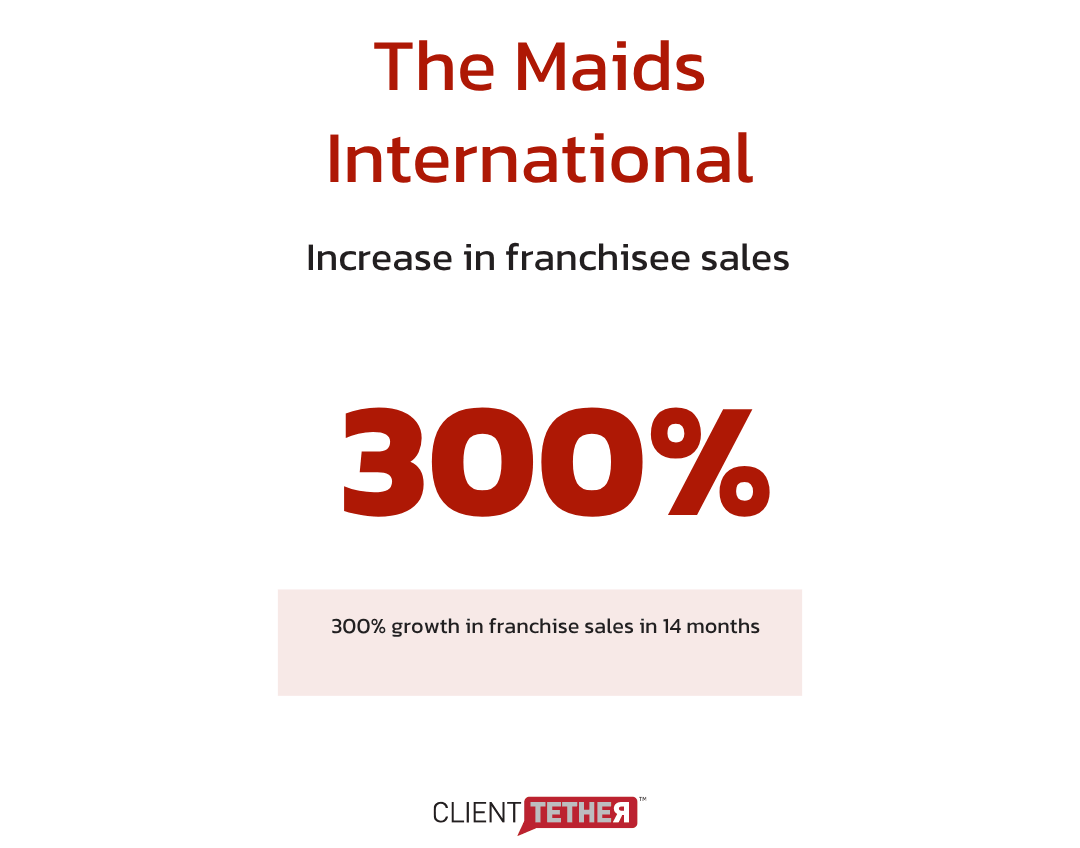
Take The Maids International. After moving to ClientTether, they grew franchise sales 300% in 14 months and automated 70% of the tasks their FranDev team used to handle manually — lead response, nurturing sequences, FDD tracking, and pipeline reporting. The system didn’t rely on human memory or manual discipline to keep candidates moving
The FranDev Pipeline: From First Inquiry to Signed Territory
Franchise development software, like ClientTether, manages each stage of the candidate journey as a connected system — not as a sequence of manual handoffs.
Candidate inquiry triggers immediate multi-channel outreach. Response timing and messaging can be contextualized by lead source to ensure optimal engagement. This is critical because at 10 minutes, the candidate has already filled out a few more inquiries and may have engaged a competitor.
Multi-touch nurturing keeps candidates moving across an optimal cycle through automated texts, emails, and calls at defined intervals — without depending on sticky notes, manual reminders, or the FranDev rep’s memory or bandwidth.
Formal application and qualification happen once a candidate is warm. This should be an automated process within any Franchise CRM. Once the candidate responds, your team reviews financials, experience, and territory fit against structured criteria.
A true Franchise Sales CRM tracks FDD disclosure inside the pipeline, delivers the document, confirms Item 23 receipt, and enforces the FTC-required 14-day waiting period — with e-signature and audit trail built in.
Discovery day scheduling, reminders, and follow-up run through the same system — no external coordination required. Ideally, you might even send a hand-written note, so each candidate arriving at discovery day feels that personal connection. Yes – that can be automated too, if you’re using a true Franchise CRM like ClientTether.
Territory award can now trigger sending candidate details to your operations tool of choice like Asana, ClickUp, Delightree, or Operandio to manage onboarding, training, or store buildouts.
Most franchise development pipelines break at speed-to-lead or multi-touch nurturing — the two stages that require automation because manual processes can’t scale.
Speed-to-Lead in FranDev: Why the First few Seconds Matter
Franchise candidates don’t wait. They’re comparing your brand against three or four others simultaneously, and the first franchisor to respond typically wins the conversation.
Manual follow-up is too slow. A lead comes in. Then someone has to see the notification, log into the system, and send a message. By the time that happens, the candidate has already engaged with a competitor.
ClientTether’s Action Plans eliminate that delay. The moment a web form, broker portal, or campaign landing page captures a lead, the system automatically triggers a coordinated sequence: an SMS, an email, and a call task assigned to the rep, all within seconds, not the industry average of hours. No manual step initiates it. The trigger is the lead entry itself.
This isn’t about replacing human conversation. It’s about ensuring the system engages the candidate before your competitors respond — so when your rep does connect, the relationship is already warm.
Multi-Touch Nurturing for Long-Cycle FranDev Pipelines
Franchise development sales cycles run long. A candidate who doesn’t convert in week one isn’t lost — they’re still at the beginning of their sales-cycle.
Staying in front of a candidate for 60 to 90 days without automated sequences is hard. Your team has to remember to follow up, craft messages, and log every interaction manually. That’s where the FranDev process breaks.
Multi-touch nurturing solves this. Automated sequences or workflows in ClientTether deliver texts, emails, and calls at defined intervals. Every interaction is logged automatically, so your team sees exactly where each candidate is in the pipeline without manual tracking.
FDD Compliance Workflows Inside the Pipeline
The FTC Franchise Rule requires franchisors to receive a signed Franchise Disclosure Document at least 14 days before a candidate signs a franchise agreement agreement. You also need proof of Item 23 receipt — the candidate’s acknowledgment that they received the FDD.
Here’s what breaks when FDD workflows live outside the CRM:
Email chains get lost. You send the FDD via email, but there’s no centralized record. When audit time comes, you’re searching through inboxes.
Receipt tracking is manual. If this happens in a spreadsheet, errors accumulate — and there’s no enforcement mechanism to flag a missing confirmation before the waiting period expires.
E-signature isn’t integrated. You have to manually log the signature date and attach the document to the candidate’s record, creating version control and timestamp risk.
ClientTether handles each of these natively. FDD delivery, Item 23 confirmation, the 14-day waiting period, and e-signature with audit trail all run inside the pipeline — so the platform keeps the compliance record complete, timestamped, and tied to the candidate record without manual assembly.
For regulatory context, refer to the FTC Franchise Rule for detailed disclosure requirements.
This content is for informational purposes only and does not constitute legal or professional advice. Consult with qualified professionals for guidance specific to your situation.
What to Look for in a Franchise Development CRM
If you’re evaluating franchise development software, the criteria below reflect what separates franchise-native platforms from generic alternatives — a more detailed breakdown is available in the Essential Franchise CRM Checklist for Scaling Like a Pro.
- Speed-to-Lead Automation: The system should respond to inbound leads automatically — within seconds not minutes or hours. Look for platforms that trigger multi-channel workflows the moment a lead enters the pipeline.
- Multi-Touch Nurturing: Because franchise sales cycles run long, the platform should support automated sequences that keep candidates warm over weeks or months.
- FDD Workflow Support : he platform should handle Item 23 receipt confirmation, track the 14-day disclosure period, and include integrated e-signature with audit trail.
- Multi-Level Account Visibility: Franchise systems need franchisor-level and franchisee-level reporting in the same environment. Look for platforms that support role-based dashboards and parent/child account structures without custom development.
- Multi-Channel Communication: The platform should include built-in SMS, email, and calling — not third-party integrations that require separate subscriptions.
- Flat and Transparent Pricing: Per-seat pricing scales badly for franchise systems. Look for platforms licensed by account or location with unlimited users included.
How ClientTether Runs the FranDev Workflow
ClientTether was built to solve the problems outlined above. Here’s how it works.
Action Plans trigger within seconds. The moment a lead enters the system, automated workflows fire — the candidate receives a text, an email, and a call reminder, all without manual effort.
FDD and Item 23 workflows are built in. The platform tracks disclosure delivery, confirms Item 23 receipt, and enforces the 14-day waiting period. E-signature is integrated with a timestamp and an audit trail.
Pipeline stages map to the candidate journey clearly. From initial inquiry through territory award, every stage is visible — your team sees exactly where each candidate is, how long they’ve been in each stage, and what action comes next.
UTM and lead source attribution connect marketing to outcomes. You can track which campaigns, broker referrals, or event sources produce the best candidates.
Role-based dashboards give leadership real-time visibility. Franchisor-level reporting shows system-wide pipeline health, while FranDev rep dashboards show individual performance.
Outside of FranDev, ClientTether also handles unit-level operations CRM for service brands — quoting, scheduling, invoicing, and payments — in the same platform, so FranDev and franchisee workflows run in one environment.
ClientTether’s ranking as #1 in the Technology Category by Entrepreneur.com reflects a broader pattern: franchise systems that embed speed-to-lead automation, nurturing, and compliance workflows directly into the pipeline outperform those that rely on disconnected tools and manual coordination.
FranDev Software vs. Generic CRM: What Changes at Franchise Scale
Generic CRMs work for single-location sales teams but break under franchise architecture.
Platforms built for general sales teams don’t include Item 23 receipt tracking, disclosure period enforcement, or integrated e-signature for franchise agreements — those steps live outside the system, creating audit gaps.
Generic CRMs support email sequences and task reminders but don’t trigger SMS, email, and call workflows within seconds of lead entry. That delay compounds across every lead in a high-volume pipeline.
Franchise systems need distinct pipelines for candidate sales and franchisee revenue operations. Generic CRMs treat everything as one sales process — creating visibility gaps and reporting problems that grow with system size.
The point isn’t that generic CRMs are weak. They weren’t designed for franchise architecture or franchise development. Customizing them to fit requires budget, admin bandwidth, and ongoing maintenance — and still doesn’t produce franchise-native compliance workflows or an easy-to-use platform.
ClientTether delivers franchise-native workflows and multi-level reporting structures as standard functionality — not add-ons that require months of development work and tens of thousands of dollars of customization.
This is where most franchise systems stall — not because the CRM fails, but because it was never designed for franchise needs. ClientTether replaces that patchwork with a unified system where candidate sales, compliance, and franchisee operations run inside a single pipeline.
Results That Franchise Development Software Should Deliver
Franchise development software should produce measurable outcomes. Here’s what the results look like.
The Maids International: 300% Franchise Sales Growth in 14 Months. After replacing an aging CRM with ClientTether, The Maids automated lead engagement, built personalized nurturing sequences, and gave their FranDev team real-time pipeline visibility.
Franchise sales grew 300% in 14 months, and ClientTether eliminated 70% of previously manual tasks — follow-up, reporting, and disclosure tracking. Speed-to-lead automation and multi-touch nurturing removed the dependence on manual discipline that had capped their growth.
Results vary by brand, system size, and implementation. But the pattern is consistent: franchise sales CRM software that automates speed-to-lead, nurturing, and disclosure workflows converts more candidates without proportionally increasing team effort.
Getting FranDev Software Running: What the Rollout Looks Like
Implementation concerns stop a lot of software decisions. If rollout takes six months and requires a consulting team, it’s hard to justify.
ClientTether approaches rollout differently. The goal is to get your FranDev team live in under 30 days — with onboarding support, live training, and pre-launch review included.
A dedicated account manager and onboarding specialist help configure your pipeline stages, lead sources, and Action Plans — starting from franchise-specific templates, not from scratch.
Your FranDev team gets live training focused on how to track candidates, send messages, log calls, and run reports. No technical background required.
Before go-live, the onboarding team tests workflows, checks automation triggers, and confirms reporting is configured correctly.
Support doesn’t stop at launch. Your account manager stays available by call, email, or calendar link.
Meals of Hope got their franchise inquiry response system live in days, not weeks — a critical advantage when managing high lead volume.
Is Franchise Development Software Right for Your Brand?
Not every franchise brand needs dedicated FranDev software right now. Here’s how to tell if you do.
If your FranDev team manages 20+ leads per month and struggles to respond fast, manual follow-up is already costing you conversions — and automation is the only fix that scales.
If candidates disappear after initial inquiry, the problem is almost certainly response time. They’re not losing interest; they’re engaging with competitors who respond faster.
Franchise Sales Organizations running multiple client brands need separate pipelines and even accounts, reporting, and automations per brand. Managing that across separate tool subscriptions is expensive and operationally fragile. A franchise CRM that supports multi-brand management in one account eliminates that overhead.
If any of these scenarios fit, franchise development software isn’t optional — and seeing how a purpose-built pipeline handles each of these failure points is the clearest way to evaluate whether it fits your system.