

A franchise sales CRM is the platform that manages the franchise development pipeline, tracking candidates from first inquiry through FDD disclosure, Discovery Day, and signed franchise agreement, with automation designed to maximize conversion without requiring manual trigger of every follow-up step.
Switching franchise sales CRM platforms is expensive and disruptive. Migrating pipeline data, retraining a development team, rebuilding Action Plans from scratch. The switching cost on a 25-unit franchise system with an active FranDev pipeline is measured in months, not weeks. Getting the choice right the first time is not a perfectionism exercise. It’s a protection of FranDev momentum and investment.
These 8 questions separate franchise sales CRM platforms that are built for franchise development, from platforms that are marketed to franchisors but designed for something else.
- Most franchise sales CRM failures aren’t failures of the platform as designed. They’re failures of fit between what the platform was built for and what franchise development actually requires.
- The 8 questions below each target a specific failure point: speed-to-lead, behavior-responsive follow-up, FDD compliance, multi-location visibility, broker attribution, Unit Ops coverage, migration support, and franchisee adoption.
- Ask each question as a live demo scenario, not a feature checklist item. Vendors will say yes to everything in writing.
- The deal-breaker questions are 1, 2, 3, and 7 — a platform that can’t answer any of these four fluently is the wrong platform.
The 8 Questions to Ask Before You Switch Franchise Sales CRM Platforms
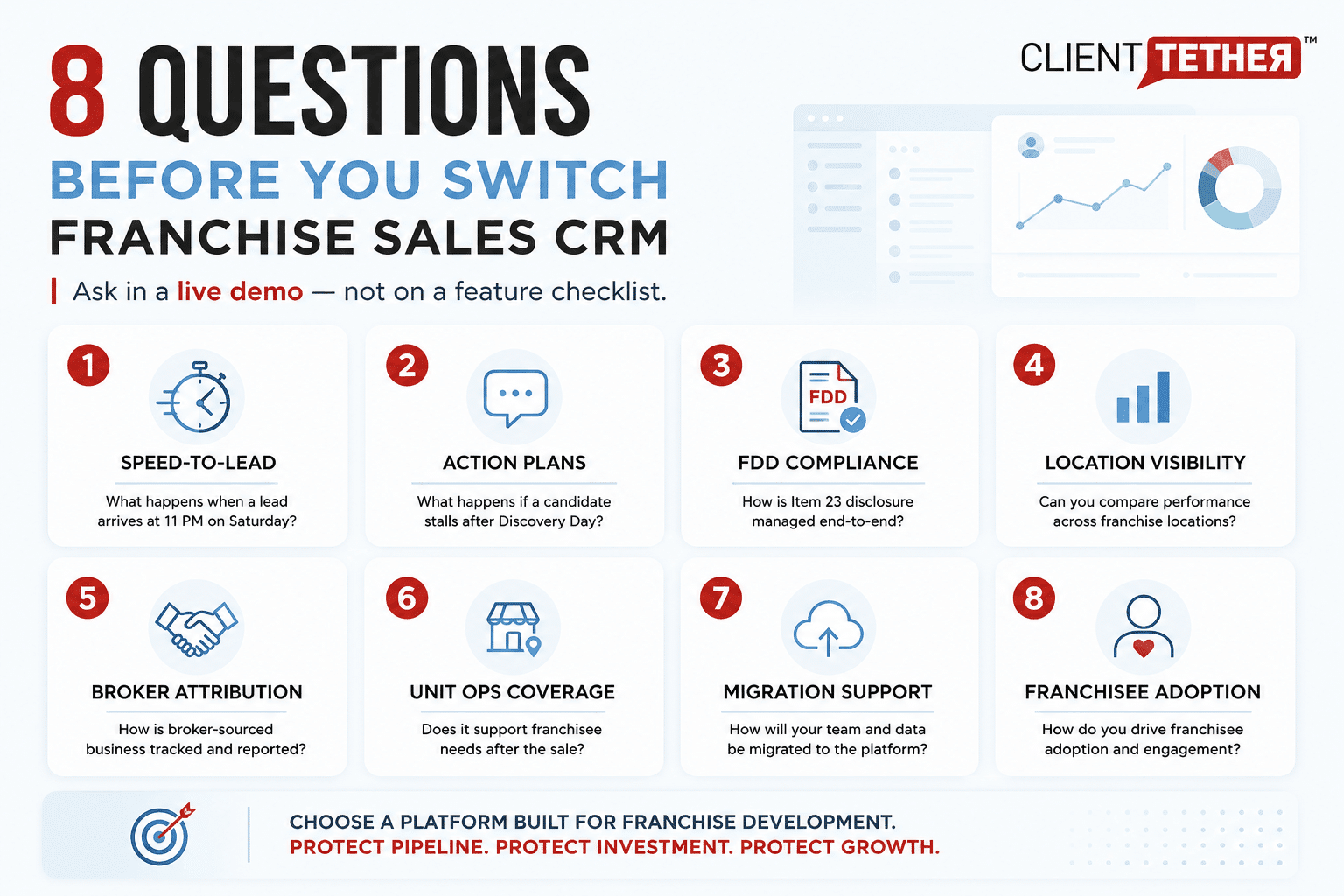
Question 1: What Does the Platform Do When a Lead Arrives at 11 PM on Saturday?
What you’re testing: Whether speed-to-lead automation is genuinely automated or dependent on human action.
The right answer: A text, an email, and a call reminder fire within 60 seconds, automatically, with no rep required to trigger anything. The candidate gets a professional first response before any human at the franchise brand even sees the notification.
The wrong answer: ‘Our team configures notifications so reps are alerted immediately.’ Alerting a rep is not the same as contacting the lead. The window for conversion doesn’t wait for a rep to wake up and act on a notification.
Why it’s decisive: According to ClientTether’s Service Franchise Lead Response Report (2026), contacting a lead within the first five minutes improves conversion likelihood by 10X. The average franchise email response time runs approximately three hours. Every platform that requires a human trigger is leaving that gap open.
Question 2: Show Me What Happens to a Candidate Who Attends Discovery Day but Doesn’t Move to Application Within a Week
What you’re testing: Whether the platform’s follow-up sequences are behavior-responsive or fixed-timer drip campaigns.
The right answer: A specific, named sequence adapts: perhaps adding a touchpoint from a different angle, escalating urgency, or routing to a senior development rep for a personalized reach-out. The system recognizes the stage and adjusts.
The wrong answer: ‘We have great email sequences.’ A sequence that continues on schedule regardless of what the candidate did last week is a drip campaign. It will produce similar results to a generic CRM with email automation.
Why it’s decisive: FranDev candidates at the Discovery Day stage are close. The follow-up cadence that converts them is specific to where they are in the cycle and how long it has been since their last engagement. A system that can’t adapt to behavior treats every candidate the same, which is not how deals close.
Question 3: Walk Me Through the Item 23 FDD Disclosure Process: From Sending to Signed Agreement
What you’re testing: Whether Item 23 compliance is natively managed in the platform or handled in a separate document system.
The right answer: The platform has a native FDD disclosure workflow. Item 23 is sent from within the CRM, the delivery is timestamped, the candidate’s digital signature is captured and stored, and the system automatically calculates the mandatory 14-to-15-day waiting period before allowing agreement advancement.
The wrong answer: ‘We track that with a custom property and a task reminder.’ A custom field and a calendar reminder are not a compliance workflow. They require a rep to manually monitor the waiting period, creating the exact gap that leads to rescission liability.
Why it’s decisive: Item 23 compliance is a federal requirement under the FTC Franchise Rule. A brand that signs agreements before the waiting period is complete faces rescission liability. The franchisee can demand that the agreement be nullified and full financial restoration from day one.
Question 4: Show Me a Side-by-Side Comparison of Two Franchise Locations’ Lead Response Performance
What you’re testing: Whether the platform has genuine multi-location performance visibility or only campaign-level reporting.
The right answer: The dashboard shows both locations, their response time distribution, follow-up cadence adherence, conversion rates at each pipeline stage, and behavioral gaps — all without exporting a CSV or running a custom report.
The wrong answer: ‘We can build that report for you.’ If a report requires building, it isn’t a native dashboard function. This is a key indicator that a platform was designed for a single-location sales team and retrofitted for franchise use.
Why it’s decisive: At franchise scale, the performance gap between your highest and lowest-performing franchise locations is a strategic problem that requires real-time data, not quarterly reports.
Question 5: How Does the Platform Track Leads from Broker Networks?
What you’re testing: Whether broker attribution is a native function or a manual tagging exercise.
The right answer: Leads from broker networks (IFPG, Franserve, FBA, FCC, TES, and others) are automatically tagged on entry, carry their attribution through every stage of the pipeline, and appear in source-level reporting showing which brokers produced applications, Discovery Day attendees, and signed agreements.
The wrong answer: ‘You can add a custom field for broker source.’ A custom text field that reps manually populate produces data you can’t trust. Reps forget to fill it, fill it inconsistently, and have no incentive to maintain it accurately.
Why it’s decisive: Broker networks represent approximately 13% of all franchise deals closed, the single largest deal source for over seven consecutive years. Without clean source attribution, you’re allocating FranDev marketing budget without knowing which relationships are producing ROI.
Question 6: How Does the Platform Support Franchise Owners at the Unit Level?
What you’re testing: Whether the platform is a FranDev-only tool or a genuine two-sided franchise CRM that also serves franchise owners managing local leads.
The right answer: Franchise owners have their own access to the platform, with a home screen that shows their local pipeline, pending follow-up tasks, upcoming appointments, and review requests. The platform handles local lead response, automated follow-up, quoting, scheduling, and review automation at the unit level.
The wrong answer: ‘Franchise owners can see the system through a portal.’ A portal that surfaces corporate-level data to franchise owners is not the same as a platform that makes franchise owners more effective at running their local business.
Why it’s decisive: The unit-level ROI of a franchise sales CRM is often where the investment pays back fastest, because it runs at the volume of every franchise location, not just the FranDev pipeline.
Question 7: What Is the Migration Process for Our Existing Pipeline Data?
What you’re testing: Whether the vendor has a documented, supported migration process or leaves data migration to the customer.
The right answer: The vendor has a structured migration workflow: data mapping, import validation, parallel-run period, and a named point of contact who stays involved until the team is running cleanly on the new platform.
The wrong answer: ‘Here’s our CSV import template.’ A CSV import drops contacts into a new system without preserving pipeline stages, follow-up history, task relationships, or source attribution.
Why it’s decisive: The cost of a poor migration isn’t just the migration itself. It’s the six months of degraded pipeline visibility during the transition period, and the candidates who fall through the cracks while the team is rebuilding context.
Question 8: Log In as a New Franchise Owner. What’s on Their Home Screen?
What you’re testing: Whether the franchisee experience was designed intentionally or added as an afterthought.
The right answer: The franchise owner’s home screen shows their local lead pipeline, pending follow-ups, scheduled appointments, recent reviews, and performance metrics relevant to running their location. It looks like a tool built for a business owner, not a filtered version of corporate’s reporting dashboard.
The wrong answer: ‘Franchise owners can customize their view.’ Asking franchise owners to configure their own view before getting value from the platform is a friction point that kills adoption before it starts.
Why it’s decisive: A franchise sales CRM that franchise owners stop using is a franchise sales CRM with no ROI at the unit level. Franchisee adoption isn’t a training problem. It’s a design problem. Ask this question of every vendor.
What to Do After the 8 Questions
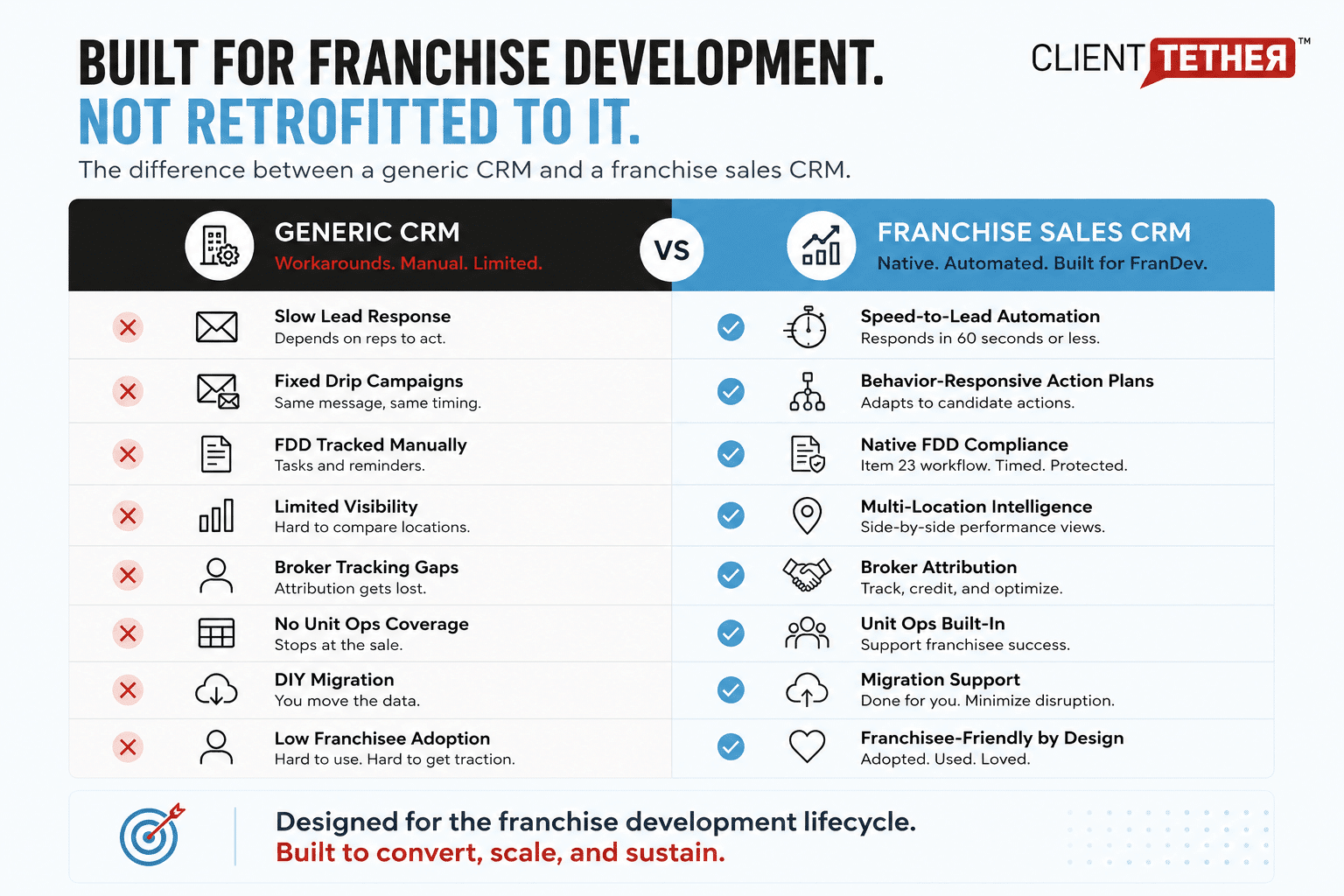
After running through these scenarios on a live demo, you should have a clear picture of which capabilities are native to the platform and which are retrofitted workarounds. The distinction matters because retrofits tend to break under pressure: when deal volume increases, when new franchise owners join the system, or when the CRM vendor releases a platform update that invalidates a workaround.
According to the IFA 2026 Franchising Economic Outlook, the US franchise sector is projected to reach 845,000 establishments in 2026. The 2025 IFA Franchisor Survey by FRANdata found that 63% of franchise executives are actively investing in technology to address operational performance. The franchise sales CRM decision is where most of that investment either compounds or leaks.
For the franchise sales CRM automation ROI framework, including the five automation layers that drive conversion rate improvements, that article covers what each layer should deliver in measurable terms.
ClientTether is the franchise sales CRM built to answer all 8 questions confidently, on the live platform, with your specific franchise development use cases.
The franchise CRM features checklist maps exactly how each capability works.
Frequently Asked Questions
What is a franchise sales CRM?
A franchise sales CRM is customer relationship management software designed specifically for franchise development pipelines, managing candidate leads from first inquiry through FDD disclosure, Discovery Day, and signed franchise agreement. It differs from generic CRM in five ways: speed-to-lead automation that fires without human intervention, behavior-responsive Action Plans, native FDD Item 23 compliance, broker channel attribution, and multi-location visibility for both FranDev and Unit Ops.
How is choosing a franchise sales CRM different from choosing a regular CRM?
A franchise sales CRM evaluation must test franchise-specific capabilities: whether speed-to-lead fires automatically at 11 PM, whether sequences adapt to candidate behavior at the Discovery Day stage, whether Item 23 compliance is native or managed externally, and whether franchise owners actually use the franchisee-facing tools. These are architectural decisions, not configurable features.
What’s the biggest mistake franchise brands make when choosing a franchise sales CRM?
Choosing based on feature lists rather than live scenario testing. A feature list tells you what the platform claims to do. A live demo of 8 specific franchise development scenarios tells you what it actually does at 11 PM on Saturday when a lead comes in, during a Discovery Day follow-up, and at the unit level when a franchise owner needs to run their local business.
When is the right time to switch franchise sales CRM platforms?
Before Stage 3 of the generic CRM failure pattern, typically at 25–50 units or when FranDev lead volume regularly exceeds 15 per week. Switching after that point requires migrating corrupted compliance data and retraining a team with ingrained workarounds.
How long does it take to switch franchise sales CRM platforms?
A well-managed platform switch takes 6–10 weeks from contract to live pipeline on the new system, including data migration, Action Plan configuration, team training, and parallel testing. Migrations that take longer typically stall at data quality issues or at franchisee onboarding.
Does a franchise sales CRM need to handle both FranDev and unit operations?
The best franchise sales CRM platforms handle both. When a FranDev candidate becomes a franchisee, they transition from the development pipeline to the unit operations layer. A platform that handles both maintains visibility across that transition. The corporate team can see when a new franchise owner is slow to respond to local leads, which is an early indicator of adoption risk.