
Most franchise brands discover what franchise CRM software actually is the hard way.
They start with something familiar. Salesforce. HubSpot. A tool someone used at a previous job. It works for a while. Contacts load, emails go out, the pipeline looks reasonable. Then a lead comes in from a new territory and nobody knows who owns it. A candidate sequence runs for two days and stops because a rep forgot to trigger the next step. The VP wants pipeline performance across a dozen locations and gets back a spreadsheet stitched together from six different exports.
That is not a settings problem. It is structural.
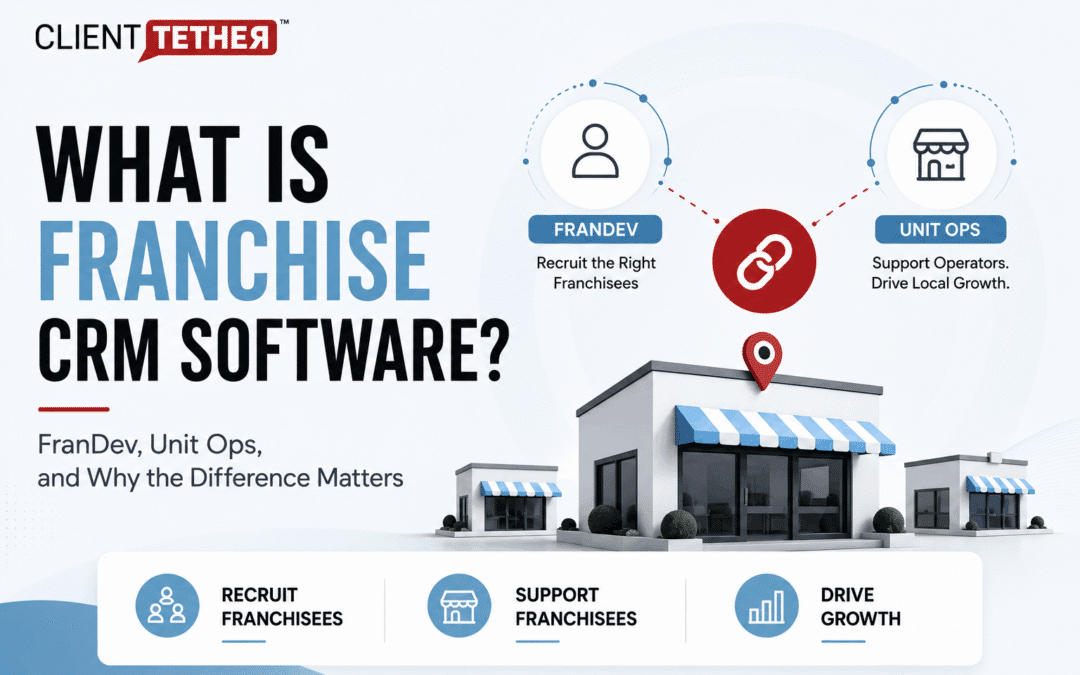
Franchise CRM software exists because franchise systems have fundamentally different requirements than single-location businesses. But here is what most evaluations miss: franchise CRM software is not one thing. What a FranDev team needs from a platform looks almost nothing like what a franchisee running Unit Ops needs. This article breaks both sides down clearly.
Franchise CRM software is purpose-built for the account structure and follow-up requirements of franchise systems. The use case splits into two distinct tracks: FranDev, which covers recruiting new franchisees, and Unit Ops, which covers supporting franchise owners in daily operations. The features that matter in each track are different. The brands that grow fastest are the ones that understand which track they are solving for and find a platform that can handle their specific needs.
Key Takeaways
- Franchise CRM software is not one product category. It splits into FranDev and Unit Ops use cases with different feature requirements for each.
- FranDev teams need speed-to-lead automation, candidate nurturing sequences, disclosure compliance workflows, pipeline visibility across the development team, and source attribution.
- Unit Ops teams need local lead response, appointment and quote follow-up, location reporting, and systems franchise owners will actually adopt.
- Generic CRMs fail franchise systems structurally — not because of missing features, but because they cannot model the franchisor and franchise owner account hierarchy natively.
Who This Is For
Best for: Franchise development directors, VPs of operations, and franchisors evaluating their first franchise CRM software or considering a switch from a generic tool.
Not ideal for: Single-unit business owners not running a franchise system. A general CRM is the right tool for that context.
What Franchise CRM Software Actually Is
Franchise CRM software is a customer relationship platform built for the structural reality of franchise systems, not adapted from a tool designed for a flat sales team.
The core difference is account hierarchy. A standard CRM treats every contact and company as a peer. Franchise systems are not flat. There is a franchisor at the top, franchise owners below, and candidate or customer records inside each unit. A CRM that cannot model that hierarchy will misroute leads, fragment reporting, and create visibility gaps that grow worse with every new location.
Franchise CRM software handles the hierarchy natively. That includes territory-based lead routing, a parent-child account structure across the franchisor and franchise owner layer, pipeline visibility across all locations, and automated sequences that run without requiring a rep to trigger each step manually.
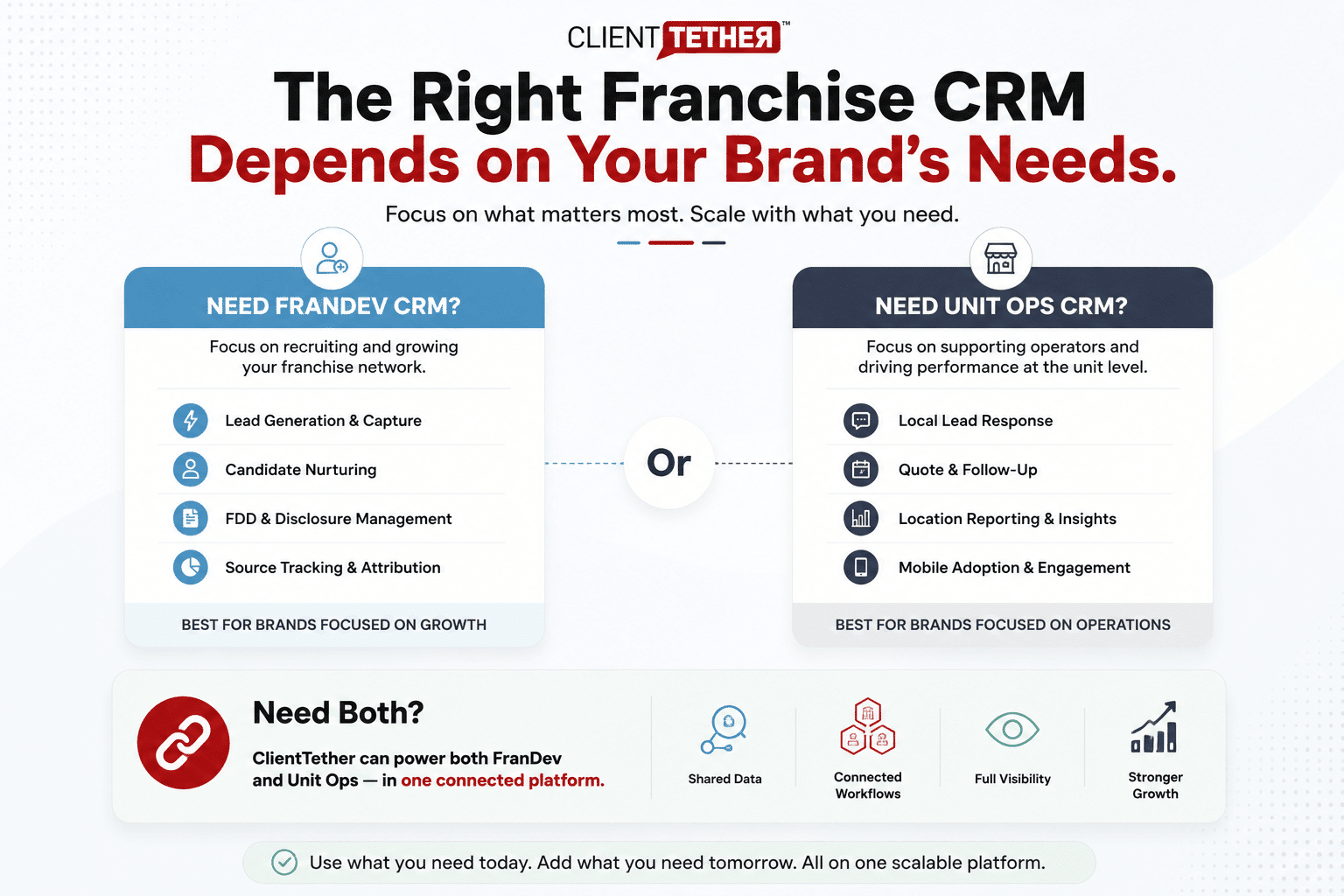
What it does not mean is one universal feature set. The buyers inside a franchise system have two different problems.
Franchise CRM Software for FranDev Teams
Franchise development is the pipeline that recruits new franchisees. Candidates come from portals, brokers, paid campaigns, trade shows, referrals, and organic web traffic. The sales cycle is long. The average prospect is evaluating three to five franchise concepts at the same time.
Every delayed response is an opening for a competitor.
What FranDev Teams Actually Need
Speed-to-lead automation.
Contacting a franchise candidate within the first 15 minutes of lead entry gives roughly a 60% chance of converting that prospect into a meaningful conversation. Most FranDev teams are not hitting that window because their CRM requires a rep to see the notification, log in, and manually start the outreach.
A franchise CRM built for FranDev triggers the first contact automatically. Text, email, or call, without waiting for a human to start it. Brands that contact a new lead within 4 minutes or less see 10X better contact rates than those that wait 10 minutes or more. That window closes fast.
Candidate nurturing across the full FranDev cycle.
A franchise candidate does not convert after one call. The FranDev pipeline is weeks long. It includes discovery calls, FDD delivery, Item 23 confirmation, the 14-day waiting period, and the franchise agreement signing. A franchise CRM needs to run outreach across every stage without a rep manually scheduling each touchpoint. Text, email, and call tasks, all running on their own. ClientTether calls these Action Plans. Not drip campaigns. Action Plans.
Disclosure and compliance tracking.
FranDev is a regulated process. Franchisors must document FDD delivery, track Item 23 receipt, and manage disclosure timing before any agreement is signed. A generic CRM can store a note that says “FDD sent.” It cannot build that step into a workflow that requires confirmation before the pipeline advances. That gap creates audit exposure. A FranDev-built franchise CRM software platform enforces it.
Source attribution and pipeline reporting.
Broker networks, including IFPG, Franserve, FBA, FCC, TES, and BAI, account for approximately 13% of all franchise deals closed. That is the single largest deal source for franchise systems over the past seven-plus years. A FranDev team needs to know which sources produce candidates that actually sign agreements, not just which sources generate the most leads. That requires reporting that connects source attribution to close outcomes, not just intake volume.
Territory routing for candidates.
A candidate who submits a form in Cleveland needs to route to the FranDev rep covering that territory. When done manually, it means a coordinator step, a potential delay, and occasional disputes about assignment. A franchise CRM maps territory lines and applies them on intake. The assignment is automatic. The coordinator handles exceptions, not every new lead.
What Breaks When FranDev Runs on a Generic CRM
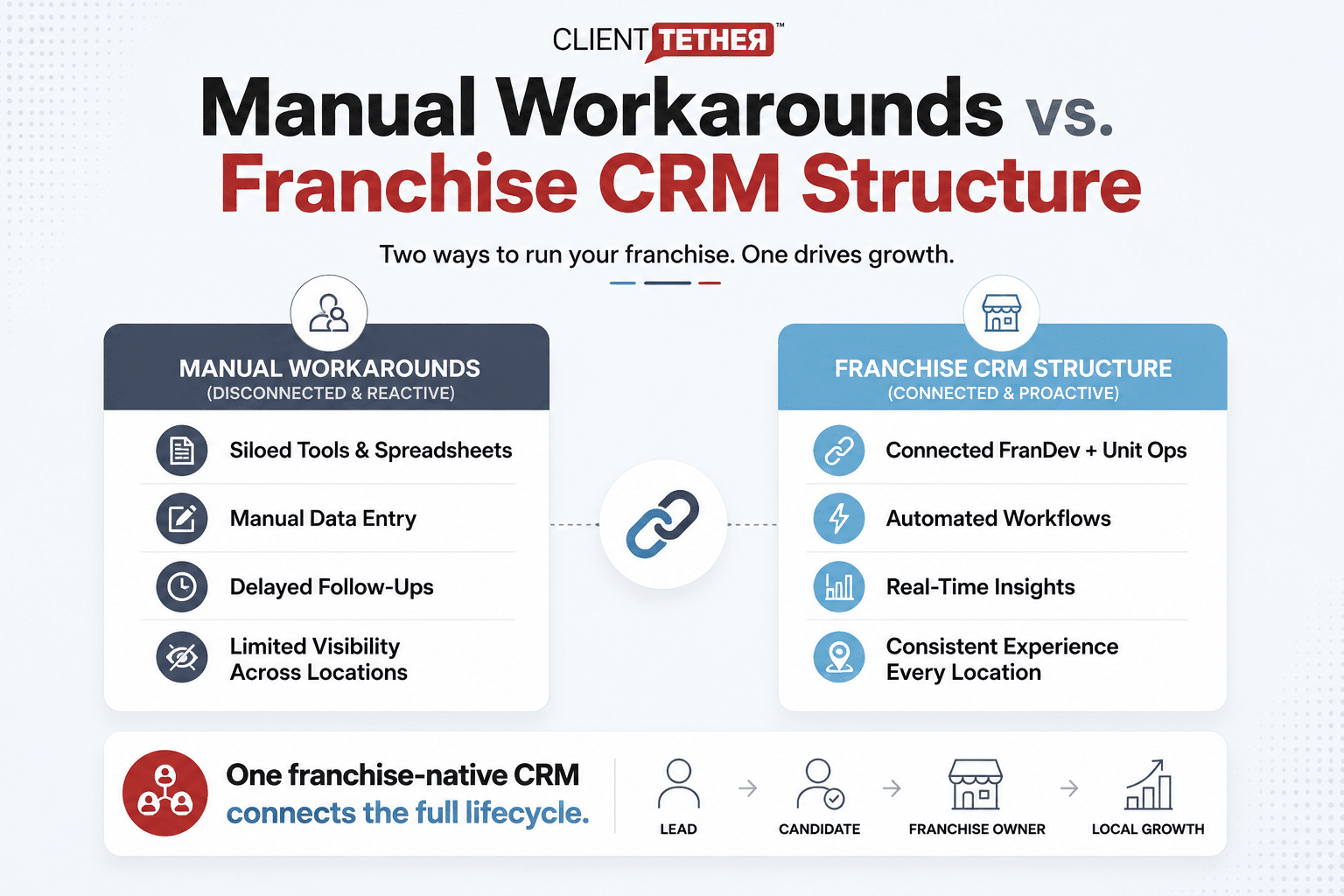
Generic CRMs can work for early FranDev teams when the pipeline is small, the team is close to the details, and someone is manually watching every next step. The problem is that the system often depends on that manual oversight more than anyone realizes.
As lead volume grows, the gaps become harder to hide. A candidate waits too long for a response. A follow-up task gets missed. A rep forgets to move someone to the next stage. Pipeline notes are inconsistent. Source attribution gets messy. Reporting starts requiring exports, cleanup, and side conversations just to understand what is actually happening.
That is usually the real warning sign: but that the team has to work around it constantly. The more the process depends on rep memory, manual updates, and spreadsheet reporting, the harder it becomes for FranDev leaders to see where candidates are stalling and what needs attention.
A franchise CRM should reduce that manual drag. It should help route leads, trigger follow-up, track stage progression, surface stalled candidates, and give leadership visibility into pipeline activity without asking the team to rebuild the process outside the platform.
For a closer look at where generic systems fail in FranDev pipelines, the franchise CRM vs. regular CRM comparison covers the structural gaps in detail.
Franchise CRM Software for Unit Ops Teams
Unit Ops is the franchisee’s world. Local leads. Service customers. Appointment conversion. Quote follow-up. Payment collection. Reviews. Repeat business.
The speed requirement here is even more demanding than FranDev. A consumer who submits a service inquiry is typically contacting two or three providers at the same time. First responder wins. The franchise owner who calls back 20 minutes later is usually calling someone who has already booked with a competitor.
What Unit Ops Teams Actually Need
Local lead response without a manual trigger.
A franchise owner running a service business from a mobile phone cannot afford to monitor a CRM dashboard waiting for new leads. The system needs to fire the first outreach automatically. Text or call within seconds of the lead entering. ClientTether’s automation responds in under 60 seconds. That is not a marketing claim. That is a structural requirement for service-oriented franchise systems.
Quote and appointment follow-up that runs on its own.
A franchisee sends a proposal. The prospect goes quiet. A generic CRM does not automatically follow up in two days, then four days, then seven. That job falls to the franchise owner, who has four other jobs. Franchise CRM software runs that follow-up automatically through an Action Plan that does not require the franchise owner to remember to do it.
Location reporting that headquarters can actually see.
A franchisor cannot coach a franchise owner they cannot see. Franchise CRM software gives the home office visibility into every location’s lead response time, pipeline activity, and conversion rates, without requiring each franchisee to export a report. That visibility is what makes data-backed coaching possible. The alternative is coaching based on assumptions. Close rates improve by 20 to 50% for franchise owners who adopt consistent CRM automation.
A system franchise owners will use.
Adoption is where most implementations fail. A platform that franchise owners find difficult to use on a mobile phone will be routed around. They will start texting leads from their personal phones. They will stop logging activity. The pipeline data becomes meaningless. The usability test is not whether the corporate team can navigate the franchise CRM software. It is whether a franchise owner running a field service business can use it from a truck.
Integration with operations tools.
Unit Ops teams need the CRM to connect with scheduling tools, quoting tools, payment processors, and review platforms without custom builds. A generic CRM requires an integration layer on top of another integration layer. A franchise CRM built for Unit Ops connects to the tools already in the workflow.
What Breaks When Unit Ops Runs on a Generic CRM
Generic CRM customization costs 10 to 20 times the onboarding cost of a franchise-native CRM. That number compounds. Each location needs training. Each new tool added to compensate for CRM gaps requires another layer of support. The franchise owners who struggle with tool complexity produce inconsistent data, which makes coaching impossible, which makes the performance gap between top and lower performers grow instead of shrink.
That is not a technology problem. It is a structure problem that technology is making worse.
When Your Brand Needs Both FranDev and Unit Ops Support
Not every franchise brand needs the same CRM setup. Some teams are focused almost entirely on franchise development. Others are trying to improve unit-level lead response, franchisee follow-up, scheduling, proposals, and local customer conversion. But when your brand needs to support both FranDev and Unit Ops, the evaluation question changes.
At that point, the question is not just, “Can this platform manage our candidate pipeline?” It is also, “Can it support what happens after a candidate becomes a franchise owner?”
Running FranDev and Unit Ops in separate systems often creates unnecessary complexity and gaps, even when integrations are in place. But it also creates a handoff that needs attention. A candidate who signs an agreement may become a franchise owner, and important context should not disappear in that transition. Candidate history, territory assignment, source attribution, communication records, and follow-up activity all help corporate understand the full relationship.
The visibility gap matters too. A franchisor with FranDev running in one system and Unit Ops in another cannot compare development pipeline performance to unit performance in one dashboard. They cannot see whether their fastest-growing territories are also their highest-performing units. They cannot identify whether a FranDev source that generates strong candidate volume also produces franchisees who perform well in operations.
ClientTether is built to work across both sides of the franchise lifecycle, FranDev and Unit Ops, without requiring a second tool. The candidate pipeline lives in the same platform as the franchisee’s daily lead management. Action Plans, territory routing, disclosure workflows, location reporting, and speed-to-lead automation all run in one environment. That is not a feature list. That is a structural decision about how franchise growth data should connect.
For a breakdown of how the candidate pipeline fits into the full system, the franchise CRM candidate pipeline guide walks through how both sides work together.
What to Look for When Evaluating Franchise CRM Software
The evaluation question that matters is not “does this platform have CRM features?” Every platform does. The question is whether it handles the structure of franchise systems natively, or whether it requires custom builds to get there.
For FranDev: Confirm the platform has territory-based lead routing, automated sequences that fire without a rep trigger, FDD delivery and Item 23 tracking built into the workflow, and source attribution that connects to close outcomes.
For Unit Ops: Confirm the platform fires outbound contact in under 60 seconds for consumer leads, runs sequences automatically without requiring franchise owner input at each step, gives the home office location-level visibility without requiring individual account logins, and is simple enough for a franchise owner to use from a mobile device.
For both: Confirm that FranDev and Unit Ops data live in the same environment. A candidate who converts to a franchise owner should not require manual data migration. Leadership should be able to view performance across both sides without switching platforms.
On implementation: A franchise CRM should come with a clear onboarding path, not an open-ended custom build. Territory mapping, Action Plan configuration, team training, lead source connections, and reporting setup should be scoped up front. A platform that needs months of heavy customization before it can support franchise routing, follow-up, pipeline visibility, and franchisee adoption may not be built for franchising from the start.
For more on what a complete feature set should include, the franchise CRM features checklist breaks down the requirements across FranDev and Unit Ops.
Frequently Asked Questions
What is franchise CRM software?
Franchise CRM software is a customer relationship platform built for the structural requirements of franchise systems, including parent-child account hierarchy, territory-based lead routing, reporting across locations, and automated follow-up workflows. It differs from standard CRM software because it models the franchisor and franchise owner relationship natively rather than requiring custom configuration to approximate it.
What is the difference between franchise CRM software and regular CRM?
A regular CRM manages flat account relationships. Franchise systems are not flat. They have a franchisor at the top, franchise owners below, and candidate or customer records inside each unit. Regular CRMs cannot model that structure without significant custom work, which creates lead routing failures, reporting gaps, and compliance risks as the system grows. Franchise CRM software handles that hierarchy natively from day one.
What does a FranDev team need from franchise CRM software?
FranDev teams need speed-to-lead automation that fires without a rep trigger, candidate nurturing across text, email, and call tasks, disclosure and FDD compliance workflows built into the pipeline, source attribution connected to close outcomes, and territory routing that assigns candidates automatically.
What does a Unit Ops team need from franchise CRM software?
Unit Ops teams need automated lead response in under 60 seconds, quote and appointment follow-up that runs without franchise owner input at each step, home office visibility into location-level performance without logging into each account separately, and a daily experience simple enough for a franchise owner running a service business from a mobile phone.
Does franchise CRM software need to cover both FranDev and Unit Ops?
Not every platform does, but the brands that run both on one system have a significant advantage. A candidate who becomes a franchise owner should move through the platform without manual data migration. Leadership should be able to compare development pipeline performance to unit operations performance in one view. Two separate systems create a data gap at that handoff that compounds as the system scales.
When does a franchise system actually need franchise CRM software?
Earlier than most brands expect. The signals show up before the tool fully breaks: leads going cold because follow-up depends on a rep starting it manually, territory disputes because the system cannot route by geography, no visibility across locations without pulling reports from each account separately, or three or more tools stitched together to cover what a franchise-built CRM handles natively. Most systems hit that threshold between five and ten locations.
How long does it take to implement franchise CRM software?
Under 30 days with proper onboarding is the standard. That covers territory mapping, Action Plan configuration, team training, and lead source connection. Longer timelines usually mean a platform that needs heavy custom work to function for franchising, which is a signal worth noting during evaluation. That custom work is where implementation cost and technical debt accumulate fastest.
What is the cost of staying on a generic CRM in a franchise system?
The cost shows up in three places. First, leads go cold because follow-up requires a rep to start each step manually. Second, territory routing fails and franchise owners call the home office about misrouted leads. Third, you pay for add-on tools and integration layers to recreate what franchise CRM software includes natively. Generic CRM customization costs 10 to 20 times the onboarding cost of a franchise-native platform, and that gap widens with every new location.