Some conversations are helpful, and then there are conversations that feel important to have right now.
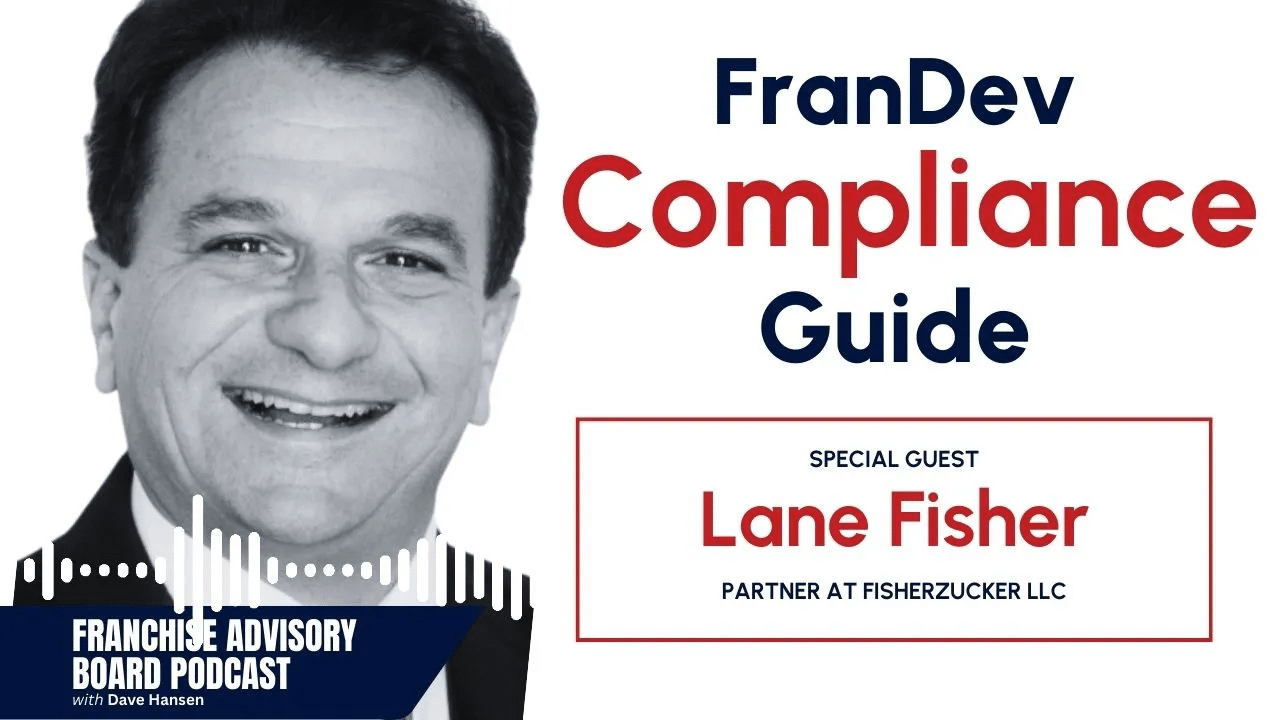
This one with Lane Fisher was the second kind.
On The Franchise Advisory Board Podcast, I wanted to dig into something that is getting harder to ignore in franchising: what is changing around franchise development regulation, broker accountability, and compliance, and what that means for franchisors, brokers, and the broader franchise community.
Lane has been around this industry long enough to see patterns before most people do. He knows where the pressure points are. He knows how regulators think. And he also knows the difference between a passing industry scare and something that is actually worth paying attention to.
This conversation mattered because the rules are changing, the scrutiny is increasing, and the people who pay attention early are going to be in a much better position than the people who assume someone else will handle it.
Meet Lane Fisher
Lane Fisher is the co-founder and senior partner at Fisher Zucker Law Firm, and he is one of those people in franchising who has both the experience and the perspective to talk about legal shifts in a way that is actually useful.
As I said in the episode, “I’ve got with me a friend of mine and also just a brilliant guy.” That is exactly why I wanted him on. Lane has represented more than 150 brands, has been in private practice since 1989, and has spent years helping franchisors navigate both growth and complexity. He is also one of the minds behind events like the Unconference, Young Conference, and Springboard, all of which are built around helping brands learn faster and avoid mistakes they do not need to make.
Training is no longer optional if you want to lead responsibly
One of the clearest takeaways from this conversation is that education is becoming part of the risk conversation.
Lane talked about why his team started building franchise sales compliance training into their programming, and the reasoning was simple: when regulators start describing brokers as “untrained” or “unscrupulous,” the industry needs a better answer than good intentions.
The line that stuck with me most was this: “You’re never going to be faulted for having too much training in responsible franchising or regulatory compliance.”
That is the real issue here. Training is not just a nice internal best practice anymore. It is quickly becoming part of how people will prove they are operating responsibly. If you are a broker, a franchise sales organization, or a franchisor with people involved in development, documented education matters.
California and NASA are creating pressure from two directions
A big reason this topic matters right now is that this is not a one-off issue.
Lane explained that two separate tracks are moving at the same time: California’s new broker law and the model rule being pushed by NASA, the North American Securities Administrators Association. They are not identical, but they are both aimed at the same general concern.
As Lane put it, “There are two things moving in parallel attempting to regulate the same thing.”
That is the kind of sentence franchisors need to pay attention to. This is not just about one state doing one unusual thing. It is a sign that franchise development activity, especially where brokers are involved, is getting more scrutiny. And once that starts happening, it tends to spread.
Liability and disclosure are becoming much more serious issues
Another important part of the conversation was the difference between what California is doing and what NASA has proposed, especially around liability.
Lane pointed out that California’s rule, at least as discussed here, does not automatically make franchisors jointly and severally liable for broker noncompliance unless they know about it. That is a meaningful distinction.
His wording was direct: “California does not look to make franchisors jointly and severally liable for some failure to comply unless they know about it.”
That matters because one of the biggest questions in all of this is who owns the consequences when a broker fails to register, fails to disclose properly, or makes problematic statements in the sales process. Franchisors cannot afford to be careless here. Even if a rule stops short of automatic liability, this is still an area where oversight, documentation, and separation of roles matter a lot.
The era of hidden broker history is fading
This was one of the strongest moments in the episode.
Lane walked through the kinds of disclosures regulators are pushing for, including items related to professional history, litigation, bankruptcy, compensation, and the brands a broker has sold. Whether every detail stays exactly the same as proposals evolve remains to be seen, but the larger trend is clear: transparency is increasing.
Lane said it plainly: “If you’re a broker with a lot of litigation and bankruptcy history, I think the days of you being incognito are done.”
That is a sharp line, and honestly, it is one franchisors should hear. Most people in this space are trying to do the right thing. But whenever an industry has inconsistent standards, the weakest actors tend to create the biggest regulatory response. More disclosure is one way regulators try to deal with that.
Ignoring California may feel practical, but it does not solve the bigger issue
One thing that came up toward the end of the discussion is that many people’s first reaction is to simply avoid California altogether.
I understand that instinct. California already has a reputation for being a more difficult environment for operators, and this adds another layer. But the bigger issue is not just California. It is what California often signals.
Lane said, “This is another reason in the long list of reasons that California is more problematic.”
That may be true, but I do not think the right lesson is to shrug this off as a California-only problem. The better lesson is to get more disciplined now. If other states adopt similar approaches, or if the broader standards around broker conduct keep tightening, the brands that take this seriously early will have a much easier time adapting.
Wrap Up Thoughts
What I took away from this conversation is that franchising is at one of those moments where the people who think ahead are going to have an advantage.
I said during the episode that “we’re playing chess here, not checkers,” and that still feels like the right way to frame it.
If people in positions of influence are starting to say brokers are undertrained or inconsistent, then the answer cannot just be frustration. It has to be standards. It has to be education. It has to be a better process, better oversight, and better proof that the people doing this work are doing it responsibly.
That is why I appreciate Lane’s approach. He is not just reacting to the changes. He is helping people prepare for them. And that is what good leadership looks like in a shifting market.
Listen & Watch the Full Conversation
Watch the full episode on YouTube
Check out the Podcast hub Channel
Connect with Lane Fisher and Fisher Zucker Law Firm