If it feels like franchise development is changing faster than ever, you are not wrong.
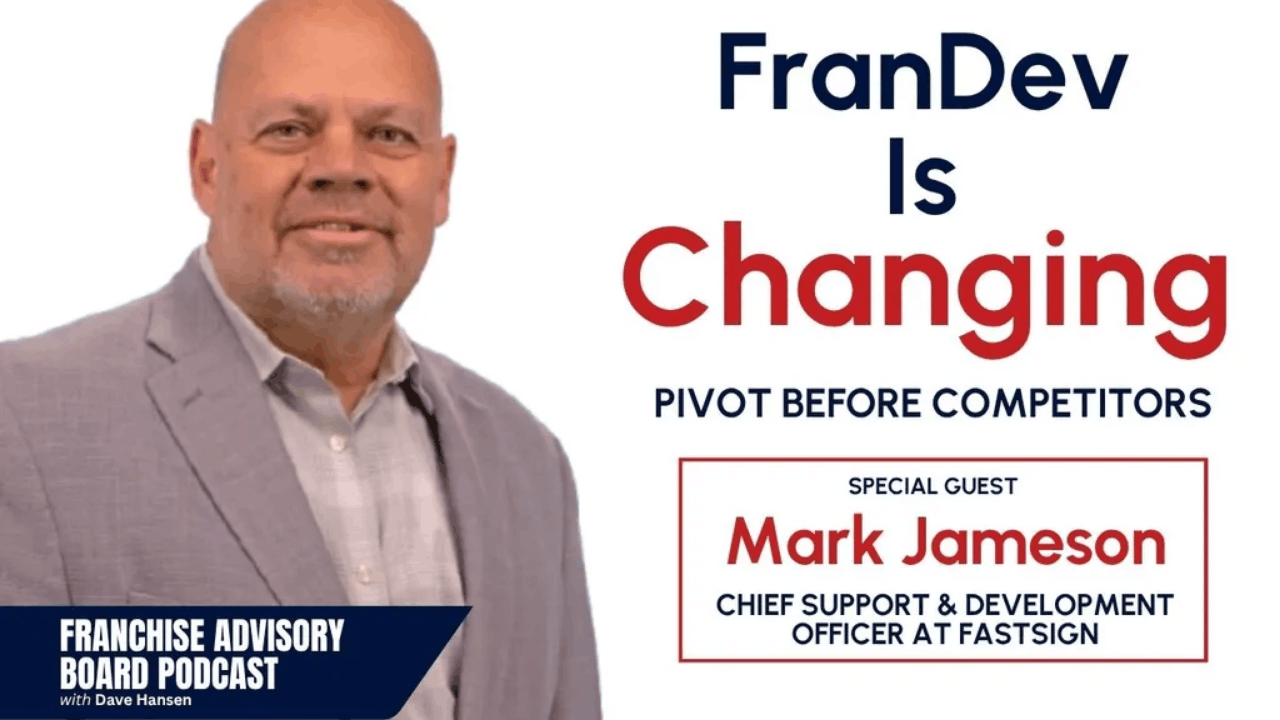
In this episode of The Franchise Advisory Board Podcast, I sat down with Mark Jameson to talk about what is actually shifting in FranDev right now, what smart brands are doing to adapt, and what still matters no matter how much the tools evolve. It was one of those conversations that felt especially timely because the market is moving, candidate behavior is changing, and the pressure to generate better leads and better conversions is very real.
What I appreciated about this conversation is that it did not stay at the surface. We talked about AI, search behavior, lead quality, data, broker channels, candidate psychology, and process discipline. But underneath all of that, we kept coming back to the same truth: the best franchise development teams are still the ones that know their candidate, build trust well, and stay disciplined in how they operate.
Meet Mark Jameson
Mark joined me on the show as the Chief Development Officer for Propel Brands, the platform company behind FASTSIGNS, MY SALON Suite, and Camp Bow Wow. He has spent decades in franchising, and that depth came through clearly in this conversation. What makes his perspective especially valuable is that his background is not limited to franchise development alone. He came up through operations first, and that still shapes how he looks at growth today.
That matters, because Mark does not talk about franchise development as if it exists in isolation. He keeps bringing it back to the operator, the economics, and the long-term success of the franchisee. That lens gives his advice weight.
As Mark said, “It all stems around driving economics for franchisees and franchise satisfaction.”
That line captures the heart of his approach. This is not just about selling more units. It is about building a system that attracts the right people, supports them well, and helps them succeed where it matters most: at the unit level.
Today’s franchise candidate is more informed before the first conversation
One of the biggest shifts Mark pointed out is how much more informed franchise candidates are before they ever speak with a brand. They are doing research earlier, comparing options more carefully, and often ruling brands out before they ever fill out a form or take a call.
Mark said, “What we are seeing is a more sophisticated franchise candidate that has done their research and done their work.”
That changes the game. It means your website, your brand presence, your proof points, and your overall visibility are all doing part of the qualifying work before your sales team ever enters the picture. If a candidate cannot quickly understand who you are, why you matter, and what makes your opportunity credible, you may never get the chance to have the real conversation.
If you do not shape the narrative online, AI and search will shape it for you
This was one of the sharpest parts of the episode.
Mark talked about how important it is for brands to make sure their information is available online in ways that search engines and AI tools can find, understand, and trust. Candidates are not just browsing casually anymore. They are actively researching, asking questions, and looking for proof.
Mark said, “If AI doesn’t say anything good about you, you may never get that lead.”
That is a simple statement, but it carries a lot of weight. If your best information is hidden, missing, or unsupported, the market will fill in the gaps for you. And that usually means candidates are going to find whatever happens to be easiest to crawl, whether that is accurate or not. The brands that are winning right now are the ones putting strong information out there, backing up their claims, and making it easier for candidates and AI tools alike to understand the story.
A diverse lead strategy only works when the data drives the decisions
Mark was clear that there is no single perfect lead source. Different channels can bring different kinds of candidates, and that is exactly why a diversified strategy matters. Portals, brokers, PR, direct mail, digital channels, and other sources can all play a role, but only if you are measuring them honestly and adjusting as the market changes.
He said, “I’m a believer in having a diverse lead generation strategy, but then measuring it and using data against it.”
That is the discipline piece. A channel may work well for a season and then cool off. Another may suddenly outperform. If your strategy is rigid, you miss that. If your team is watching the numbers and staying flexible, you can reallocate faster and make better decisions. That kind of responsiveness is becoming more important, not less.
Relationships still matter more than the tools
For all the discussion around AI, automation, candidate data, and process optimization, Mark kept bringing the conversation back to what has not changed: listening well and building real trust. Technology can help you move faster, stay organized, and create a better process. But it cannot replace human judgment or the quality of the relationship.
Mark said, “It still comes down to listening.”
That stood out to me because it is easy right now to over-focus on the toolset and under-focus on the conversation. Better conversions do not come from automating everything. They come from understanding what the candidate actually wants, what they are worried about, and whether the opportunity really fits their goals, finances, and life. That part still takes trust, honesty, and real engagement.
The right candidates do more than qualify financially. They follow the system
One of my favorite parts of the conversation was Mark’s perspective on evaluating franchisees. Rather than leaning heavily on profiling tools, his team pays close attention to how candidates behave during the process itself. Are they cooperative? Are they engaged? Do they complete what is asked? Do they take the process seriously?
As Mark put it, “Follow the system. It works.”
That quote lands because it applies on both sides of the table. It applies to franchisees, and it applies to franchise development teams too. Strong systems create consistency. They improve decision-making. They help you bring in better people. And they reduce the risk of letting emotion or short-term pressure take over. There is room for creativity later, but first there has to be discipline.
Wrap Up Thoughts
What I kept coming back to after this conversation is that the fundamentals still win.
Yes, franchise development is evolving. Yes, AI is reshaping search. Yes, candidates are entering the process more educated and more selective. But underneath all of that, the strongest brands are still doing the same core things well: they understand their candidate, communicate clearly, measure honestly, stay flexible, and build trust throughout the process.
That is what I appreciated most about Mark’s perspective. It is current without being reactionary. It is strategic without becoming abstract. And it keeps the focus where it belongs: on bringing in the right people and helping them succeed for the long haul.
Listen & Watch the Full Conversation
Watch the full episode on YouTube
Check out the Podcast hub Channel
Connect with Mark Jameson and connect with FASTSIGNS