Some conversations are useful because they give you tactics. Others are useful because they sharpen how you think.
This conversation with Dan Claps did both.
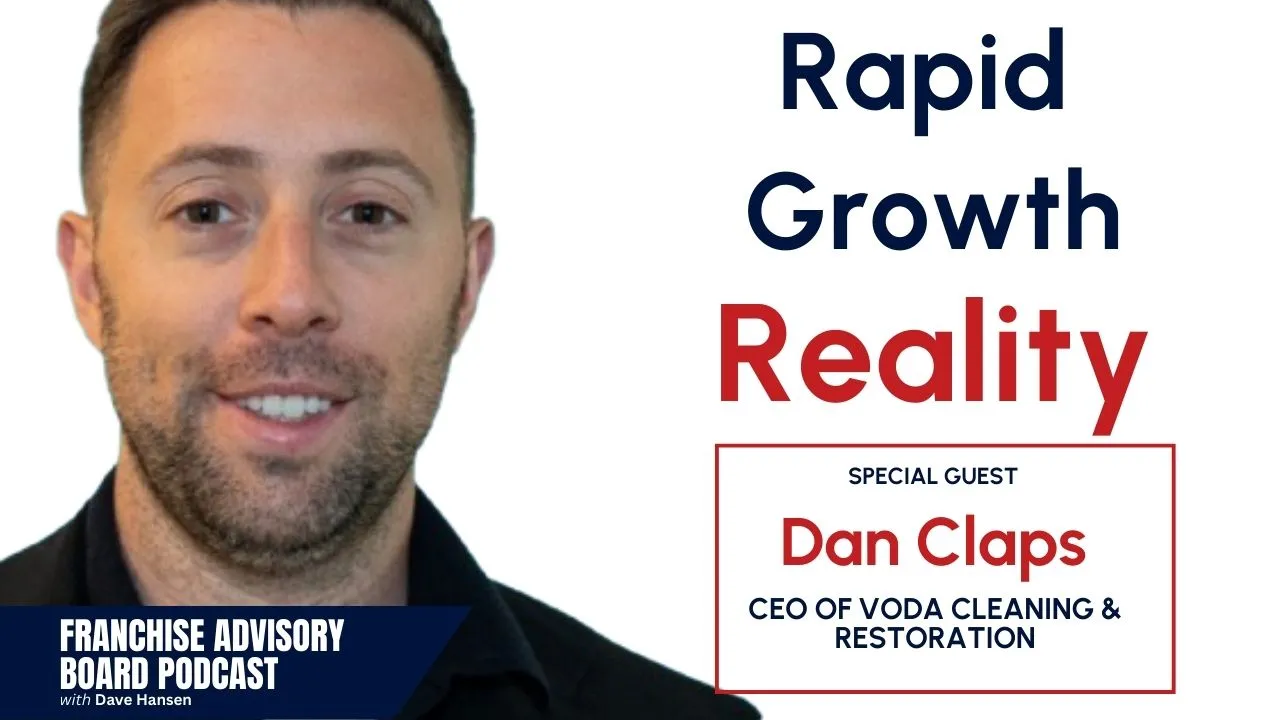
Dan is the CEO and co-founder of Voda Cleaning & Restoration, and in this episode of The Franchise Advisory Board Podcast, we got into a topic that matters to every growing franchise brand: how to balance franchise development with franchisee success as you scale.
That sounds simple on paper. It is not simple in practice.
What I appreciated about this conversation is that Dan did not talk in abstractions. He talked like someone who has been in the trenches, built with intention, learned in real time, and stayed honest about what growth demands from a franchisor.
Meet Dan Claps
I’ve known Dan for years, and one of the things I respect about him is that he understands franchising from multiple angles.
Before launching Voda, he had already spent years in the franchise world as a business broker and as a co-founder of a franchise lead generation company. That background matters because Voda was not built by accident. It was built by people who came into the brand with real franchising experience and a very clear point of view.
That came through clearly in our conversation when Dan said, “I do believe Voda’s success over three years was really more like 10 years in the making.” That is a strong reminder that what looks like fast growth from the outside is often built on years of learning, relationships, and preparation behind the scenes.
Fast growth only works when the pace is intentional
One of the most useful points Dan made was that the word fast is relative. Different franchise categories operate under different realities, and people often compare brands as if they all scale under the same conditions. They do not.
Dan explained that Voda had a clear plan for development, operations, and system growth, and that they had followed that plan with surprising consistency. What stood out to me was that the pace was not random. It was deliberate. That kind of discipline matters because it gives your training, onboarding, and internal team the chance to grow in a healthy way instead of constantly playing catch-up.
A line that really captured that mindset was: “We’ve bought the same amount of franchises, give or take, as an average every month by design.”
That is not accidental growth. That is measured growth.
The right leadership team saves you years of struggle
This part of the conversation hit home for me because I believe this deeply: you are going to pay for expertise one way or another.
You can pay for it up front by bringing in the right people, or you can pay for it later through delay, mistakes, misalignment, and friction.
Dan was very candid here, and I appreciated that. He said, “One of my skills is recruiting the right people, getting them in the bus, and then creating compensation structures and plans where they’re motivated.”
That self-awareness matters. Dan was not trying to be the person who could do everything. He knew the kind of team he needed, and he built around complementary strengths. That included leadership across operations, marketing, sales, and strategy, with trust and clear ownership inside each lane.
When a brand is growing quickly, a strong leadership team does more than keep things moving. It helps you anticipate what is coming and handle the unexpected without losing your footing.
Onboarding starts the moment the agreement is signed
Dan made a point here that every franchisor should take seriously: the clock starts when the franchise agreement is signed.
That is where momentum begins. It is where expectations form. It is where a new owner either starts moving with clarity or starts drifting into confusion and delay.
Dan put it this way: “The clock starts from the day they sign a franchise agreement.”
What I liked about Voda’s approach is that they do not treat onboarding like a rushed checklist. They start immediately, but they also resist the temptation to compress everything too quickly. Dan talked about how they have learned that a longer, more intentional onboarding process often works better than trying to speed through it while the owner is excited.
He also shared how they built group onboarding to create camaraderie, accountability, and momentum between franchisees moving through the process at the same time. That is smart. It helps people feel like they are building something together, not just checking boxes alone.
Small operational gaps can become big system problems
One of the most helpful parts of the conversation was Dan’s transparency around operational friction.
He shared an example around bookkeeping, and even though it may sound like a back-office detail, it actually touches a much bigger issue: if your numbers are not current and clean, your coaching gets weaker, your visibility gets worse, and your ability to help owners improve performance starts to break down.
What stood out was not just the issue itself. It was the way Dan thought about it. He was not simply saying owners needed to do better. He was asking how the onboarding and support system could remove unnecessary friction so owners had less to manage on their own.
The quote that best captured that mindset was: “We just keep learning and improving just to try to take one less thing off their plate.”
That is a franchisor mindset worth paying attention to. Good systems are not built by assuming people will always do everything perfectly. They are built by reducing the opportunities for breakdown.
Franchisee support has to evolve as the owner evolves
This may have been the most thoughtful part of the whole conversation.
Dan talked about how what a franchisee needs in year one is different from what they need in year two or three. Early on, the franchisor may be central to everything. Later, a strong operator may feel more independent. Then, as the business matures, the needs shift again into coaching, visibility, system growth, lead flow, and long-term support.
Dan framed it with a simple question: “What do they need now?”
That is the right question.
It is easy for a franchisor to point to what was built in the beginning and assume that should carry the relationship forever. But if owners are paying royalties today, they want value today. That does not mean the early support was unimportant. It means support has to keep evolving as the owner and the business mature.
I appreciated Dan’s honesty here too. He was clear that they know how to ramp owners well, they have a strong handle on years one and two, and they are still learning alongside franchisees as the system matures. That kind of humility builds trust.
Wrap Up Thought
What stayed with me after this conversation is that sustainable franchise growth does not happen by accident.
It takes the right people. It takes clear systems. It takes discipline to stay focused on what matters most. And maybe more than anything, it takes a willingness to keep listening as the brand grows and the needs of franchisees change.
That is what I appreciated most about Dan’s perspective. He was not talking about growth as a vanity metric. He was talking about growth as a responsibility. A responsibility to onboard well, to coach well, to build the right team, to solve the real problems, and to keep improving the system so franchisees have a better chance to succeed.
For any franchisor trying to scale without losing operational excellence, there is a lot to learn from that mindset.
Listen & Watch the Full Conversation
Watch the full episode on YouTube
Check out the Podcast hub Channel
Connect with Dan Claps
Connect with Voda Cleaning & Restoration