Here’s where most franchise brands go wrong when they start evaluating CRM for franchises: they treat it like a single buying decision with one feature list.
It isn’t. A franchise system has two distinct buyer needs operating at the same time, and they are not interchangeable.
Franchise development needs a CRM that protects the candidate pipeline, enforces compliance, and holds development reps accountable for speed and follow-up. Unit operations needs a CRM that puts the right tools in franchise owners’ hands, so they actually respond to local leads, book appointments, and follow up after quotes, without corporate having to chase them.
Blending those needs into one universal must-have list produces an evaluation that looks thorough but misses the actual decision. You end up picking a tool that’s fine at everything and built for neither.
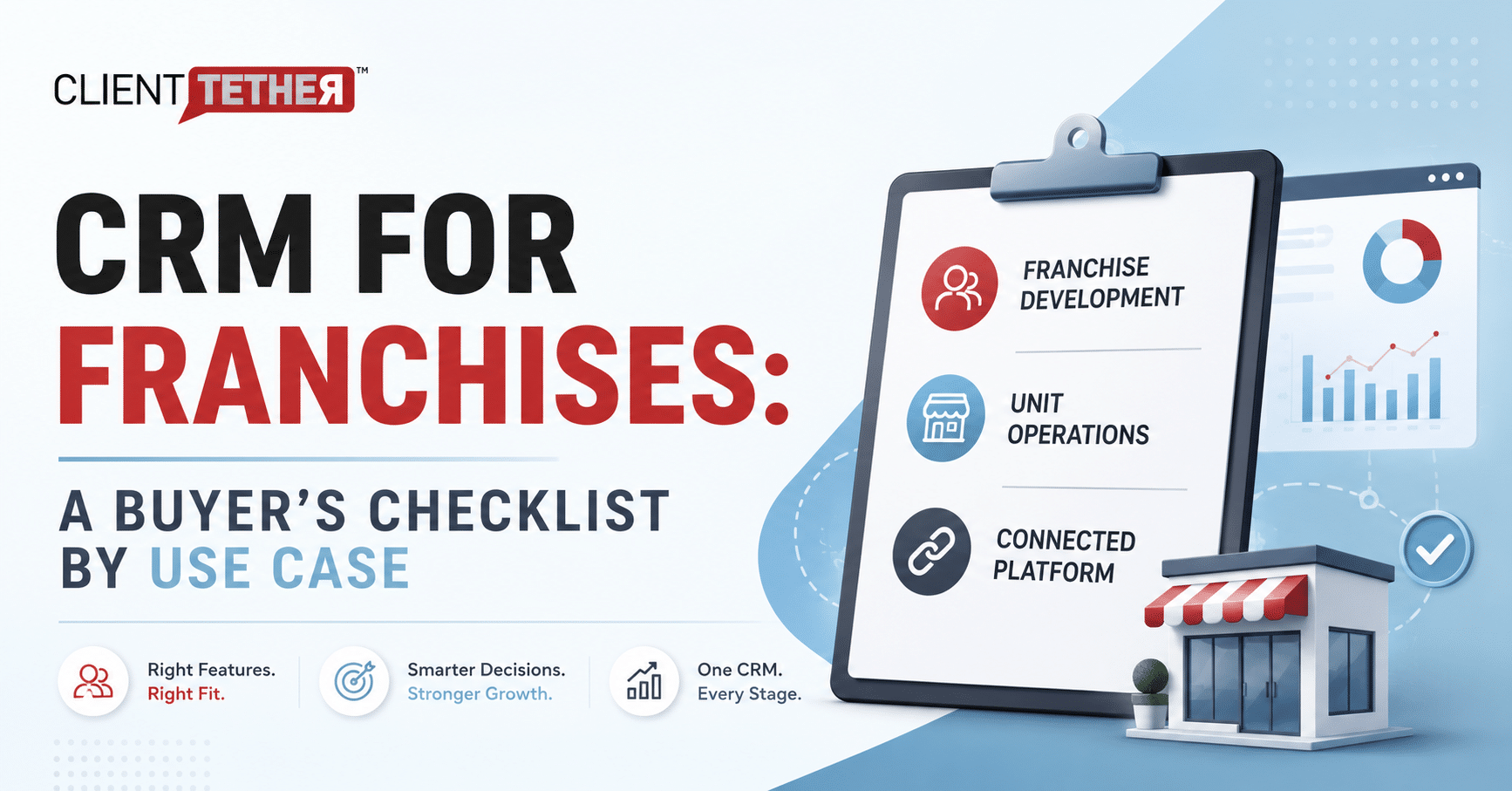
This checklist breaks it down the right way: what to evaluate if your priority is FranDev, what to evaluate if your priority is Unit Ops, and what to look for if you want one connected system that handles both sides of the franchise lifecycle.
The wrong CRM decision isn’t always obvious until eighteen months in, when your franchise owners have stopped logging in, and your candidates are signing with someone else. Here’s what to know before you evaluate.
-
- FranDev and Unit Ops are different buying problems. Evaluate them separately before deciding whether to solve them with one platform or two.
- FDD compliance is non-negotiable for FranDev. If a platform can’t demonstrate it live, it fails the checklist.
- For Unit Ops, franchise owner adoption is the only metric that matters. A tool corporate builds that franchise owners don’t use has zero ROI.
- The most overlooked capability in both motions: multi-channel follow-up that adapts to lead behavior, not just a day-of-week schedule.
- Brands that want one connected system should confirm the platform was built for franchising, not adapted from a generic CRM with workarounds bolted on.
Part 1: CRM for Franchises in FranDev
Franchise development is a long-cycle, high-stakes sales process. The average franchise candidate is evaluating three to five concepts simultaneously. Research consistently shows that engaging a franchise candidate within the first five minutes improves conversion likelihood by 10X. Every hour a candidate goes without contact is an hour your competitor has the floor.
This checklist covers the capabilities that determine whether a franchise CRM can actually run a professional FranDev operation, not just store contacts.
Not all franchise sales software is built for that standard.
Capability 1: Automated First Response (Under 60 Seconds)
[Non-negotiable] This capability must pass. A live demo failure here ends the evaluation.
Demo this: Submit a test lead while the vendor is on the call. Time the first automated response. If a sales rep has to click anything to start the sequence, fail this capability.
Why it matters: Engaging leads first is the largest predictor of who wins the candidate. The brands that respond first set the standard every other brand gets measured against. The average franchise candidate isn’t waiting. They submitted to three other brands the same afternoon.
Capability 2: Multi-Channel Action Plans
[Non-negotiable] This capability must pass. A live demo failure here ends the evaluation.
Demo this: Ask the vendor what happens when a candidate opens an email but doesn’t reply. Does the Action Plan adapt? Does it shift the next step? Or does the sequence continue unchanged regardless of candidate behavior?
Why it matters: An Action Plan that responds to lead behavior is the difference between a CRM that closes deals and a CRM that schedules emails. A platform that can’t adapt on engagement signals is a scheduling tool, not a sales system. These are Action Plans, not drip campaigns. The distinction matters. Drip sends. Action Plans guide.
Capability 3: FDD Item 23 Compliance Workflow
[Non-negotiable] This capability must pass. A live demo failure here ends the evaluation.
Demo this: Ask the vendor to walk through a full FDD disclosure workflow, from document delivery to Item 23 receipt confirmation to e-signature. Ask specifically: does the system track when the FDD was delivered, when the candidate acknowledged receipt, and when the agreement was signed — and does it surface that history in the contact record?
Why it matters: This is a federal compliance requirement under the FTC Franchise Rule. Missing or out-of-sync Item 23 tracking exposes your brand to rescission liability on every deal, meaning a franchisee who discovers the error could be entitled to get their full investment back from day one. A CRM that can’t demonstrate this live should not be in your final evaluation.
Capability 4: Broker Channel Attribution
[Recommended] Strongly recommended — prioritize if your system has multi-unit or multi-source complexity.
Demo this: Ask the vendor to show how the CRM tracks source attribution through the full FranDev funnel. FranDev teams need to know which portals, brokers, campaigns, and referral sources are producing qualified candidates, Discovery Day attendees, and signed agreements — not just inquiry volume. Ask to see that data tied to individual candidate records, not just aggregate totals.
Why it matters: FranDev teams spend across portals, brokers, paid campaigns, and referral programs. Without source-to-close attribution tied to individual candidate records, budget allocation is guesswork. A platform that can only tell you where leads came from — not which sources produced qualified candidates, scheduled Discovery Days, or closed agreements — is not giving you the data you need to make decisions.
Capability 5: Development Team Accountability Reporting
[Recommended] Strongly recommended — prioritize if your system has multi-unit or multi-source complexity.
Demo this: Ask the vendor to show a side-by-side comparison of two development reps’ candidate pipeline activity. What is the average time-to-first-contact per rep? Which rep has the highest stall rate at Discovery Day?
Why it matters: FranDev is a high-stakes, long-cycle process. Without rep-level visibility into response times, follow-up activity, and pipeline stage movement, leadership is managing on assumption rather than data. A franchise sales CRM that surfaces this accountability data in real time is the difference between a development team you can coach and one you can only hope performs. If you can’t see it, you can’t correct it.
Part 2: CRM for Franchises in Unit Ops
Unit operations is a completely different problem. Franchise owners run local businesses. Their leads are consumers, including homeowners, business owners, and service customers, who contact two or three providers at once and hire whoever responds first. According to ClientTether’s Service Franchise Lead Response Report (2026), service-based business leads average three competitive quotes. They move quickly. They do not wait.
The Unit Ops checklist is not about compliance workflows or pipeline attribution. It’s about whether the system is actually built for franchise owners to use daily, not just for corporate to monitor from above.
Capability 1: Speed-to-Lead Automation for Local Leads
[Non-negotiable] This capability must pass. A live demo failure here ends the evaluation.
Demo this: Have the vendor submit a test lead into a franchise owner’s pipeline. Time the first automated text response. If the franchise owner has to trigger anything, this capability fails.
Why it matters: According to ClientTether’s Service Franchise Lead Response Report (2026), the average text response time across 250 franchise locations studied was 21 hours. The average call response was 22 hours. Service franchise brands invest an average of $91 per lead. A lead that doesn’t get a response in the first few minutes is largely wasted spend.
Capability 2: Franchise Owner-Facing Tools
[Non-negotiable] This capability must pass. A live demo failure here ends the evaluation.
Demo this: Log in as a franchise owner, not a corporate admin. What’s on their home screen? What can they do in the first two minutes without any guidance from corporate? If the answer is “not much,” this is a corporate tool extended downward, not a tool built for franchise owners.
Why it matters: Franchise owner adoption determines ROI. Full stop. A CRM built exclusively for the corporate layer generates exactly the adoption pattern that kills franchise technology investments. Franchise owners route around it, corporate loses behavioral visibility, and the ROI evaporates. Two Maids saw franchisee lead conversion rates increase by 278% within the first 90 days of ClientTether deployment, according to Director of Marketing and Branding Katie Belling.
Capability 3: Multi-Channel Action Plans for Local Lead Conversion
[Non-negotiable] This capability must pass. A live demo failure here ends the evaluation.
Demo this: Ask what happens when a consumer submits a quote request and does not respond to the first text. Can the platform continue follow-up across multiple channels, such as email, SMS, call tasks, and reminders? Can follow-up steps be tied to timing, lead status, Sales Cycle stage, or other triggers? The goal is to confirm that the system supports structured, multi-channel follow-up rather than relying on a franchise owner to manually remember the next step.
Why it matters: According to ClientTether’s Speed2Lead Playbook (2025), converting leads requires eight to ten touches. Most franchise owners make one or two before moving on. An Action Plan running in the background, without the franchise owner having to remember to follow up, is what closes the gap between what should happen and what actually does.
Capability 4: Location-Level Performance Dashboard
[Recommended] Strongly recommended — prioritize if your system has multi-unit or multi-source complexity.
Demo this: Ask the vendor to show a side-by-side performance comparison of two franchise locations. If the answer involves exporting a CSV, the dashboard layer isn’t built for multi-location behavioral visibility. It’s built for accounting.
Why it matters: Performance variation between locations is the primary operational challenge for growing franchise systems. When leadership can see where response behavior breaks down, not just who has the lowest revenue, coaching stops being opinion-based and becomes data-backed. That is a different kind of leadership conversation.
Capability 5: Parent-Child Account Structure
[Recommended] Strongly recommended — prioritize if your system has multi-unit or multi-source complexity.
Demo this: Ask the vendor to show a franchisee who owns multiple units. Is it one contact record with linked locations, or multiple unrelated contact records?
Why it matters: Multi-unit operators are a growing share of every franchise system. A CRM that treats each location as a separate contact record creates duplicated follow-up, fragmented history, and unreliable performance reporting for the franchisees who matter most to the system’s growth.
Part 3: Brands That Want Both Sides Connected
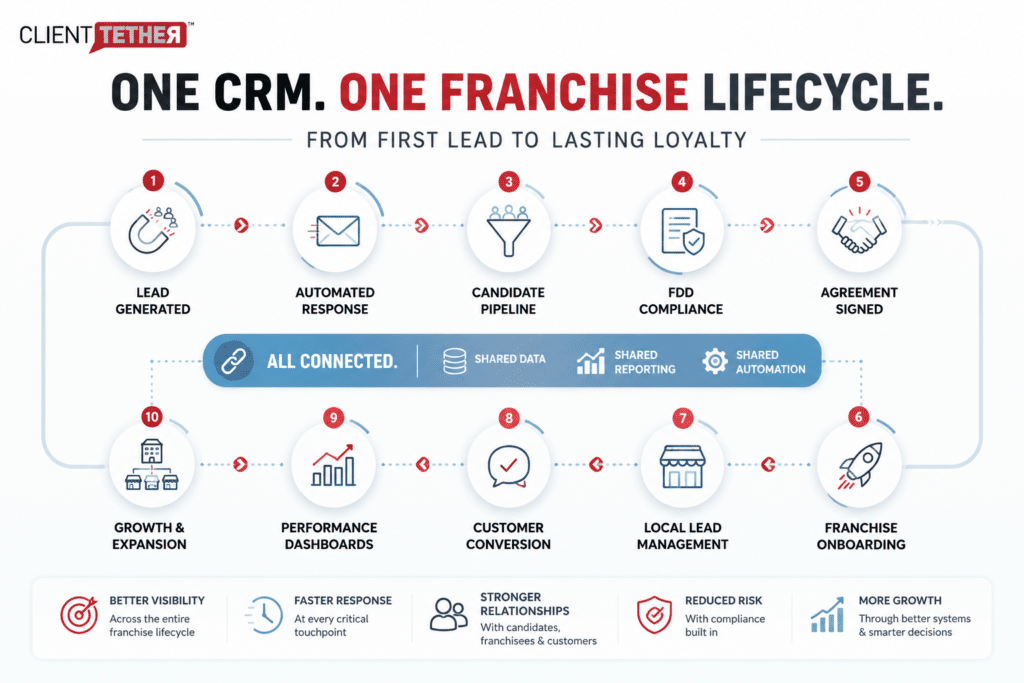
Some franchise brands need a platform that covers the full franchise lifecycle: recruiting candidates on the front end and converting local customers on the back end, with shared visibility across both.
Most franchise software handles one side of that lifecycle well. Few handle both without workarounds.
That’s a legitimate buying position. But it requires a different evaluation question.
The question is not whether a CRM can be used for both FranDev and Unit Ops. Most franchise software can technically be configured to touch both. The question is whether the platform was built for franchising on both sides, or built for something else and adapted. When a generic CRM gets adapted to franchising, you get workarounds. FDD compliance gets bolted on through a third-party integration that doesn’t track FDD delivery and Item 23 acknowledgment in the contact record. Multi-location dashboards require manual exports. Franchise owner tools are absent or require custom configuration that costs 10 to 20 times the onboarding cost of a franchise-native platform. If you’re evaluating franchise management software that claims to cover both motions, this is the demo that reveals whether the claim holds.
Demo this: Ask the vendor to run through a full lifecycle scenario. Start with franchise candidate first contact through FDD disclosure, Item 23 receipt confirmation, and agreement signing. Then switch to the franchisee account and show how the same platform manages local lead response, follow-up automation, and performance reporting. If the vendor has to switch systems, log into a different tool, or describe a workaround at any point, that is not a connected system. That is two tools with a shared login.
Evaluate depth, not just breadth. A platform that claims to cover both motions should demonstrate FDD Item 23 compliance enforcement, multi-channel Action Plans for both candidate and consumer pipelines, franchise owner tools built for daily use, and location-level dashboards that give corporate behavioral visibility, not just activity counts.
Most franchise sales software on the market will check individual boxes on this list. The question is whether it can demonstrate all of them, live, in a single connected platform built specifically for franchising.
What the connected system delivers. When both motions run through the same platform, the franchise lifecycle closes. Development teams see the full candidate history through to signing. Franchisees get onboarded into the same system they’ll use to run their local business. Corporate sees performance data across both motions without stitching together reports from two different tools.
ClientTether is a franchise CRM built for this. It covers both FranDev and Unit Ops because the franchise growth lifecycle requires both, and the brands that grow fastest are the ones that treat them as connected, not parallel.
How to Use This Checklist
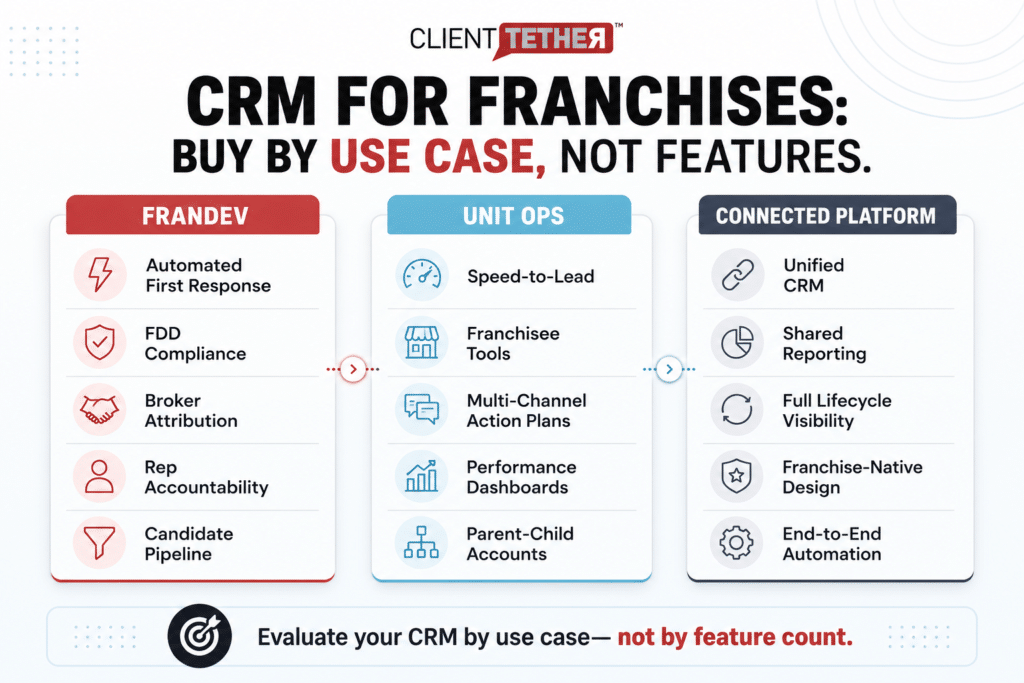
Run each capability as a live demo scenario, not a feature slide and not a self-reported capabilities document.
Vendors will claim every item on a written checklist. The test is whether they can demonstrate each capability on their live platform with your specific franchise use case in real time.
Start with the non-negotiables in your primary motion. A platform that fails a non-negotiable for your motion doesn’t belong in the final evaluation regardless of what it does well in the other.
For a deeper look at how these capabilities map across platforms, see the franchise CRM software comparison framework and the franchise CRM features checklist.
According to the IFA 2026 Franchising Economic Outlook, the US franchise sector is projected to reach 845,000 establishments. The FTC Franchise Rule governs the compliance requirements that any FranDev platform must support. The CRM decision is the highest-leverage technology investment most franchise brands will make. Evaluate it like one.
Frequently Asked Questions
What is CRM for franchises?
CRM for franchises is customer relationship management software built around the structural requirements of franchising, not adapted from a single-brand sales tool. It serves two distinct use cases: franchise development, which covers recruiting and converting franchise candidates, and unit operations, which covers local lead response and conversion for franchise owners. The architecture differs from generic CRM because franchising is a fundamentally different operating model.
Do FranDev and Unit Ops need different CRM features?
Yes. FranDev needs compliance workflows (FDD disclosure tracking, Item 23 receipt confirmation, e-signature), candidate pipeline management, broker attribution, and development team accountability reporting. Unit Ops needs speed-to-lead automation for consumer leads, franchise owner tools, multi-channel follow-up sequences, and location-level performance dashboards. Some platforms cover both, but evaluate each motion on its own checklist before deciding whether one platform can handle both.
When should a franchise brand move off spreadsheets to a CRM?
The practical trigger for FranDev is roughly 10 leads per week. At that volume, manual coordination creates consistent gaps in follow-up and FDD compliance tracking. For Unit Ops, the trigger is 15 or more franchise locations, where performance variation between franchise owners becomes difficult to identify without behavioral data. Dropped leads, compliance errors, and inconsistent follow-up all cost more than the platform.
What is the most important capability to evaluate in a FranDev CRM?
FDD Item 23 compliance enforcement combined with automated first response. The compliance workflow is non-negotiable under the FTC Franchise Rule. A platform that cannot demonstrate live Item 23 tracking, timestamped FDD delivery, and e-signature tied to the candidate record fails the checklist regardless of its other features.
What is the most important capability to evaluate in a Unit Ops CRM?
Franchise owner adoption design. The platform must give franchise owners tools they will actually use daily, not just a filtered view of corporate data. Evaluate this by logging in as a franchise owner during the demo and asking what they can do in the first two minutes without guidance from corporate.
Does a franchise CRM replace development reps?
No. A CRM handles the automation layer: first contact, follow-up sequences, FDD staging, and candidate tracking. Development reps handle the relationship layer, including conversations, Discovery Days, candidate questions, and territory discussions. The CRM makes each rep significantly more effective by ensuring no lead falls through between conversations.
That is what separates a franchise sales CRM from a generic contact database.
What is the difference between a franchise CRM and franchise management software?
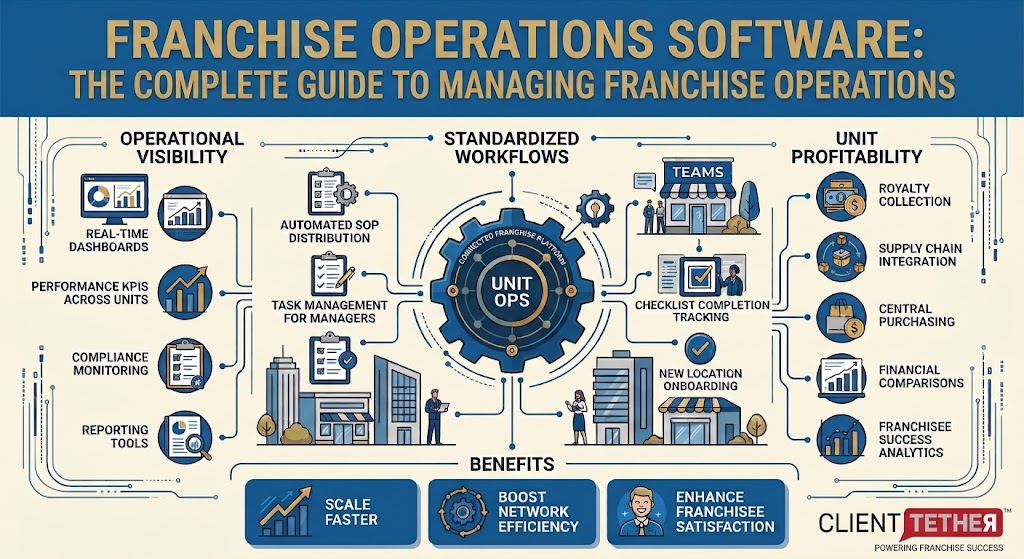
A franchise CRM manages the growth and conversion layer: candidate pipeline management, Unit Ops lead response, FDD compliance workflows, and performance visibility across locations. Franchise management software typically handles the operational layer after franchisees are onboarded: royalty collection, compliance auditing, training delivery, and ongoing franchisee support.