

CEO of ClientTether. Franchise CRM operator, multi-unit franchise owner, and franchise sales leader with 7+ years growing franchise systems.
Most franchisors think about marketing software one tool at a time. Something for brand assets. A platform for local ads. An email tool. A CRM that handles inbound leads.
Each one solves a specific problem. None of them talks to each other.
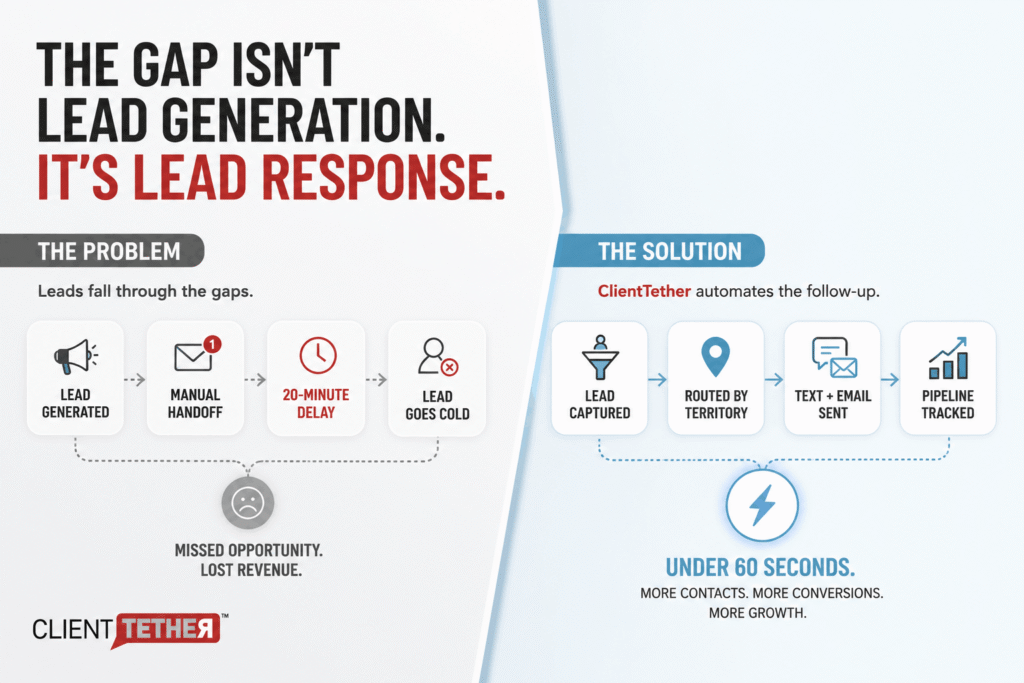
The result: corporate spends money generating leads, the leads hit the system, and nothing happens for 20 minutes because nobody knows who should call. The franchise owner assumes the headquarters followed up. Headquarters assumes the franchise owner did. The lead goes cold.
Franchise marketing software is the category that addresses this. Not one tool. A set of tools. And the way they connect is what determines whether your marketing budget actually converts.
Most franchisors think about marketing software one tool at a time. Something for brand assets. A platform for local ads. An email tool. A CRM that handles inbound leads.
Each one solves a specific problem. None of them talks to each other.
The result: corporate spends money generating leads, the leads hit the system, and nothing happens for 20 minutes because nobody knows who should call. The franchise owner assumes the headquarters followed up. Headquarters assumes the franchise owner did. The lead goes cold.
Franchise marketing software is the category that addresses this. Not one tool. A set of tools. And the way they connect is what determines whether your marketing budget actually converts.
Key Takeaways
- Franchise marketing software is not one product. It is a stack of five tool categories that must work together
- The most common breakdown point is the gap between lead generation and lead contact. Marketing tools generate leads, but nothing picks them up automatically.
- Corporate and franchise owner level visibility is required: one shows brand performance, the other shows conversion by location
- ClientTether handles the automation and CRM layer: lead response, follow-up sequences, and pipeline tracking, working alongside tools like aiADZ to strengthen the connection between campaign performance and lead conversion.
- The right evaluation question is not “which tool is best” but “which gap in my current stack is costing the most revenue.”
Who This Is For
Best for: VPs of marketing at franchise brands, franchise development directors, and franchisors building or restructuring their marketing technology stack.
Not ideal for: Single-unit business owners not running a franchise system. Standard marketing platforms cover most of their needs without franchise-built architecture.
What Is Franchise Marketing Software?
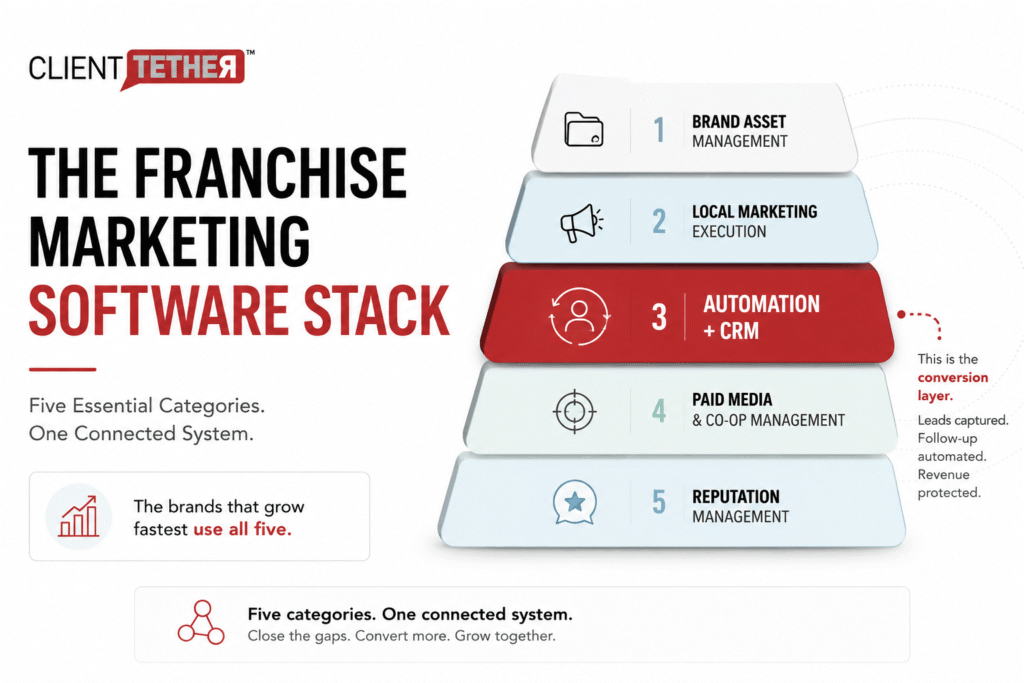
Franchise marketing software is the set of platforms that franchise systems use to generate leads, manage brand consistency across locations, convert candidates and customers, and track performance at both the corporate and franchise owner level.
It spans five tool categories: brand asset management, local marketing execution, marketing automation and CRM, paid media and co op ad management, and reputation tools. Most growing franchise brands run two to four tools in this stack.
The Five Types of Franchise Marketing Software
Understanding what each category does, and what it does not do, is the starting point for building a stack that works.
1. Brand Asset Management
Brand asset management tools give corporate a single place to store, update, and distribute approved marketing materials. Logos, templates, ad creative, campaign kits. Franchise owners pull approved materials from one source rather than creating their own versions.
The problem these tools solve is brand consistency. Without a central asset library, franchise owners improvise. Some do it well. Many do not. The result is a brand that looks different across 30 or 40 locations.
These tools do not generate leads. They do not follow up with candidates. They hold and distribute the materials that other tools use.
2. Local Marketing Execution Platforms
Local marketing execution platforms help franchise owners deploy campaigns approved by corporate in their territories. They handle locally targeted ads, localized versions of corporate campaigns, and social media scheduling at the unit level.
Platforms like SOCi and similar tools exist specifically for this use case: national brand, local execution. Corporate sets the guardrails. Franchise owners customize within those bounds.
These tools drive lead volume at the local level. They do not manage what happens to those leads after they come in.
3. Franchise Marketing Automation and CRM
This is the layer most franchise brands underinvest in. Marketing automation and CRM software manage what happens after a lead enters the system: automated contact within seconds, follow-up sequences across text, email, and calls, pipeline tracking, and conversion reporting at both the corporate and franchise owner level.
This is the category where lead generation and lead conversion connect. Without it, local marketing execution tools generate leads that nobody contacts fast enough. Research on lead response timing shows that brands that respond within 4 minutes see 10x better contact rates than those who wait 10 minutes or more.
Most franchise brands run a generic CRM that was not designed for parent-child account structure, territory routing, or FranDev compliance. Those gaps are the reason leads go cold. The franchise CRM software overview covers what this layer needs to do in more detail.
4. Paid Media and Co Op Ad Management
Co op ad management tools handle the financial and operational complexity of franchise advertising funds. Brands collect ad contributions from franchise owners and deploy them through coordinated paid campaigns. These tools track contributions, allocate spend by territory, and report results back to contributors.
This category is distinct from local marketing execution. It handles the fund management side, not just ad deployment.
5. Reputation and Review Management
Franchise systems live and die by reviews. One location with a 3.2 rating drags the brand even if 40 others are at 4.8. Reputation tools monitor reviews across all locations, route response assignments to the right franchise owner or corporate team, and track rating trends over time.
These tools also feed lead generation. Higher ratings produce better local search rankings. Better rankings produce more organic leads.
What Franchise Marketing Software Must Be Able to Do
The category has one functional requirement that nothing else replaces: it must operate at two levels at once.
The corporation needs to see brand performance, lead volume by territory, and conversion rates across the full system. Franchise owners need to see their own pipeline, their own lead response times, and their own customers. Both views have to exist in the same data layer, not in separate exports.
Here is where most stacks break down.
Operate at Two Levels Without Manual Exports
The tools corporate uses to run campaigns need to share data with the tools franchise owners use to follow up. When those systems do not connect, the handoff between lead generation and lead contact requires a human step. That step is where the delay of 20 minutes happens.
Route Leads to the Right Franchise Owner Automatically
Every lead that enters the system needs to be routed to the correct franchise owner based on territory. Not based on who checks email first. Not based on a coordinator making a call. Based on geography, applied automatically on intake.
Generic marketing platforms do not have territory logic. Franchise marketing automation platforms do.
Trigger Follow-Up Without a Rep Starting It
Automated follow-up sequences must start the moment a lead enters the system. The first text or email should go out in under 60 seconds. The sequence should continue across multiple touches without a rep manually advancing each step.
This is the difference between a marketing stack that generates leads and one that converts them.
Give Corporate Visibility Into Local Performance
A franchisor running 30 locations needs to see which territories are converting leads, which are letting them go cold, and which are booking at rates below average. That visibility has to come from the system, not from a weekly report that each franchise owner submits.
Maintain Brand Consistency Across Locations
Every customer-facing message, every automated follow-up, every review response needs to reflect the same brand voice. That requires both asset control at the brand asset management layer and message control at the automation layer.
Where Most Franchise Marketing Stacks Break Down
I have seen franchise systems spend heavily on local ad deployment and almost nothing on the automation layer that picks up the leads those ads generate. Here is what that looks like in practice.
The Handoff Gap
A franchise owner runs a localized campaign through their marketing platform. Leads come in. The leads go to an inbox that nobody checks until the next morning. By then, the contact rate drops significantly. The campaign looks like it failed. The problem was not the campaign.
The fix is not a better marketing tool. It is a marketing automation platform that contacts the lead automatically, the moment it enters the system.
The Visibility Gap
Corporate sees total lead volume from campaign reporting. They do not see what happened to each lead at the franchise owner level. Two territories run the same campaign. One converts at 40 percent. One converts at 8 percent. Without visibility across the system, corporate does not know there is a problem until Q4 reviews.
The Consistency Gap
Twelve franchise owners handling leads twelve different ways. Some follow up immediately. Some wait. Some send a personal email. Some do nothing and hope the lead calls back. The customer experience is inconsistent, and the brand takes the hit.
Franchise marketing automation solves this by standardizing the follow-up process. Every lead gets the same response time and the same sequence. Franchise owners still close the deal. The system handles the first five touches.
How ClientTether Fits the Franchise Marketing Stack
For franchise systems, the marketing stack does not stop once a customer books or a candidate advances. Post-service engagement, review requests, referral activity, and retention workflows all influence future demand.
ClientTether helps automate those touchpoints so franchisees can strengthen their reputation, encourage repeat business, and create a more consistent customer experience across locations.
For a broader overview of how franchise software categories work together, the franchise software guide for franchisors covers the full stack.
How to Choose Franchise Marketing Software
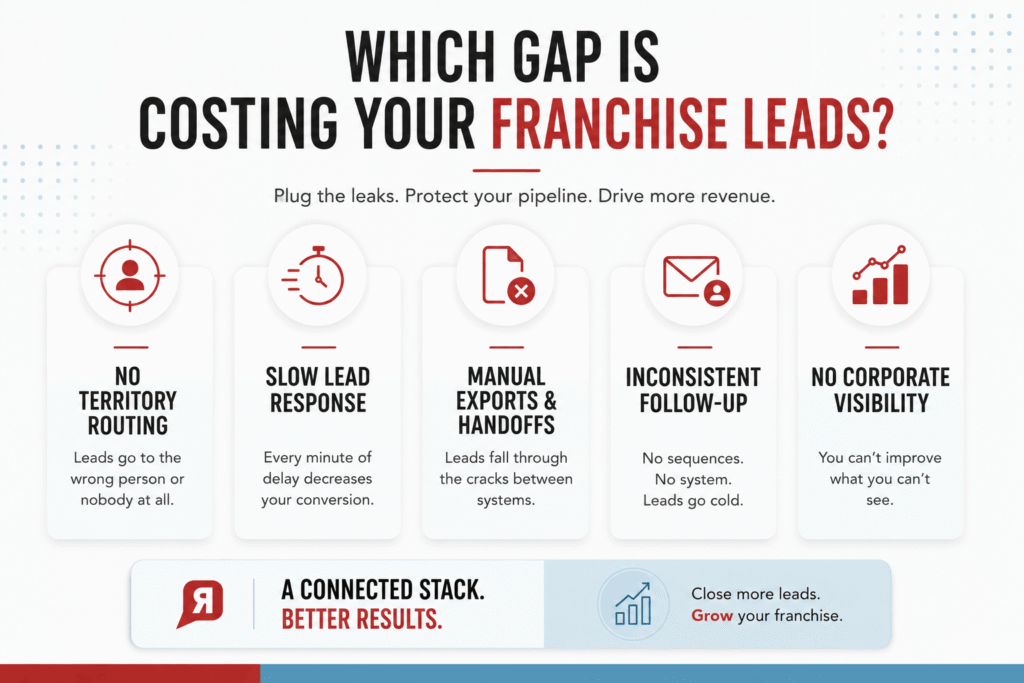
The right question is not which platform is best in its category. It is which gap in your current stack is costing the most leads?
Ask these five questions before evaluating any new tool:
- Where do leads go cold in our current process? If the answer is “right after they come in,” you need automation before anything else.
- Can corporate see performance at the franchise owner level without pulling reports manually? If the answer is no, you have a visibility gap.
- Does your current CRM support territory routing and parent-child account structure natively? If not, you are managing franchise complexity with a tool not designed for it.
- Are all 5 stack categories covered? Map your current tools against the five types above. Any gap is a revenue leak.
- What does the handoff between lead generation and lead contact look like right now? Count the steps between a lead entering the system and a person or automated sequence reaching them. Every manual step is a delay.
The franchise marketing overview on the ClientTether blog covers related context on franchise marketing strategy.
Frequently Asked Questions
What is franchise marketing software?
Franchise marketing software is the set of platforms franchise systems use to generate leads, maintain brand consistency across locations, convert candidates and customers, and track performance at both the corporate and franchise owner level. It spans five tool categories: brand asset management, local marketing execution, automation and CRM, paid media and co op management, and reputation tools.
What are the different types of franchise marketing software?
The five types are: brand asset management tools (store and distribute approved materials), local marketing execution platforms (run localized campaigns at the unit level), marketing automation and CRM (contact and follow up with leads automatically), paid media and co op ad management (handle franchise advertising fund deployment), and reputation and review management tools (monitor and respond to reviews across all locations).
Why do franchise systems need different marketing software than regular businesses?
Franchise systems operate at two levels at once: corporate brand management and local franchise owner execution. Generic marketing platforms are built for one level. Franchise marketing software handles both, with territory logic, parent-child account structure, and visibility across locations that standard tools do not support.
What is the most common gap in franchise marketing software stacks?
The most common gap is the automation and CRM layer. Most franchise brands invest in lead generation tools but underinvest in the platform that contacts and follows up with leads automatically. The result is leads going cold between when marketing generates them and when someone actually reaches out.
How does franchise marketing automation work?
Franchise marketing automation starts a contact sequence the moment a new lead enters the system. The platform sends an initial text or email within seconds, routes the lead to the correct franchise owner based on territory, and continues the follow-up sequence across multiple touches without requiring a rep to advance each step manually.
What should I look for when evaluating a franchise marketing platform?
Look for: native territory routing, parent-child account structure for across locations visibility, automated follow-up sequences that start without manual input, speed-to-lead under 60 seconds, reporting at both the corporate and franchise owner level, and proven adoption among non-technical franchise owners.
Can one platform cover the full franchise marketing stack?
Most franchise systems are better served by a connected stack than by expecting one platform to do everything equally well. Most franchise brands run two to four tools. The priority is ensuring the tools connect. Your lead generation tools need to feed directly into your automation and CRM layer without a manual handoff step.
What is the difference between a franchise marketing platform and a franchise CRM?
A franchise marketing platform focuses on generating leads and managing brand presence: local ads, brand assets, social media, and reviews. A franchise CRM focuses on what happens after a lead comes in: response, follow-up, pipeline tracking, and conversion. Both are required. They cover different parts of the same revenue cycle.