
Franchise management software (FMS) starts to look different once you run 20 or more locations. The shared inbox, the FranDev spreadsheet, the basic CRM stitched into your ops: each one starts costing you revenue. Leads go cold. Operations teams have franchise owner conversations on personal devices and aren’t sharing notes across teams. Zees build their own workarounds. The system you built becomes a system that only half of your team uses.
The problem is structural. Most franchise platforms are built around onboarding, compliance, training, and brand standards. Those things matter. But they don’t cover what actually moves growth: how fast you respond to a new franchise prospect, whether your Zees are converting the leads they get, and whether you can see all of it from one place.
Here’s what franchise management software for brands at scale actually needs to do.
work, franchise owner engagement, and ideally, unit operations. Most Franchise CRMs are built for compliance and training. The revenue side (lead response, conversion, follow-up, and pipeline views) is typically an afterthought.
Key Takeaways
- At 20+ locations, FranDev lead response speed becomes a structural problem, not a process problem
- Brandwide compliance-focused franchise management tools leave the revenue side of franchise ops exposed
- FranDev and unit ops need to live in the same system, when possible, or data breaks at handoff
- Replacing a 3–5 tool stack with one platform removes the gaps that cost revenue
- The right FMS gives the Zor a system-wide view while Zees manage their own pipeline
Who This Is For
Best for
Franchisors running 20 to 200+ locations who are outgrowing their current tools. VPs of FranDev whose prospect pipeline lives in an outmoded or generic CRM or a spreadsheet. VPs of Operations dealing with uneven Zee results and limited reporting across the system.
Not ideal for
One location operators. Teams looking for a standalone compliance or training tool.
Top use cases
Choosing franchise software before an expansion across locations. Consolidating a fragmented tech stack. Improving speed-to-lead and FranDev pipeline conversion at scale.
What Changes When You Cross 20 Locations
Why Does Lead Response Break as Your Location Count Grows?
Lead response breaks as the location count grows because volume outpaces what any manual process can handle. Most franchise CRMs manage follow-up by hand when they’re small. A few active FranDev prospects, a rep who knows each one: the process holds.
Cross 20 prospects in your pipeline or 20 operating locations, and it breaks.
Not because the team stopped caring. Because the volume of franchise inquiries, unit-level customer leads, and Zee support needs exceed what any manual process can handle. At that point, lead response speed becomes the gap between a warm prospect and a lost one.
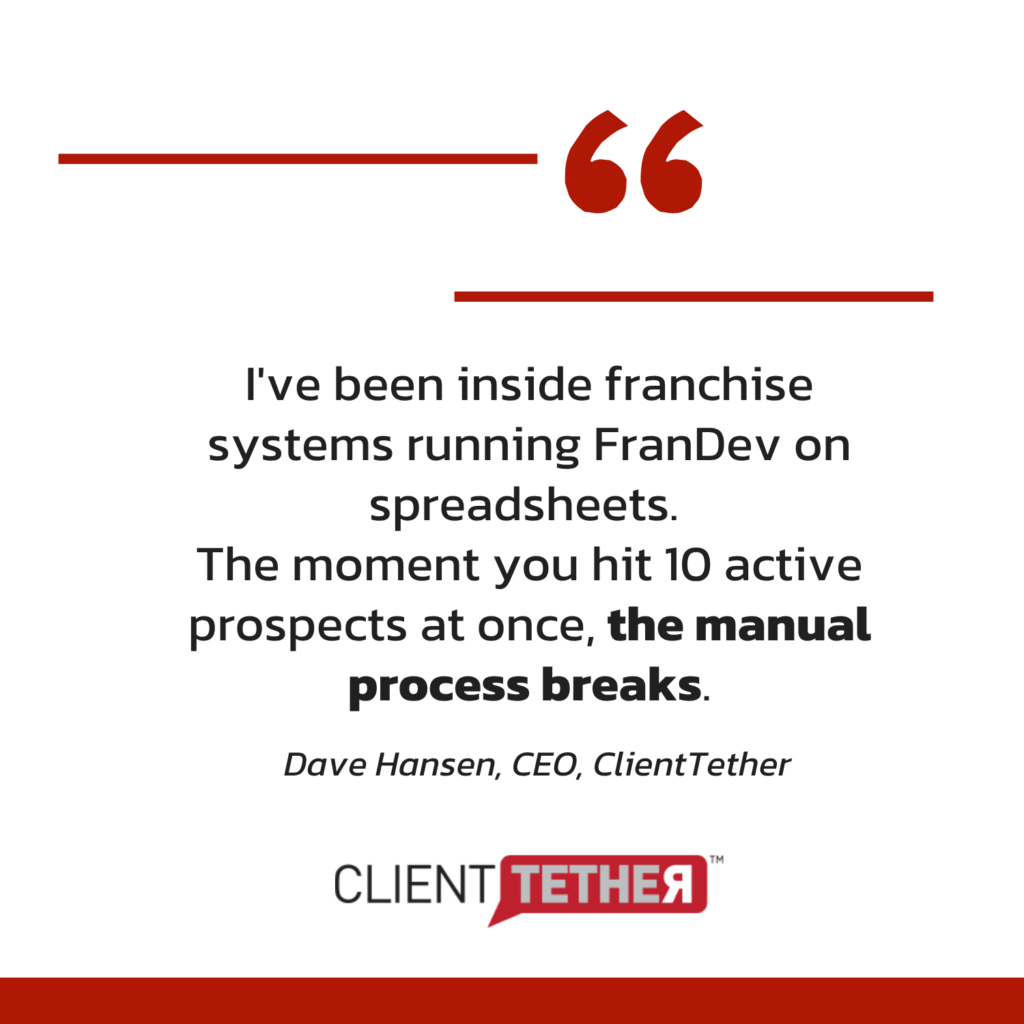
I’ve seen FranDev teams tracking 10 active prospects on a spreadsheet. The moment the 11th comes in, someone falls through. That is not a people problem. That is what happens when the process depends on memory or manually checking poorly designed CRMs rather than an automated franchise-focused system.
The fix is using franchise software that responds the moment a lead comes in. It fires across text, email, and follow-up calls without anyone manually starting it. It has the structure in place to support local owners while enforcing engagement standards brandwide.
Why Does Compliance Focused Software Leave Revenue on the Table?
Walk through the top-ranked FMS platforms, and most lead with the same set of tools: audit trails, brand standards, training tools, royalty tracking, and compliance records.
That’s the compliance layer. It matters as your network grows. But it focuses on what has happened and how to enforce brand standards for operational consistency.
Compliance tools don’t respond to a prospect who just filled out your interest form. They don’t trigger a follow-up when a Zee’s customer lead goes cold. They don’t help the FranDev team engage broker networks effectively, nurture leads, or help the franchise business coaches centralize communications.
The gap is structural. A franchise system built on compliance-focused software has solved for brand standards and tracking. It has left the revenue and even the coaching side exposed. At 20 locations, the cost is small. At 100, it compounds.
What Most Franchise Management Software Platforms Cover vs. What Multi-Location Brands Need
| Capability | Compliance-Focused FMS | Multi-Location FMS |
|---|---|---|
| Audit trails and brand standards | Yes | Yes |
| Zee training and onboarding | Yes | Yes |
| Royalty tracking and reporting | Yes | Yes |
| FranDev pipeline with compliance steps | No | Yes |
| Speed-to-lead automation | No | Yes |
| Unit-level quoting and payments | No | Yes |
| Live reporting across the system | Partial | Yes |
What Franchise Management Software Actually Needs to Cover
FranDev Pipeline: From First Inquiry to Signed Agreement
Franchise development is a long and somewhat complicated sales cycle. The right prospect takes months to move from first inquiry through discovery, FDD review, and territory award. Every stage needs consistent follow-up, clear records, and a structured pipeline.
Most generic CRMs can track contacts. What they can’t do without heavy custom setup and third-party bolt-on software is handle the compliance steps in the FranDev process: Item 23 receipt tracking, e-signature at key steps, sending out background checks, candidate profiles, and automated follow-up that keeps prospects moving forward without a rep manually triggering each touch. That’s the gap a franchise sales CRM fills that a generic contact tool never will.
Franchise development software built for multi-location brands manages the full prospect journey from first touch to signed agreement, with the compliance and contact steps built in, not bolted on. For a closer look at the pipeline stages, Franchise CRM: Pipeline Visibility for Franchise Growth covers how FranDev visibility changes conversion outcomes.
Unit Operations: Follow-Up, Quoting, and Payment in One System
The ops side of a multi-location franchise is a different workflow. A Zee in Texas running a home services brand needs to have a system in place to streamline its speed to revenue. They’re converting customer leads, sending quotes, collecting deposits, and moving to the next job.
What breaks here is handoff. When the quoting tool, the follow-up system, and the payment tool are separate platforms, the Zee works across three logins to close one job. That slows the process. It also reduces how often they use any of it. And the data is invisible to the franchise business coach, which makes it challenging for them to know how to help the franchisee succeed.
Here’s the real problem: a Zee who finds their own workaround isn’t just a headache. They’re invisible to the system. The Zor can’t see their pipeline. Results gaps go undetected until the numbers are already behind.
FMS and proper franchise CRM tools that handle unit ops keep quoting, e-signatures, follow-up sequences, and payment in one place. Franchise Management System: 6 Clear Wins for Multi-Unit Operations goes deep on what those wins look like at the location level.
Franchisor Visibility: What’s Happening Across Every Location
A Zor running 50 locations can’t visit each one. What they need is a clear view of how each location is doing: which ones are converting leads, which ones are letting inquiries sit, and where the pipeline is stalling.
Live view at the system level requires software that ties activity at each location to reporting at the Zor level. The right franchise management solution gives the Zor a direct line into each location’s activity. You’re not waiting on Zees to report their own numbers. Without it, you’re always looking at last month’s problems through the murky lens of their self-reported P&Ls.
The Architecture That Makes Multi-Location Work
Why FranDev and Unit Ops Typically Live in Separate Tools
I’ve been inside franchise systems where FranDev ran in one CRM and unit ops ran in another, with no connection between them. Any CRM for franchises faces this same tension: it gets configured for one workflow and leaves the other underserved.
The cost isn’t obvious at first. But when a prospect becomes a Zee, the data doesn’t transfer. The new franchisee starts from zero in the ops system. Nobody sees whether onboarding is going well until something breaks. The Zor has no single view of either pipeline from one place.
When FranDev and unit ops live in the same system, the handoff is automatic. The record that started as a franchise prospect becomes the franchisee’s account. No manual data entry or duplicate tracking between two tools.
That’s not a feature. That’s a design choice. Most platforms haven’t made it.
Three things a well-built franchise management system should do without manual work:
- Move a FranDev prospect record into Zee’s account at signing
- Route new leads to the right location on its own
- Give the Zor a live view of every location’s pipeline from one place
Replacing a 3–5 Tool Stack With One Operating Platform
A lot of franchise brands run something like this:
- A generic CRM for FranDev pipeline work
- A review tool for reputation
- A quoting platform for proposals
- A payment processor for invoices
- A messaging system for Zee contact
That’s five subscriptions, five logins, and five systems that don’t share data cleanly. Every time data has to move between them, something can break. A follow-up that should have gone out didn’t. A prospect handoff got dropped. A Zee payment doesn’t tie back to the results report.
FranchiseWire’s 2026 franchise technology outlook points to platform consolidation as one of the key moves franchisors are making heading into the next growth phase. The brands consolidating their tool stack aren’t just cutting costs. They’re removing the handoff failures that slow pipeline work and hide results gaps.
ClientTether is built as one platform: FranDev pipeline, unit ops, follow-up sequences, quotes, payments, reputation, and reporting across the system — in one franchise-native system. It was built to replace the stack, not add to it. If you want to see how that works in practice, our team can walk you through the design.
Signs You’ve Outgrown Your Current Tools
Here’s a simple test. If more than two of these are true, your current tools are likely holding you back:
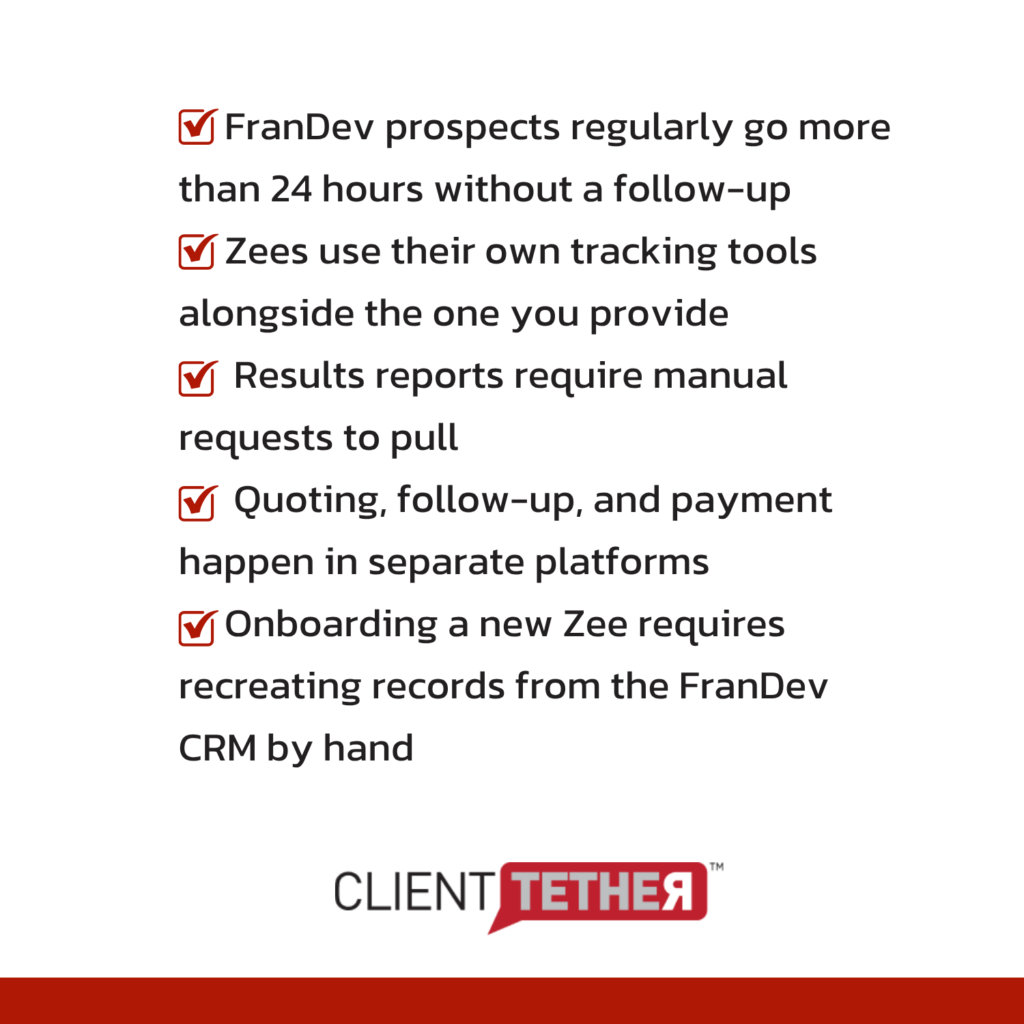
None of these is permanent. But each one signals that your current setup is patched together. At 50 or 100 locations, patches become gaps. According to the 2025 IFA Franchisor Survey, franchise brands are putting more weight on technology as a core growth lever — and the gap between brands with consolidated systems and those still patching tools together is widening.
If several of those boxes rang true, Is Your Franchise Software Built for Real Growth? is a useful next read. It covers the signals that separate software built to scale from software that just looks like it can.
FAQ
What is franchise management software?
Franchise management software is a platform that helps franchisors run their system. That covers bringing in new Zees, supporting ongoing unit ops, tracking compliance, and reporting on results across all locations. The strongest platforms cover both FranDev and unit ops. Most specialize in one or the other.
What’s the difference between franchise management software and a CRM?
A CRM manages contacts, leads, and follow-up sequences. Franchise management software is a broader category that also covers compliance tracking, Zee onboarding, royalty tracking, and reporting across locations. The real question is whether the two share data cleanly, or whether the handoff between them creates gaps. Franchise CRM software designed for multi-location brands, like ClientTether, bridges both sides in one system.
What features does franchise management software need for multi-location brands?
For brands running 20 or more locations: speed-to-lead automation, a parent-child account structure so the Zor can see all locations while Zees manage their own pipeline, FranDev pipeline work with compliance steps built in, and unit-level contact and payment tools that Zees will actually use. Reporting that does not require manual pulls is also essential at scale.
How do I know if my franchise management software can scale?
Three tests: Can the system route a new lead to the right Zee automatically across every zone? Can the Zor see live pipeline data for every location without requesting a report? Does onboarding a new Zee require rebuilding records from another system? If any of those answers is no, the design may not hold as the network grows.
How does franchise management software handle lead response at scale?
The best platforms automate first contact entirely. A new lead triggers a pre-built sequence across text, email, and call reminders, without anyone manually starting it. Speed matters more than most brands realize. ClientTether is built to respond within 29 seconds of a new inquiry, across every location in the system, without manual work.