
Most franchisors start with a generic CRM that they are familiar with from another industry, or that works for their original business model.
It works at first. A few leads a week. One or two FranDev reps. Manageable volume. That is… until your marketing team starts driving 10 leads a week or more. Reporting is unmanageable, manual task lists are growing, and the FranDev team is burning through leads and missing opportunities that could have been some of your best owners.
On the franchise operations side, everything seems to be going well with your corporate-owned location. Then you sell your first franchise, and realize that your reporting won’t work with multiple locations, your units have to set up their franchise software, configuration takes days, and training is complicated.
By the time you have five active franchise locations, your costs are way more than your budgeted tech fees, you have 3 add-ons to get the automations your franchises need, and your technical debt is growing faster than your royalties. These generic CRM tools don’t fail slowly. They fail all at once because they are not built as franchise software.
A franchise CRM is built for this. Not adapted from a sales tool that was never designed for a multi-location system. Built from the start for the structure franchising requires. This guide covers what franchise CRM software does, why it’s different, what features to look for, and how to choose what your franchise system needs.
Key Takeaways
- A franchise CRM is built around a parent-child account structure. The franchisor sees all locations and performance data. Each franchisee sees their own data only.
- It handles two separate workflows: FranDev (recruiting new franchisees) and unit operations (running existing locations).
- The best franchise technology enables sales with Speed-to-lead automations. Systems that send first contact in under five minutes outperform those that rely on manual outreach.
- Franchise CRM software needs to handle outreach across channels, full lead and field service support, and reporting at both the brand and location levels.
- Franchisors managing 10 or more active FranDev candidates, or those that have three or more locations, need software built for franchise systems. A customized generic tool won’t hold.
Who This Is For
- Best for: Franchisors managing active FranDev pipelines, multi-unit businesses with 5 or more franchise locations, and VPs of FranDev or Operations reviewing franchise software
- Not ideal for: Single-location businesses, though they love the system too.
- Top use cases: Automating FranDev candidate follow-up, helping franchise owners grow their businesses, home service franchises, replacing a stack of disconnected tools with one platform, and tracking lead source to close across the brand
What Is a Franchise CRM?
A franchise CRM is a CRM platform built for franchise systems. It handles the full lead-to-close cycle on both sides of the business: FranDev (from first inquiry through FDD delivery and territory award) and unit operations (from customer inquiry through booking, proposal, job scheduling, payment, and online reviews).
The key point is that it’s built for franchising from the ground up. Most CRM for franchises on the market are either generic tools with an afterthought layer for loose reporting, or platforms designed for one part of the workflow. A true franchise CRM is built around the structure of a franchise system from day one: multiple owners, shared branding, separate location data, and a need for brand-level reports.
What a Franchise CRM Is Not
A franchise CRM is not a generic sales tool pointed at franchise leads. It is also not a franchise management system focused on compliance, royalty collection, or operations tracking. Those tools serve real needs. But they are not built to drive revenue across the brand.
Franchise CRM software sits at the point where sales automation meets franchise structure. Its job is to help franchisors recruit better candidates faster, and help franchisees convert more local leads without adding staff or technology complexity.
Why Franchise CRM Software Is Structurally Different
Here’s the gap. A standard CRM stores contacts, logs activity, and sends reminders in a single data pool. It does this well for a flat sales team with a simple pipeline, where all sales reps work within a single data set.
Franchise systems are not flat. A franchisor with 50 franchise locations has 50 separate data sets, ownership groups, reporting structures, markets, dynamic lead sources, local marketing efforts, and sometimes unique market needs.
Each owner has its own leads, its own pipeline, and its own close rate. Plus a separate FranDev pipeline at the brand level. The data structure alone is different, and not supporting this out of the box can cost hundreds of thousands of dollars and months of frustrating workarounds and consulting fees to try to emulate.
Three things set franchise CRM software apart from a generic platform.
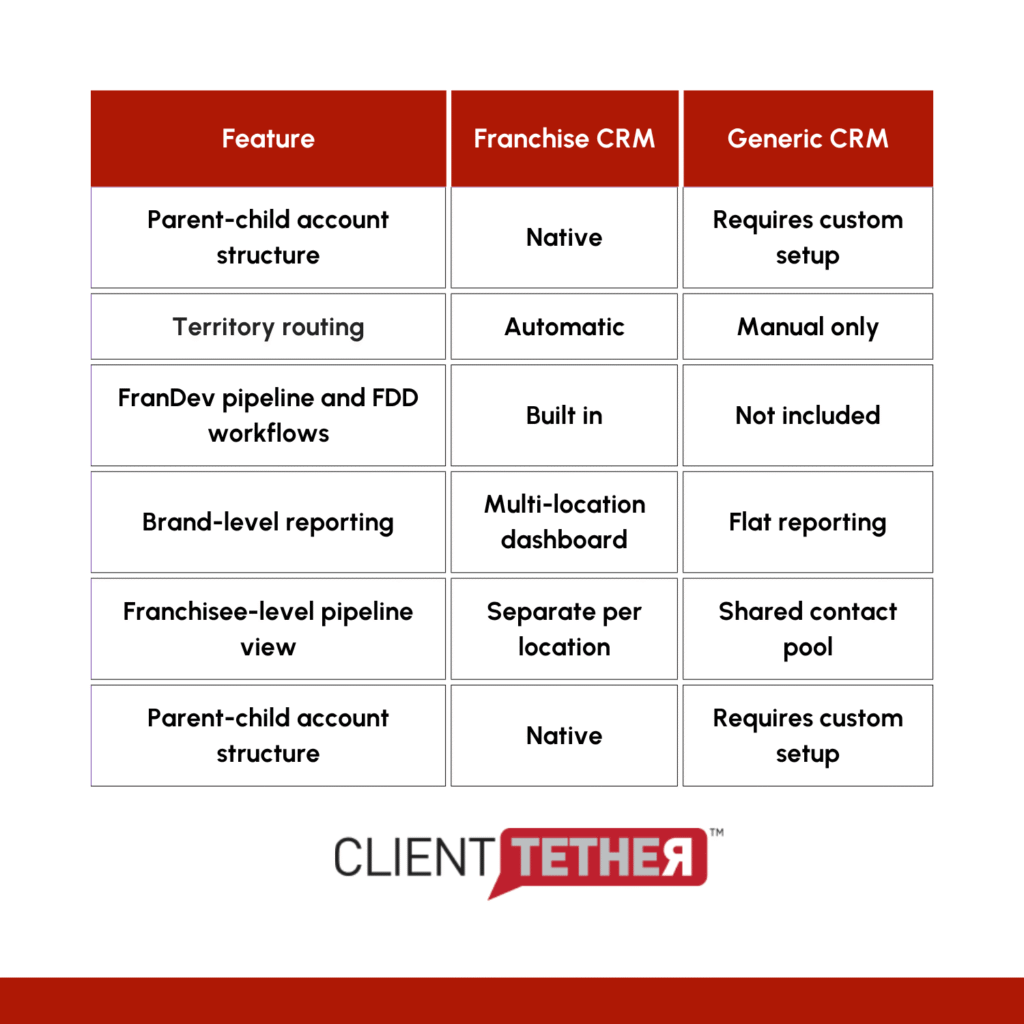
1. Parent-child structure: The franchisor needs to see pipeline activity across every location. Each franchisee manages their own leads without seeing other locations’ data. A generic CRM stores contacts in a flat structure. It has no concept of this kind of account setup. That flat structure breaks the moment you need brand-level reporting. Or, you have to spend six figures integrating third-party reporting tools to try to get close.
2. Territory routing: When a lead comes in through the national website, it needs to route to the right franchise location based on geography. Without proper territory structures built in, the lead sits in a shared queue until someone assigns it by hand. Manual routing is where leads go cold. Some brands try to accommodate this by having a national call center, but local outreach and engagement always beat national call center support.
3. Dual workflow support: FranDev and unit operations run on different timelines, different sales cycles, different contact sequences, and different close goals. A franchise management solution has to support both without forcing one team to work in a system built for the other.
These are not setup preferences. The gap is structural. A generic CRM cannot copy the parent-child structure with a settings change. That’s why franchisors who outgrow spreadsheets and generic CRM tools hit a wall, and why a move to software built for franchise systems changes outcomes, budgets, and reduces franchise brand overhead in the short and long term.
The Two Workflows a Franchise CRM Must Support
Franchise Development
FranDev is the process of recruiting, qualifying, and awarding new franchise units. A franchise sales CRM manages the candidate pipeline from first inquiry through FDD delivery, discovery day, and territory award.
The key here is speed. A serious franchise candidate is looking at multiple brands at the same time. Reaching out within minutes of an inquiry, not four hours, changes the outcome. In systems that rely on manual outreach, response times average four hours or more. The candidates who were still lukewarm at hour one aren’t waiting.
Franchise development software automates the first response the moment a lead submits a form. It runs a sequence across text, email, and call reminders without waiting for a rep to log in. By the time the rep sees the lead, there’s already a thread going.
For compliance, franchise CRM software should also handle FDD workflows natively: Item 23 receipt tracking, electronic signature, and candidate confirmation. Missing these creates real liability risk in the disclosure process. For more on building a pipeline that converts, see The Franchise Development Process: From Concept to Award.
Unit Level Operations
On the unit side, the challenge is consistent execution across locations. A franchise system rises or falls on whether franchisees follow through on lead response, outreach, quoting, post-sale nurturing, and online review gathering. The franchisor sets the standard. The franchise software holds franchise owners accountable to the brand standards.
A franchise CRM at the unit level automates the same things a FranDev team automates: first contact, outreach sequences, review requests, and reconnects. The franchisee doesn’t have to remember to send the third outreach text seven days after the estimate. Franchise owners are not buried in manual task reminders. The system handles it on its own.
One painting franchise using this approach lifted close rates to 65-80%, against a typical baseline of 25-35%. The change was not more leads. It was faster outreach and more touches before the lead went cold, and after quote delivery.
The franchisor, meanwhile, can see close rates across every location from one place. That visibility is what turns informal field coaching discussions into data-driven, objective coaching.
Core Features to Look For in Franchise CRM Software
Not all franchise software is the same. Here’s what sets a system that drives revenue apart from one that just tracks contacts.
Speed-to-lead: The ability to contact a new lead in under 60 seconds, without a rep having to log in or even lift a finger. Systems that reach out across text, call, and email within 4 minutes or less see 10X better contact rates than brands that wait 10 minutes or more. This is table stakes for the right franchise sales software. Speed matters. For benchmarks on lead response and close tactics, see How to Fix Your Lead Response Time and Close More Deals.
Outreach across channels: Email alone does not close franchise leads. Each lead follow-up sequence needs to include email, text, calls, and call reminders across a sequence that runs over days or weeks. Franchise marketing software that sends only email leaves deals on the table.
Territory routing: Leads should route to the right location based on zip code or other geography alignment on their own. Without this, leads stack up in a shared inbox or never get assigned at all.
Parent-child reporting: Franchisors need brand-level visibility. Franchisees need location-level clarity. These are different views with different access, and both are needed without investing in 3rd party software
FranDev compliance support: FDD workflows, electronic signatures, integrated candidate assessments, background checks, applications, or confidential questionnaires, and Item 23 receipt tracking should be part of the system, not managed separately through an outside tool.
Ease of use for franchisee: The best franchise CRM system in the world fails if franchisees won’t use it. Operators who are not technical need a clean interface and simple processes to follow. Visual cues, easy automations. If they don’t use it every day, it won’t drive results. For a full list of what to review, see The Essential Franchise CRM Checklist for Scaling Like a Pro.
Evaluating a Franchise CRM: A Stage-Based View
When you’re first launching into franchising, your understanding of what you need is pretty limited. What you need at 10 units completely changes your requirements, and it is not what you need at 100+ units. So, it’s important to know what you’ll need as you continue to grow, so your franchise technology doesn’t crumble under the increased pressure.
Early stage (1-10 units): A franchise management solution that handles the FranDev pipeline, automated lead response, and basic location reporting. Speed-to-lead is still the most important feature at this stage. Slow response costs you candidates, no matter how small the system. Effective nurturing and data visualization will help you make better decisions that can shape the strategy you’ll need to grow beyond your first few units.
CRMs for franchises won’t need as much complexity at this stage of growth; however, don’t become myopic. Just because you can make a tool work doesn’t make it something you can scale your franchise system with. Consider how your technology for franchise owners will automate their daily minutiae. How can you increase speed to lead, nurture effectively, manage proposals, payments, QuickBooks integration, online reviews, etc. How is the reporting? This becomes a much bigger issue as you grow.
Growth stage (10-50 units): The franchisor needs brand-level reports, territory performance tracking, and dashboards for both the unit and the franchise business coaches.
At this stage, the cost of inconsistent execution compounds if your franchise tools can’t keep up. One low-performing location affects the brand’s overall efficiency and validation for future franchise owners.
At this stage, not having a franchise CRM is going to become painful. Painful in both the exorbitant license fees you’ll incur with per-user license fees as well as limitations in architecture that don’t support true parent-child data structures, reporting, and brand controls.
This is where the wheels start coming off of big-box CRMs, and you’ll notice your spend for customizations, consultant hours, and total cost of ownership are way out of line with your tech fees and budgets.
Scale stage (50 or more units): This is where the franchise software needs to consolidate tools.
Most franchisors at this stage are running a generic CRM, a separate review platform, a quoting tool, and an SMS and email messaging layer that don’t connect natively. The overhead cost to manage 5-6 mostly-integrated tools alone can be staggering. Think of the support costs, frustration with franchise owners, and the increased complexity, which makes them not want to use the systems. All of these issues create angst and resistance until you find yourself with an expensive piece of software that none of your franchise owners are using.
Ultimately, this is why a purpose-built franchise CRM platform becomes an operating necessity. The native functions, reporting, ease of use, and the manageable and predictable cost models make them a tool for scaling without crippling your operations and finances.
One power-washing franchise made this move and scaled to 197 locations across 27 states in 18-24 months. The key was not just the software. It was having one place where lead contact and franchise sales ran together in a seamless FranDev flow.
Another brand grew from 6 to 160 locations without needing to make a technology switch, because they had all of the tools they needed in one place, and at an affordable rate.
According to the 2025 IFA Franchisor Survey, franchisors continue to point to tech adoption and lead close rates as top priorities. Getting the franchise software decision right has a direct business impact.
What ClientTether Delivers as a Franchise CRM
ClientTether is a sales automation CRM built for franchising. It was built by franchisors, for franchisors. It handles the full lead-to-close cycle across FranDev and unit-level operations in franchise systems so brands can convert more leads without adding headcount. It is the only CRM for franchises that works in both areas of franchising.
What that looks like in practice:
- FranDev pipeline with automated candidate outreach, FDD workflow, electronic signatures, and broker engagement for your franchise sales team
- Unit-level automation with Action Plans that run text, email, and call sequences without manual triggers
- Parent-child structure giving franchisors full brand visibility while each location manages its own pipeline
- Quote to payment inside the same system: proposals, electronic signatures, invoicing, and TetherPay payment tools
- Online reviews, nurturing, simplified callback management, task management, and industry-leading AI integrations to automate even more of your franchise owners’ operations
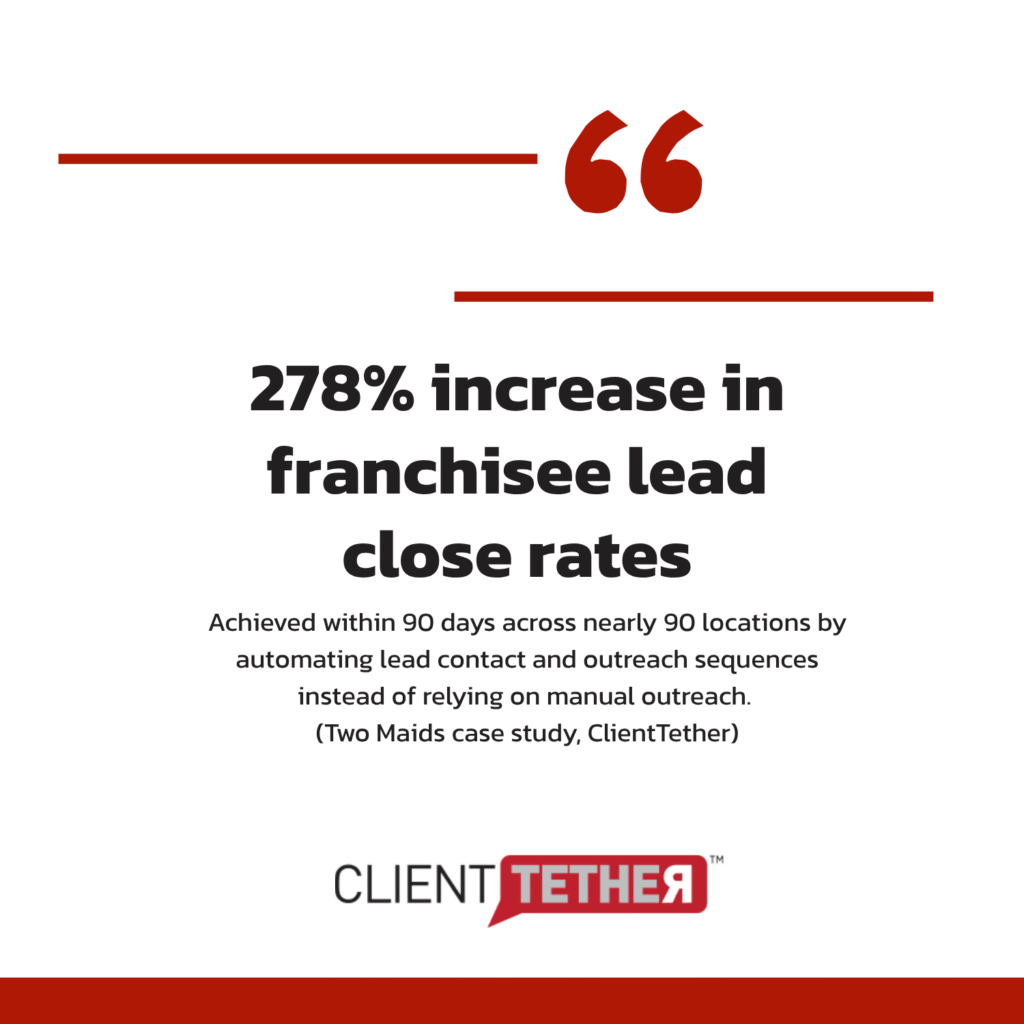
The results come from execution, not from features alone. One home cleaning franchise improved franchisee lead close rates 278% within 90 days across nearly 90 locations after setting up the ClientTether platform.
The system did not generate new leads. It made sure every existing lead got contacted faster, followed up more often, and moved through the pipeline with less manual work.
ClientTether has been recognized for five consecutive years in Entrepreneur Magazine’s Top Franchise Suppliers ranking, including the top spot in the Technology category in 2024, and the top 3 position across all franchise technologies for the past 3 years.
If you’re managing FranDev candidates on spreadsheets, running unit-level outreach through a generic tool, or missing brand-level visibility because your franchise software was not built for a system with multiple locations, that’s the problem ClientTether was built to solve.
Frequently Asked Questions
What is the difference between a franchise CRM and a regular CRM?
A franchise CRM is built around a parent-child account structure, proper sales automation, and support for both FranDev and unit operations. A regular CRM stores contacts in a flat structure with no concept of franchise levels, territory maps, or multi-location reporting. Franchise systems that use a regular CRM typically need heavy custom work to get close to what a platform built for franchising provides from day one; they take months to deploy, and they cost 10-20X the onboarding costs of a true CRM for franchises.
What does a franchise sales CRM do for FranDev teams?
A franchise sales CRM automates candidate outreach from the first inquiry through the full pipeline, including text, email, and call sequences. It also handles FDD workflows natively: Item 23 receipt tracking, electronic signature, and candidate applications. The goal is to cut contact time for new leads, keep serious candidates active through your FranDev cycle, and give FranDev reps a full pipeline view without manual reporting.
How does franchise CRM software support unit operations?
On the unit side, franchise CRM software automates lead contact and outreach for each location, routes leads based on geography, and gives the franchisor visibility into close rates across all locations. Franchisees get a system that handles outreach on its own, without needing to manage every touchpoint in a busy day, which saves franchise owners hours and helps them increase close rates by 20-50%.
When does a franchisor need franchise management software?
Most franchise systems hit a wall at 10 or more active FranDev candidates or 5 or more locations. At that point, the manual process creates enough friction to cost real revenue. The earlier a franchisor moves to software built for franchise systems, the more consistent the execution from the start, the better the reporting to drive business decisions, and the better the cost model to fuel future growth.
Can franchise management software replace multiple tools?
Yes. The right franchise management solution replaces a stack of tools: CRM, review management, quoting, messaging, and payment processing. The benefit is not just lower cost. It is cutting the handoff points where leads fall through, data gets lost, and reports break down.