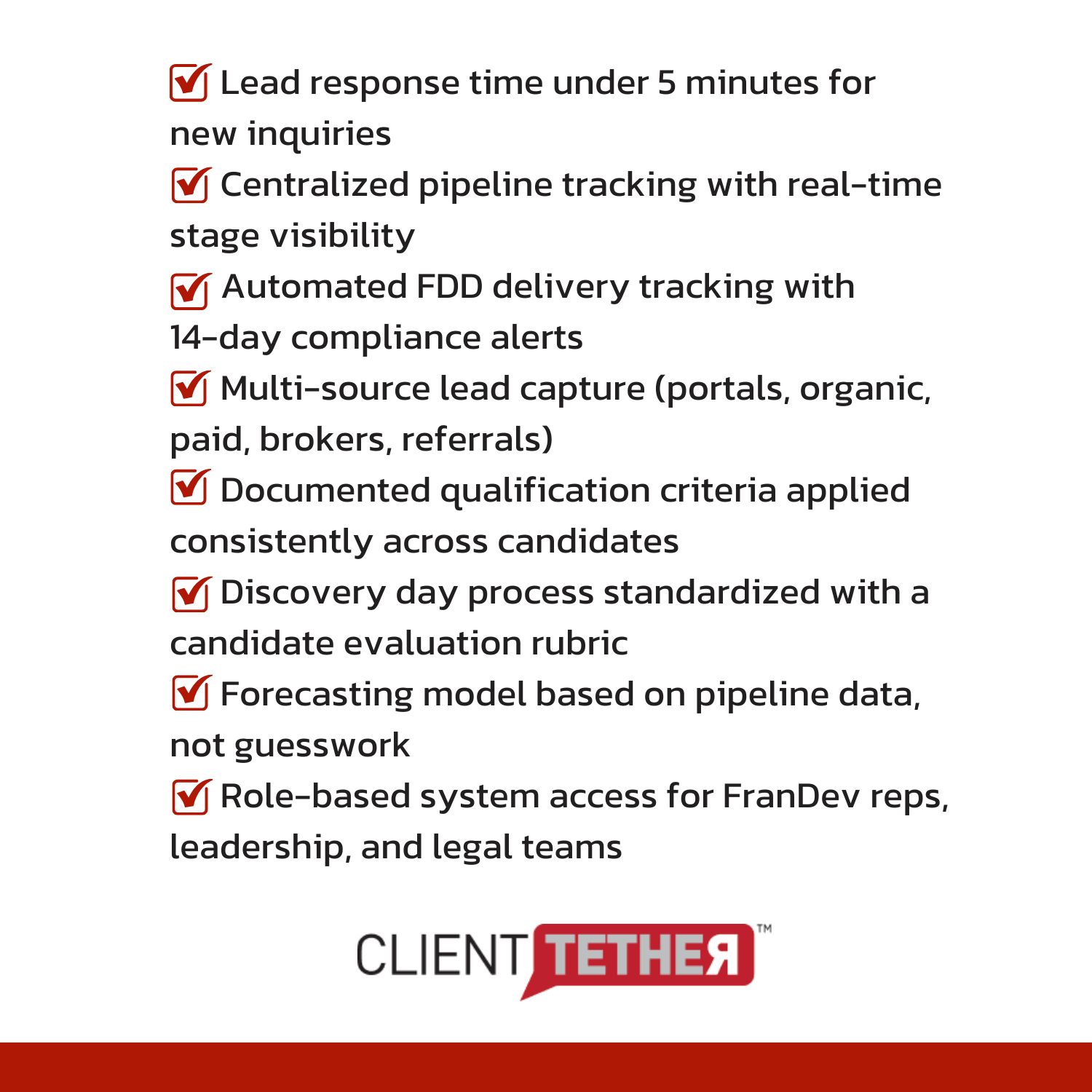
The franchise development process is the roadmap emerging franchisors follow to transform a proven business concept into a scalable franchise system.
If you’ve built a successful operation and you’re wondering what it takes to sell franchises, you’re asking the right question.
The journey from concept validation to awarding your first franchise territory involves four distinct stages — each with its own challenges, milestones, and decisions about when to invest in systems that support growth.
This guide walks you through the franchise development lifecycle, clarifies when software becomes necessary, and helps you build a candidate pipeline that converts interest into signed agreements.
The franchise development process includes four stages: validating your business model, creating legal structure and FDD documentation, building a sales pipeline to recruit candidates, and onboarding new franchisees. Early-stage franchisors (1-5 units) can manage manually, but growth-stage operators (5-20 units) need structured systems for pipeline visibility and candidate follow-up. Software investment makes sense when manual processes create bottlenecks in lead response, compliance tracking, or forecasting accuracy.
- Franchise development is the B2B sales function of recruiting franchisees, distinct from operations
- Stage 1 focuses on proving unit economics before selling franchises
- Stage 2 requires FDD creation and state registration for legal compliance
- Stage 3 builds candidate pipelines through lead generation and qualification workflows
- Software investment timing depends on unit count and pipeline complexity
Who This Is For
- Best for: Emerging franchisors managing 1-20 units, multi-location operators planning franchise expansion, business owners evaluating franchise readiness
- Not ideal for: Single-location businesses not planning to franchise, established franchisors (50+ units) with mature FranDev teams already in place
- Top use cases: Understanding FranDev lifecycle stages, determining software investment timing, building scalable candidate pipelines, navigating FDD compliance requirements
What Is Franchise Development?
Franchise development is the function responsible for recruiting, qualifying, and awarding franchise territories to new franchisees.
It’s the growth engine of your franchise system—the B2B sales process that expands your brand footprint through qualified operators who pay franchise fees and ongoing royalties.
Franchise Development vs Franchise Operations
FranDev is about selling franchises—generating leads, nurturing candidates, managing discovery days, delivering FDDs, and executing franchise agreements.
Operations is about running the franchise system once franchisees are awarded—training, site selection, ongoing coaching, compliance monitoring, and performance tracking.
This distinction matters. FranDev is a marketing and sales function. Operations is service and support. They require different skillsets, different systems, and different metrics.
Confusing the two creates organizational bottlenecks as you scale. For more on how franchise systems are structured, see Understanding Franchise Systems: What Franchisors Should Know.
The Role of FranDev in Franchise Growth
Your FranDev function drives revenue and market expansion.
Every franchise sale represents upfront franchise fees and a long-term royalty stream tied to the performance of each franchise location.
A systematic FranDev process means you can forecast growth, allocate territories strategically, and avoid awarding franchises to candidates who won’t succeed.
Ad-hoc recruitment works when you’re awarding one or two franchises per year. But if your goal is to scale to 20, 50, or 100+ units, you need repeatable workflows for lead capture, qualification, and conversion. The best franchise systems treat FranDev like any other sales function: measurable, optimizable, and supported by systems that provide visibility.
What are The Stages of Franchise Development?
The franchise development process unfolds in four distinct stages. Each stage has specific deliverables, typical timelines, and decision points that determine whether you’re ready to move forward.
Stage 1 – Franchise Concept and Business Model Validation
Before you sell a single franchise, you need proof that your business model works and can be replicated. Stage 1 is about documenting what makes your concept successful and demonstrating that it can succeed in the hands of someone who isn’t you.
Key activities include proving unit economics (consistent profitability across multiple locations or time periods), documenting operational systems (creating an operations manual that captures workflows and standard procedures), and preparing for replication (identifying what training and support new franchisees will need).
This stage answers: “Is this business franchisable?” If your unit economics depend on your personal relationships or founder skills, you’re not ready yet.
Stage 2 – Legal Structure and FDD Creation
Stage 2 formalizes the legal framework required to sell franchises. The centerpiece is the Franchise Disclosure Document (FDD), a federally mandated document that provides prospective franchisees with detailed information about your franchise opportunity, fees, obligations, and risks.
Key activities include FDD development (working with franchise attorneys to draft financial performance representations, fee structures, and disclosure statements), state registration (registering your FDD in states like California, New York, and Illinois), and franchise agreement creation (the binding contract governing the franchisor-franchisee relationship).
The FTC Franchise Rule requires franchisors to provide the FDD at least 14 days before signing any agreement or accepting payment.
This stage typically involves working with experienced franchise attorneys and advisors to structure the legal and disclosure framework required to offer franchises.
Stage 3 – Franchise Sales and Candidate Pipeline
Stage 3 is where franchise development becomes an active sales function. You’re generating leads, qualifying candidates, managing discovery processes, and converting interest into signed agreements.
Key activities include lead generation (franchise portals, broker networks, organic search, and paid advertising), candidate qualification (assessing financial capacity, culture fit, and operational readiness), discovery days (structured site visits where candidates meet your team and experience your brand), and FDD delivery (providing disclosure documents within regulatory timelines).
This stage is where most emerging franchisors hit their first scaling bottleneck. Manual follow-up and spreadsheet-based pipeline tracking break down when you’re managing 10+ active candidates simultaneously.
According to the 2025 IFA Franchisor Survey, labor challenges and economic constraints continue to impact franchise growth, making efficient candidate conversion increasingly important.
Stage 4 – Onboarding and Launch
Stage 4 begins after the franchise agreement is signed. You’re transitioning the franchisee from candidate to operator—providing training, supporting site selection, coordinating grand opening activities, and coaching through the first 90-180 days.
Key activities include training delivery (initial classroom and field training), site selection support (real estate evaluation and lease negotiation), grand opening coordination (pre-launch marketing and opening day logistics), and ongoing coaching (regular check-ins and performance monitoring).
A franchisee who struggles out of the gate becomes a validation liability for future candidates. Strong onboarding ensures new franchisees hit performance benchmarks quickly.
Building Your Franchise Candidate Pipeline
A functional FranDev pipeline moves candidates through predictable stages: awareness, interest, qualification, evaluation, and commitment. Each stage requires specific actions and communication touchpoints.
Lead Generation for Franchise Candidates
Franchise lead generation operates differently than B2C lead generation. You’re targeting individuals with $100,000+ liquidity, entrepreneurial mindset, and industry alignment—not mass consumer audiences.
Effective lead sources include franchise listing portals (paid placements on high-traffic marketplaces), franchise broker networks (brokers who match candidates to opportunities), organic search (content marketing targeting “best franchise opportunities”), paid advertising (Google Ads and Facebook targeting high-net-worth audiences), and referral programs (incentivizing existing franchisees to refer candidates). For insights on scaling lead generation, see 12 Surefire Franchise Growth Strategies for Brand Success.
Qualification and Discovery Process
Not every lead becomes a franchisee. Qualification separates genuinely interested, financially capable candidates from tire-kickers and misaligned inquiries.
The qualification process typically includes financial assessment (verifying liquid capital meets minimum thresholds), culture fit evaluation (assessing alignment with your brand values), and validation facilitation (connecting candidates with existing franchisees for unfiltered conversations).
Discovery days are the turning point. Candidates visit your headquarters, meet your team, tour locations, and experience your culture firsthand.
A well-structured discovery day includes facility tours, franchisee panels, financial modeling workshops, and candid Q&A sessions. The goal is mutual evaluation—you’re assessing the candidate as much as they’re assessing you.
From Application to Award
The final stage moves qualified candidates from “interested” to “committed.” This includes FDD delivery timeline management (ensuring candidates receive the FDD at least 14 days before signing), franchise agreement execution (finalizing contract terms and payment schedules), and territory assignment (confirming protected territories).
This stage requires precision. Regulatory compliance, clear communication, and timely follow-up determine whether candidates move forward or drop out. Even small delays in responding to candidate questions can result in lost deals. For benchmarks on lead response speed and conversion impact, see How to Fix Your Lead Response Time and Close More Deals.
When to Invest in Franchise Development Software
Software investment timing depends on unit count, candidate volume, and the complexity of your FranDev operations. Investing too early wastes resources. Investing too late creates bottlenecks that slow growth.
Early-Stage Franchisors (1-5 Units)
If you’re managing 1-5 franchise units and awarding 1-2 franchises per year, manual processes are usually sufficient. Spreadsheets can track candidate status. Email handles communication.
At this stage, your priority is proving the franchise model works—not optimizing FranDev workflows. Software investment can wait until manual processes become unsustainable.
Growth-Stage Franchisors (5-20 Units)
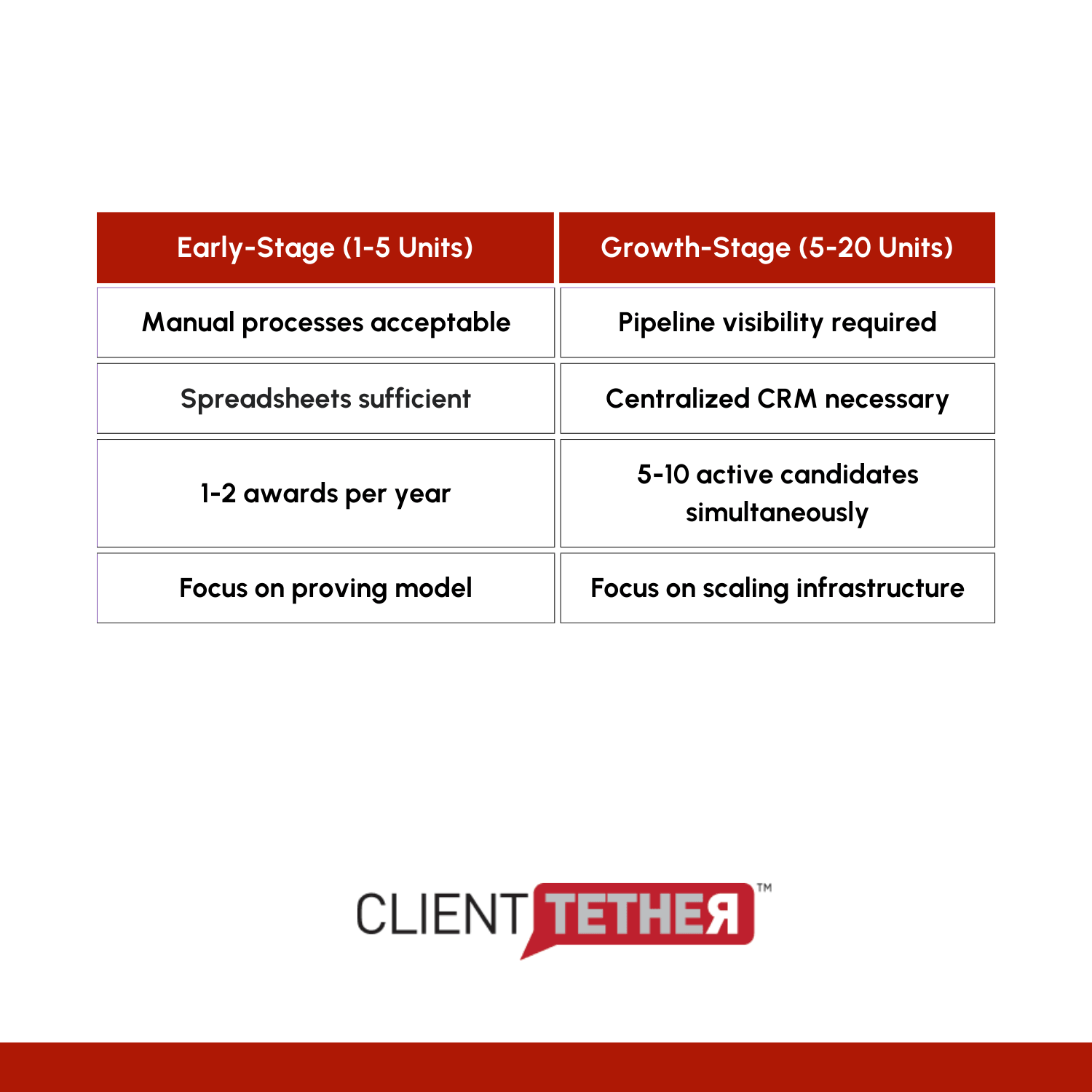
The 5-20 unit range is where manual processes break. You’re managing 5-10 active candidates at any given time. Multiple discovery days per month. FDD deliveries across different states with varying compliance requirements. Forecasting becomes guesswork because pipeline visibility is limited.
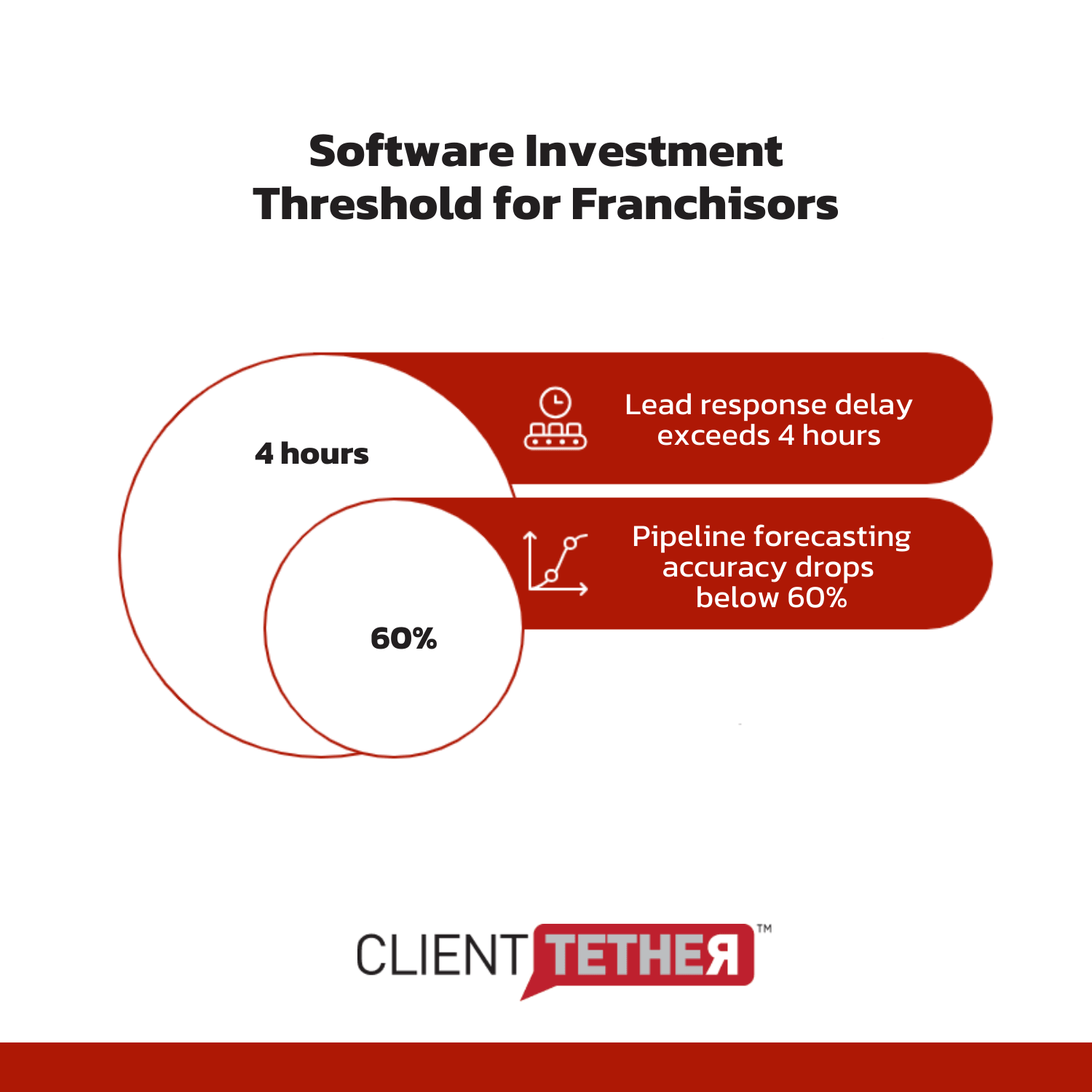
This is the software investment threshold. Key triggers include lead response delays (candidates wait hours for follow-up because inquiries get lost in email), pipeline invisibility (you can’t answer “how many candidates are in each stage?” without manually checking spreadsheets), and FDD tracking failures (missing 14-day delivery deadlines).
Growth-stage franchisors benefit from platforms that centralize candidate data, automate follow-up sequences, and provide real-time pipeline reporting. Learn more about Franchise Development Software for dedicated FranDev tooling, or explore Franchise CRM Guide for integrated pipeline management.
Established Franchisors (20+ Units)
At 20+ units, you’re operating an enterprise-level FranDev function. Dedicated FranDev teams. High candidate volume. Multi-brand complexity. Automation isn’t optional—it’s mandatory.
Established franchisors require platforms that support territory mapping, automated FDD compliance tracking, multi-user permissions, advanced reporting (cohort analysis, lead source ROI, conversion funnel metrics), and integration with marketing automation and financial systems.
Common Franchise Development Challenges
Even with structured processes, most franchisors encounter predictable challenges as they scale FranDev operations. Recognizing these patterns helps you anticipate and address them before they become bottlenecks.
Slow Candidate Follow-Up
Franchise candidates are evaluating multiple opportunities simultaneously. A 24-hour delay in follow-up can mean the difference between a discovery day and a lost lead. Manual outreach creates inconsistency and delays, especially during high-volume periods.
The challenge intensifies when leads arrive from multiple sources (franchise portals, website forms, broker referrals, paid ads). Without centralized lead capture, inquiries get missed or duplicated.
Automation helps by routing leads instantly to the right FranDev rep, triggering follow-up sequences within minutes, and ensuring no inquiry falls through the cracks. For automation strategies that improve follow-up speed, see More Deals, Less Grind: Sales Automation Done Right.
Poor Pipeline Visibility
If you can’t answer “How many candidates are in qualification vs evaluation vs commitment?” without manually checking spreadsheets, you have a visibility problem. Poor pipeline visibility creates forecasting errors, resource allocation issues, and missed opportunities to intervene when candidates stall.
CRM platforms solve this by providing real-time dashboards that show candidate distribution across pipeline stages, conversion rates at each stage, average time-to-award, and lead source performance. Leadership can identify bottlenecks, allocate resources accordingly, and forecast awards with accuracy.
FDD and Compliance Tracking
The FTC Franchise Rule requires franchisors to provide the FDD at least 14 days before signing agreements or accepting payment.
Missing this deadline exposes you to regulatory penalties. Manual FDD tracking—using calendar reminders or email follow-ups—fails when you’re managing multiple candidates across different timelines.
Software platforms automate FDD delivery tracking by recording when the FDD was sent, calculating the 14-day waiting period automatically, and alerting FranDev teams when candidates are cleared to sign.
For franchisors managing compliance complexity alongside candidate pipelines, ClientTether integrates FDD tracking, automated reminders, and compliance reporting within a unified system, reducing manual effort and regulatory exposure.