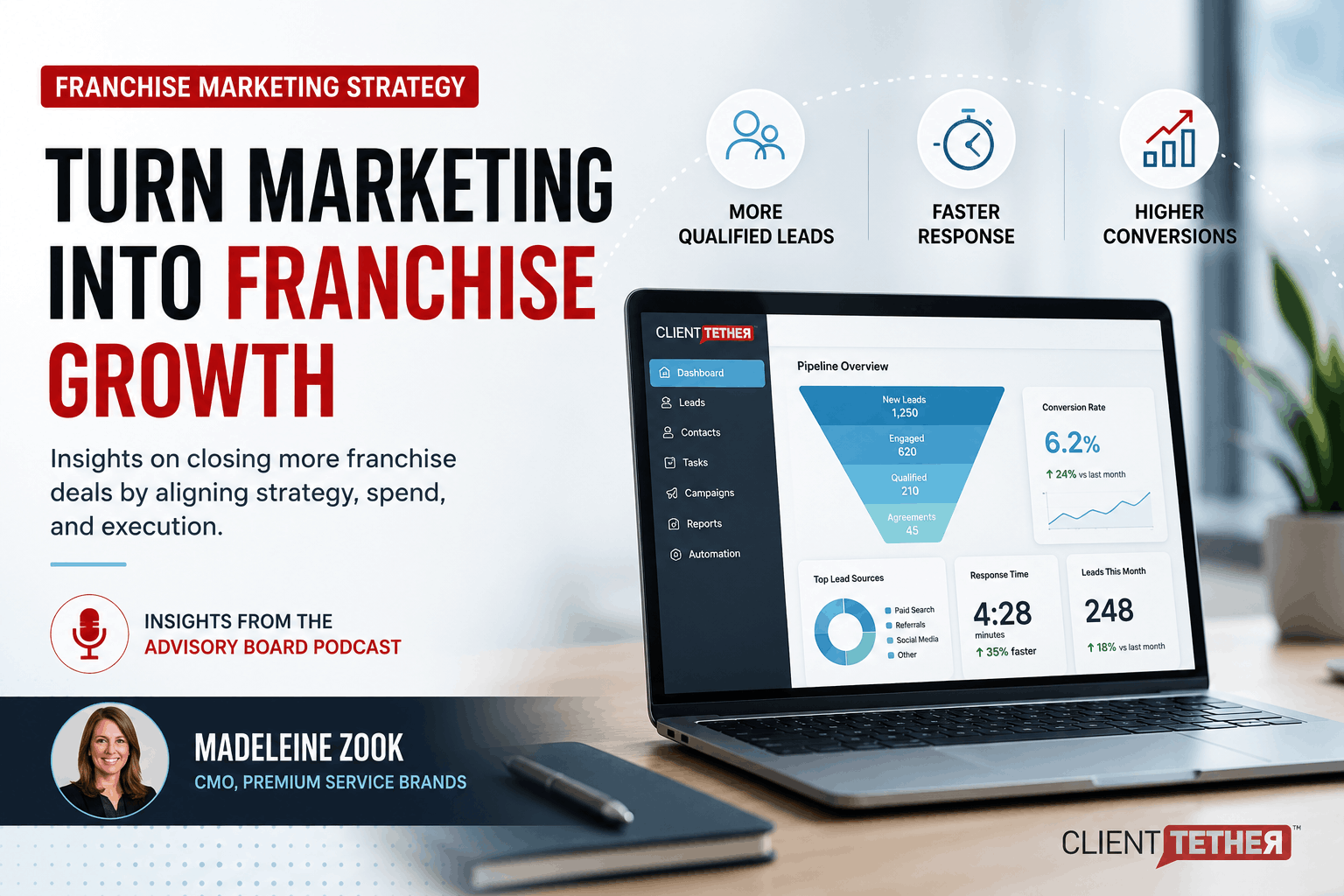
Franchise marketing strategy for franchise development isn’t just about generating leads. It’s about generating the right leads, at the right cost, and converting them faster than the three other franchise concepts those candidates are evaluating at the same time.
On a recent episode of The Advisory Board Podcast, I sat down with Madeleine Zook, CMO at Premium Service Brands, one of the most respected multi-brand franchise development executives in the industry. Madeleine’s perspective on FranDev marketing is grounded in budget reality, performance data, and a candid assessment of where most franchise brands are getting it wrong.
The conversation covered three areas where she’s seen the biggest gaps between what franchisors expect from their digital marketing and what it actually delivers.
- The gap between expectations and reality in FranDev digital marketing is wide. The root cause is misalignment between budget, spending, and communication.
- “You’ve got to know the numbers.” — Madeleine Zook. Budgeting without metrics is the primary driver of FranDev marketing waste.
- Geo-targeting traps: most franchisors make their targeting too narrow. Over-restricting territory reduces lead volume faster than it improves lead quality.
- Collaboration across the franchise network is not a soft benefit. It’s a performance multiplier. Brands that share what’s working close better.
- The franchise marketing strategy that scales requires both the top-of-funnel marketing layer and the CRM that converts leads before the window closes.
The Three Gaps in Franchise Marketing Strategy
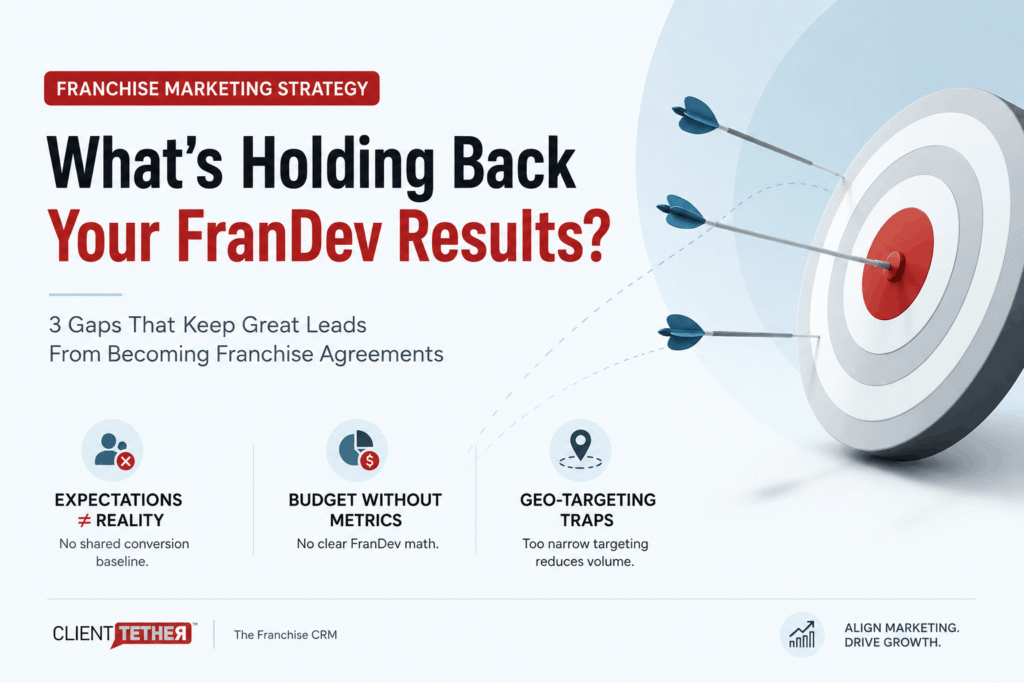
Gap 1: Expectations and Reality Are Not Aligned
Madeleine opened our conversation with a point that I’ve seen validated over and over in the data: “The reason is that expectations, spending, and communication are not aligned.”
This is the most expensive problem in FranDev marketing, and it’s invisible until you’ve already burned through budget. A franchise brand invests $10,000 per month in Google Ads, generates 30 leads, and expects 5 signed agreements by the end of the quarter. When the pipeline produces 1 agreement, the natural conclusion is that the ads are underperforming.
Usually, the ads aren’t the problem. The problem is the three-way misalignment: the marketing team expects leads to close at 10%, the development team is following up within 24 hours (not 5 minutes), and no one defined what ‘qualified’ means before the campaign launched.
Madeleine’s prescription: “The real deal is understanding what you’re up against.” That means defining conversion rate benchmarks by lead source before a campaign goes live, not after it underperforms.
From a franchise marketing strategy perspective, this is where the CRM and the marketing platform need to be connected before you run the first campaign. If your franchise sales CRM isn’t feeding conversion data back to the marketing team, you have no baseline for what your leads are actually worth and no way to distinguish a marketing problem from a follow-up problem.
Gap 2: Budgeting Without Metrics Is Strategy Without a Compass
“You’ve got to know the numbers,” Madeleine said, and this was the most consistent theme across our conversation.
FranDev marketing budgets are often set based on what’s affordable rather than what the math requires to hit development goals. If your goal is 20 new franchisees per year, and your current close rate is 3%, you need 667 qualified leads. If your cost per qualified lead is $200, the math requires a $133,000 annual marketing budget, not the $60,000 that feels comfortable.
According to the IFA 2026 Franchising Economic Outlook, the franchise sector is projected to reach 845,000 establishments. In that development environment, brands with budgets that can’t compete for candidate attention produce predictably thin pipelines.
The practical implication: define your FranDev math before setting your marketing budget. What is your current close rate? What conversion rate would you need to hit your unit goals? Is that rate achievable with your current response time and follow-up cadence?
That last question points back to the CRM. According to ClientTether’s Service Franchise Lead Response Report (2026), contacting a lead within the first five minutes improves conversion likelihood by 10X. A marketing budget that generates 100 leads per month and converts at 3% produces 3 deals. The same budget with 6% conversion produces 6 deals. The difference isn’t the ads. It’s what happens in the first 60 seconds after a lead arrives.
Gap 3: Geo-Targeting Traps Reduce Volume Without Improving Quality
This was one of the most technically specific insights Madeleine shared: “Keep volume in mind. Oftentimes franchisors assume that funneling funds into a couple specific areas will mean a spike in leads for that area. Typically, this only decreases volume. Franchise search volume decreases as you geo-target, which will slow your lead pipeline. Keep your geo-fences on the larger side for greater volume.”
The instinct to narrow geographic targeting comes from a reasonable place: if you need franchisees in three specific markets, why pay for leads from markets you can’t place? The problem is that franchise search volume is low enough in most individual markets that overly narrow targeting starves the algorithm of data, drives up cost per click, and reduces lead quality.
The better approach: run broader targeting to generate volume, then qualify leads by territory at the CRM level rather than filtering them out at the ad platform level. This is exactly the kind of territory-based lead routing that a franchise-native CRM handles natively. Leads come in from a national campaign, and the CRM routes each one to the appropriate development rep based on the candidate’s location relative to available territories.
The Collaboration Principle
“We’re all in this together,” Madeleine said, advocating for the sharing of best practices and successes across the franchise industry.
In franchise development, information about what’s working: which lead sources close, which candidate profiles convert, which follow-up cadences produce Discovery Day attendance rates above 40%, is exactly the kind of data that most brands treat as competitive intelligence rather than shared wisdom.
The brands that close faster are usually the ones with the best benchmark data. They’ve talked to other franchisors. They’ve attended IFA. They’ve compared notes with development directors at non-competing brands. They know what a good conversion rate looks like, and they can diagnose a problem because they have an external reference point.
From Podcast Insights to FranDev Performance
Madeleine’s three-gap framework maps directly to the technology requirements of a modern FranDev marketing stack:
| Gap | Root Cause | Technology Fix |
|---|---|---|
| Expectations vs. reality misalignment | No baseline conversion data before campaign launch | CRM-to-marketing feedback loop with source attribution |
| Budgeting without metrics | FranDev math not defined before budget is set | Pipeline conversion dashboard with cost-per-lead tracking |
| Geo-targeting traps | Over-restriction at ad platform level | Territory-based lead routing in franchise CRM |
| Collaboration deficit | Benchmarks set internally only | IFA benchmarking + external performance data integration |
The top-of-funnel franchise marketing software generates the leads. The franchise CRM converts them. And the strategy that connects them, defined before the budget is set, measured against real conversion benchmarks, and refined from external data, is what separates the brands that hit development goals from the ones that keep adjusting the ad spend hoping for a different result.
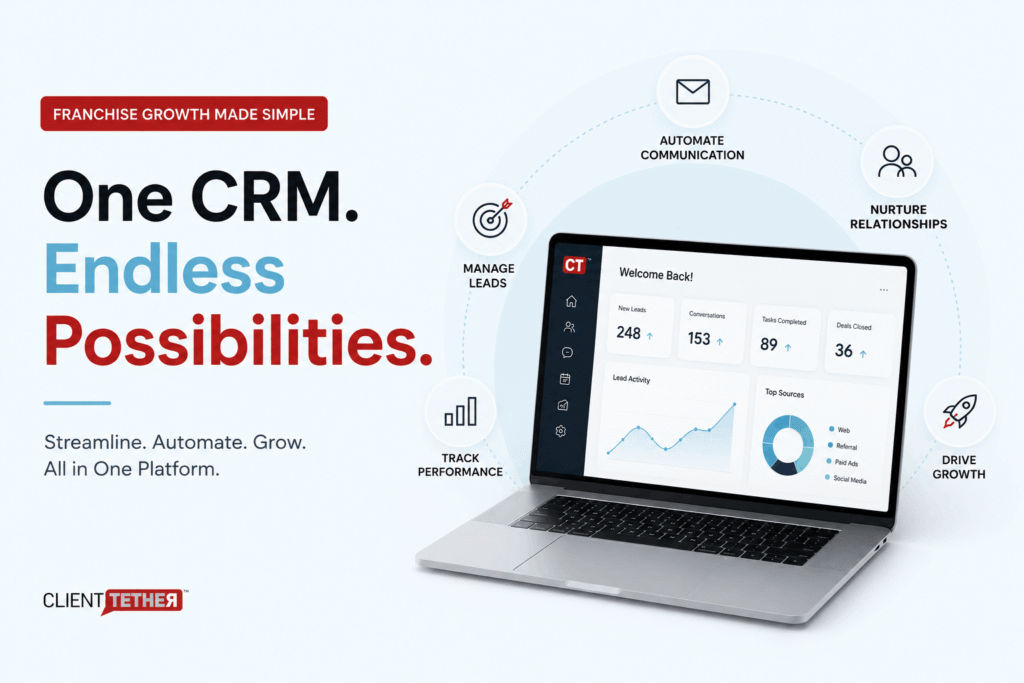
ClientTether handles the CRM layer: speed-to-lead automation, territory-based routing, source attribution from portal to signed agreement, and the performance dashboard that closes the loop between marketing spend and closed deals.
To see how it supports the kind of franchise development strategy Madeleine described, that’s the right place to start.
Frequently Asked Questions
What is a franchise marketing strategy for FranDev?
A franchise marketing strategy for FranDev is the plan that governs how a franchise brand generates, qualifies, and converts franchise candidate leads. It spans four layers: lead generation channels, qualification criteria, response and follow-up process, and conversion metrics that connect marketing spend to signed agreements.
Why do most franchise brands underperform on FranDev digital marketing?
According to Madeleine Zook, CMO at Premium Service Brands, the most common failure point is misalignment between expectations, spending, and communication. Franchise brands often set budgets without defining the math of how many leads are needed at what conversion rate to hit development goals, and then attribute underperformance to ad quality when the real problem is response time or follow-up cadence.
How does geo-targeting affect FranDev lead volume?
Over-narrow geo-targeting reduces franchise search volume faster than it improves lead quality. The better approach is to run broader targeting for volume and qualify by territory at the CRM level, using territory-based lead routing to assign leads to the appropriate development rep based on candidate location.
What is the most important metric in FranDev marketing?
Cost per qualified lead, tracked all the way to signed agreement. Total lead count and cost per lead are useful operational metrics, but the metric that connects marketing investment to development ROI is the total cost to produce one signed franchise agreement.
How does a franchise CRM connect to franchise marketing strategy?
A franchise CRM closes the loop between marketing spend and development results. Marketing generates the lead. The CRM fires the automated first response within 60 seconds, routes the lead to the appropriate development rep, runs the follow-up sequence, tracks source attribution from first contact to signed agreement, and produces the conversion data that tells the marketing team which channels produce viable candidates.
What should a franchise brand prioritize first, marketing strategy or CRM?
Both simultaneously, but if forced to sequence: set up the CRM first so that marketing spend is going into a pipeline that can convert. Marketing that generates leads without a fast, consistent follow-up system is marketing that produces candidates your competitor follows up with first.