A franchise CRM built for FranDev closes the gap where qualified candidates go cold between inquiry and discovery call.
This gap shows up for a few reasons: FranDev teams do follow-up by hand; they track FDD (Franchise Disclosure Document) steps in a spreadsheet. And they use generic CRMs that weren’t built for how franchise recruitment works.
As a result, response time slips, and follow-up depends on memory and discipline. Meanwhile, pipeline stages don’t match the actual candidate journey, and disclosure steps fall through the cracks.
A franchise-native CRM keeps candidates warm across text, email, and calls. It tracks each FDD step and shows the full pipeline in one view — so more candidates become signed franchisees without adding FranDev staff.
Franchise-native CRMs can respond to leads in seconds, automate the 6–9 follow-ups each candidate needs, and track FDD workflows in one place — increasing conversion without adding headcount.
Key takeaways
- Generic CRMs lack native FranDev pipeline stages, FDD tracking, and Item 23 receipt processing — forcing workarounds that leak candidates.
- ClientTether responds to inquiries in 29 seconds or less through automated text, email, and call workflows.
- Action Plans sustain the 6–9 touches recruitment requires without depending on rep memory or manual discipline.
- FDD delivery, Item 23 confirmation, 14-day waiting period, and e-signature all run inside the same candidate record.
- FranDev and unit-ops pipelines stay separate while franchisor-level visibility spans both.
- Source-to-award attribution connects marketing spend to actual signed franchisees.
- One 1,500+-member broker network white-labeled ClientTether as its own franchise sales CRM, reducing onboarding from days to minutes.
Why Do FranDev Pipelines Leak Between Inquiry and FDD?
FranDev pipelines leak because manual follow-up, mismatched CRM stages, and fragmented tools break visibility and consistency across the candidate journey.
Here’s what a FranDev rep’s day looks like. Inbound leads pile up in the inbox. Candidates reply to texts but not to emails. Discovery calls get booked in one tool and tracked in another. And FDD receipts get logged by hand in a sheet.
The system breaks in predictable places:
- Slow first response. Candidates evaluate multiple brands at once. The brand that reaches them first gets the conversation — and manual inbox-checking can’t compete with automated response.
- Unsustained follow-up. It typically takes 6 to 9 touches to move a candidate from inquiry to signed agreement, but without automated sequences across SMS, email, and calls, follow-up depends on rep discipline and candidates slip through.
- Mismatched pipeline stages. Generic CRMs use stages like “Lead,” “Qualified,” and “Closed.” Franchise recruitment runs through inquiry, prequalification, discovery, validation, FDD delivery, Item 23 receipt, and territory award. When stages don’t match process, visibility breaks.
- Fragmented tools with no FranDev workflow. Lead capture, email, scheduling, FDD tracking, and e-signature spread across disconnected systems. Generic CRMs don’t track Item 23 receipts, don’t trigger automated delivery sequences, and don’t separate franchise development from unit-level operations. So FranDev teams either build workarounds or lose visibility.
Industry Context: Why This Problem Is Getting Worse
The 2025 IFA Franchisor Survey confirms the pressure: franchisors are managing labor constraints, tighter candidate scrutiny, and longer sales cycles. When your recruitment process leaks at every stage, those constraints compound.
The bottleneck isn’t lead volume — it’s infrastructure. Wharton School research on workplace transformation shows that teams without modern workflow tools face compounding friction between capacity and execution. That’s exactly the gap a franchise-native CRM is built to close.
The Cost of Slow First Response in Franchise Recruitment
Speed matters more than most FranDev teams realize.
When a candidate evaluates multiple franchise opportunities at the same time, they default toward whoever reaches them first. If your first response lands 4 hours after the inquiry while a competitor texts back in 3 minutes, you’ve already lost positioning.
ClientTether is built around speed-to-lead and can respond in 29 seconds or less. That’s not a rep typing faster. Instead, it’s automated text, email, and call workflows triggered the moment a lead enters the system — before the candidate closes the form submission page.
Because of this, the candidate gets immediate acknowledgment, next steps, and a discovery call link while their intent is still high. You’re not chasing cold leads three days later. You’re engaging warm prospects within the first minute.
The difference between 29 seconds and 4 hours isn’t just faster follow-up. It’s a structural advantage that compounds across every stage of the pipeline.
What Does a Franchise-Native CRM Do That a Generic CRM Cannot?
A franchise CRM manages the full recruitment workflow—from inquiry to FDD and award—inside a single system with automated engagement, stage tracking, and built-in compliance processes.
Generic CRMs don’t run franchise recruitment — they approximate it through custom builds, third-party integrations, and manual workarounds. That’s where the breakdown happens. By contrast, ClientTether starts with FranDev structure built in.
FranDev pipeline stages are native. Instead of forcing franchise recruitment into “Lead → Qualified → Closed,” ClientTether runs stages like Inquiry, Prequalified, Discovery Scheduled, Validation Call Complete, FDD Sent, Item 23 Received, and Award Pending.
The pipeline matches the actual candidate journey — so your team doesn’t lose visibility between handoffs.
FDD tracking and e-sign sit inside the candidate workflow. When a candidate receives the FDD, ClientTether tracks delivery, logs Item 23 receipt confirmation, and triggers follow-up sequences automatically. E-signature runs inside the same system.
No separate tools. No manual logging.
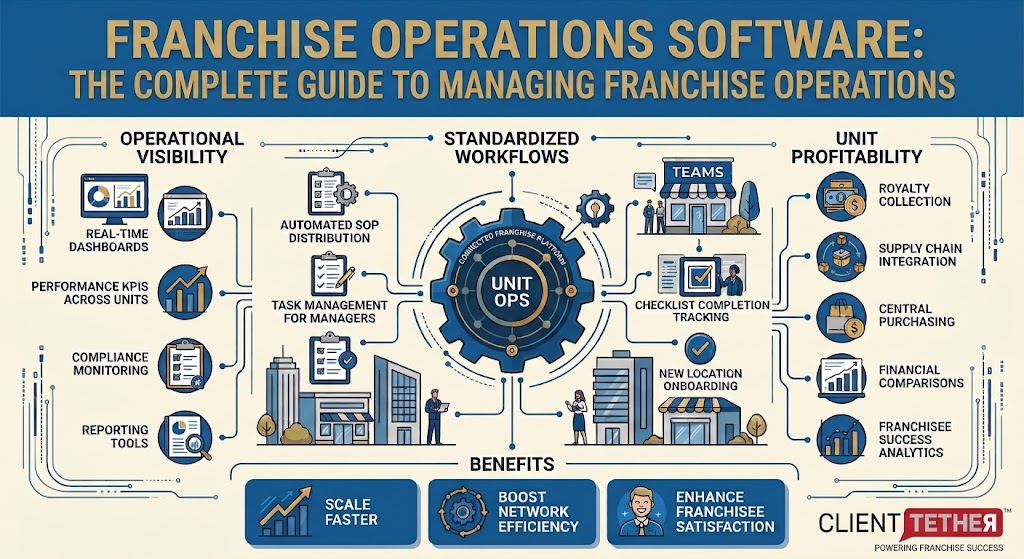
FranDev and unit-ops pipelines stay separate. Your FranDev team sees candidate activity. Your operations team sees unit-level performance. Neither collides in the same dashboard — but franchisor-level visibility spans both.
Why Retrofitting Generic CRMs Falls Short
Generic CRMs require months of customization to replicate what ClientTether handles out of the box. The structural difference isn’t feature count. It’s whether the CRM was built for this workflow or retrofitted to approximate it.
FranDev Workflow Built for the Disclosure Process
The FDD disclosure process is where most generic CRMs break.
A FranDev rep needs to send the FDD, log delivery, track Item 23 receipt confirmation, respect the 14-day waiting period, send follow-up reminders, and route the signed agreement for processing. If those steps live across email, spreadsheet, DocuSign, and manual notes, something slips.
ClientTether keeps the entire workflow inside the candidate record. The rep triggers disclosure delivery from the franchise CRM. The system logs the time. It sends the Item 23 receipt request on its own. It tracks each reply. It works out the earliest signing date. And it fires off reminders during the wait.
When it’s time to sign, integrated e-signature runs inside the same platform — no handoff to a separate tool.
What This Means for the FranDev Team
This isn’t compliance software. It’s a recruitment workflow that respects compliance requirements without forcing the team to manage them manually. ClientTether knows what the disclosure process requires, so the team doesn’t have to remember.
That same principle — automation without losing structure — extends to the full candidate engagement cycle.
Automating the 6–9 Touches Recruitment Actually Requires
Most FranDev teams don’t have automated sequences that sustain engagement across the full candidate timeline. Follow-up depends on manual discipline, calendar reminders, and individual rep habits.
ClientTether runs that engagement automatically through multichannel Action Plans.
How Action Plans Sustain Candidate Engagement
Action Plans are automated sequences that trigger text, email, call reminders, and follow-up steps based on candidate behavior.
If a candidate submits an inquiry, an Action Plan sends immediate text acknowledgment, follows up with email, triggers a call reminder for the rep, and schedules touchpoints over the next 7 days. If the candidate responds, the sequence adjusts. If they don’t, the system keeps engagement moving without manual intervention.
SMS gets higher response rates than email for franchise candidates — particularly those evaluating opportunities while working full-time. But most generic CRMs don’t include native two-way SMS, so teams either skip text or bolt on tools that don’t sync to the candidate record.
In ClientTether, SMS, email, and call logging all run inside the same system. Every interaction logs automatically. The rep sees the full conversation history in one place. The franchisor sees engagement patterns across the entire pipeline.
The Technical Foundation for Scaled Automation
The Stanford AI Index analysis notes that AI-driven tools for sales and customer outreach came of age in 2025. These tools can now handle follow-up across many channels, react to what a lead does, and tailor each sequence — all at scale.
The Maids grew franchise sales 300% in 14 months by automating roughly 70% of manual FranDev tasks through structured follow-up and pipeline automation.
What Candidate Engagement Looks Like on ClientTether
ClientTether engages candidates within 29 seconds of inquiry — automated text, email with a discovery call link and introductory materials, and a call reminder pre-loaded with the candidate’s contact info, inquiry source, and territory interest all fire without manual intervention.
If the candidate doesn’t answer, the Action Plan escalates through follow-up texts with rescheduling links. After discovery, the system triggers validation messaging, schedules follow-ups, and routes the candidate to the next pipeline stage.
At the disclosure stage, the same automation handles document delivery, Item 23 confirmation, waiting period tracking, and e-signature — no handoff needed.
Why This Creates Competitive Advantage
The candidate gets consistent engagement. The rep stays focused on high-value conversations. The franchisor sees where every candidate sits, which stages are moving, and where drop-off happens.
That visibility lets FranDev leaders identify bottlenecks and intervene before deals stall.
Pipeline Visibility and How Franchise Brands Put It Into Practice
Automation without visibility doesn’t solve the FranDev problem. You need to see where candidates are, which stages are slipping, which sources convert, and which reps are moving deals forward.
ClientTether’s franchise CRM gives FranDev leaders a view in real time. The dashboard shows candidates by stage, by rep, by source, and by age. You see which inquiry sources convert at 40% and which convert at 8%. You see which reps close at 25% and which close at 60%.
How Attribution Changes Resource Allocation
Source-to-award attribution connects marketing spend to actual outcomes — which campaigns generate signing candidates, which broker referrals convert faster, which lead magnets attract serious prospects versus tire-kickers.
That visibility changes how FranDev leaders allocate budget, coach reps, and prioritize pipeline stages.
What Brands Running a Franchise CRM Actually See
One 1,500+-member franchise broker organization replaced its prior CRM with ClientTether and white-labeled it as its own franchise sales CRM.
The outcome? New brokers ramped up in minutes, not days. Follow-up stayed steady across the whole network. And leaders could see broker activity at a glance — without having to check in on each broker one by one.
The platform automated candidate rehashing for prospects that went cold and embedded training resources inside the franchise CRM — so brokers didn’t need separate systems for candidate management and professional development.
The result was a broker network that could scale without losing consistency, and a franchisor partner base that saw measurable gains in candidate response rates and pipeline velocity.
That’s what franchise-native architecture enables. Not just better tools — better execution at the structural level.
Moving Your FranDev Process Onto a Franchise-Native CRM
The gap between inquiry and signed franchisee shouldn’t depend on manual discipline, disconnected tools, and spreadsheet-based FDD tracking.
ClientTether’s franchise CRM compresses that cycle by automating speed-to-lead response, sustaining the 6–9 touches candidates need without adding manual work, and tracking FDD-related milestones inside the same platform where engagement happens.
More qualified candidates convert. FranDev teams stop losing pipeline visibility. Franchisors close more units without growing headcount.
If your current setup leans on reps to remember follow-up, on sheets to track disclosure, and on split tools for each step — the problem isn’t your people. It’s your setup.