Some conversations stick with you because they put language to something a lot of franchise leaders are feeling but have not quite said out loud yet.
This was one of those conversations.
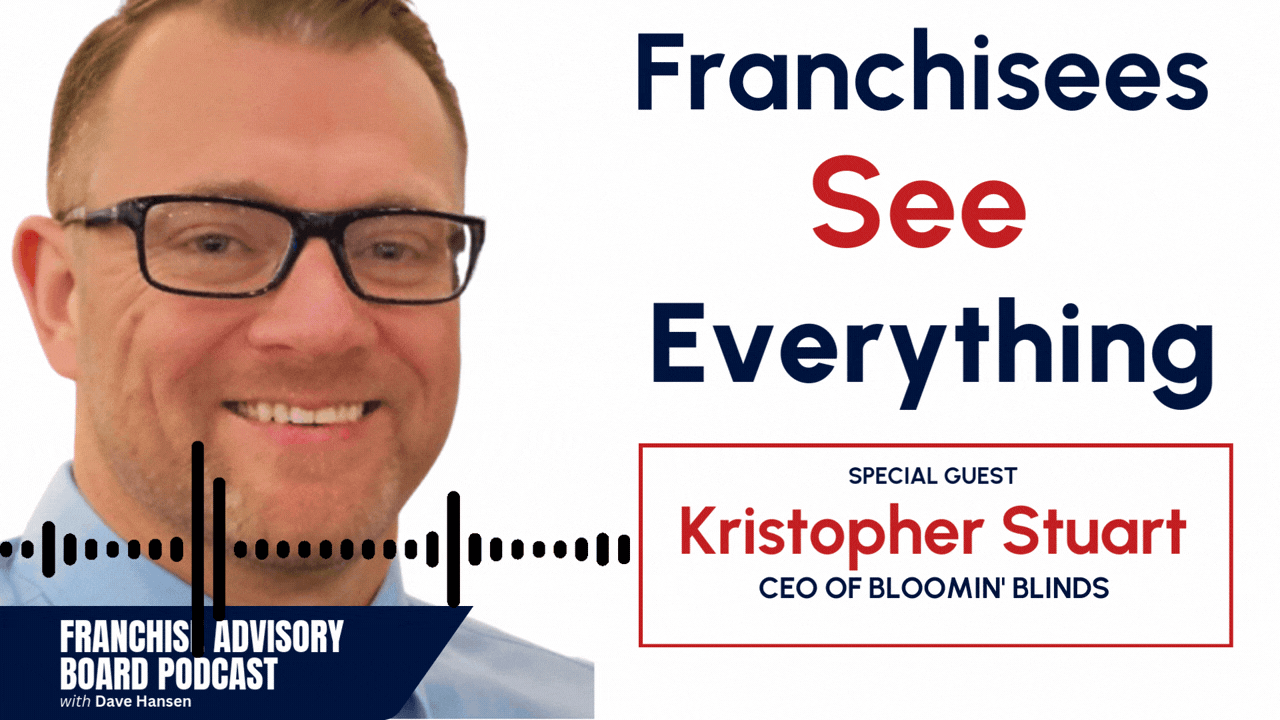
On this episode of The Franchise Advisory Board Podcast, I sat down with Kris Stuart, CEO of Bloomin’ Blinds, to talk about growth, drift, leadership, and what it really takes to keep a franchise system healthy over time.
What I appreciated about this conversation is that it was not theoretical. Kris shared the kind of perspective that only comes from carrying real responsibility, making hard calls, and being willing to admit when something is off. We talked about what happens when system growth starts hiding unit-level problems, why “proven systems” still need to be re-proven, and how easy it is for even a well-intentioned strategy to drift away from the people it is supposed to serve.
For me, this episode was a reminder that franchising is not about defending yesterday’s wins. It is about staying close enough to your franchisees, your mission, and your market to keep making the right next decision.
Meet Kris Stuart
Before we got into the bigger strategic lessons, I wanted listeners to understand who Kris is and why his perspective carries weight.
Kris is the CEO of Bloomin’ Blinds, a founder-led, unapologetically customer-first franchise brand in the window covering space. There is a real family story behind the business, too. His mom, Karen, founded it, and Kris is now helping lead the second generation of that brand. He also spent 12 years as a fire lieutenant and paramedic in North Texas, which explains a lot about the way he thinks about service, responsibility, and action.
That background comes through in the way he talks. He is practical, warm, direct, and deeply wired to help people. One of the clearest lines in this section was when he explained why franchising became such a natural fit for him after the fire service: “It was the actual like I can touch what this feels like. I can do this actually do this thing and get the instant gratification of that effort.” That line tells you a lot about how he leads. He is not interested in abstract leadership. He is interested in tangible service.
If franchisee profitability is not improving, you have to pay attention
One of the clearest signals Kris described was the gap between system growth and franchisee growth. From the outside, a brand can look like it is moving in the right direction. Sales may be up. Development may be working. New units may still be coming in. But if franchisee revenue and profitability are not improving the way they should, that is not a small problem. That is the problem.
What I appreciated here was the honesty. Kris did not hide behind vanity metrics. He said they had to listen to what they were already saying and then be willing to admit when their actions were not lining up with their priorities. That kind of clarity is uncomfortable, but it is necessary.
The line that captured it best was: “The system is growing, but the stores aren’t growing.”
A proven system still has to be re-proven
This may have been the most important idea in the whole conversation.
In franchising, people love the phrase “proven system,” and for good reason. Systems matter. They create repeatability. They reduce guesswork. They help franchisees move faster with more confidence. But Kris made an important point: a proven system is not a permanent finish line.
Conditions change. Markets change. Technology changes. Consumer expectations change. Even your own internal environment changes as your brand grows. So if a system was proven under one set of conditions, the real question is whether it is still serving franchisees under today’s conditions.
Kris put that challenge into one sharp question: “If that system is proven in that set of conditions, what happens when the conditions change?”
That is the work. Not defending the label, but doing the hard work of re-validating the system as reality changes around you.
Franchisors need to buy experience early
Another part of this conversation that I think will resonate with emerging brands was Kris’s point about experience. Being good at the widget is not the same thing as being good at franchising. Those are different muscles. A strong franchise system needs more than product expertise. It needs a real bench across coaching, marketing, development, support, and franchisee success.
Kris talked about the importance of understanding that responsibility early. It is not enough to help franchisees do the job well. You also have to build the brand well around them. That means bringing in people who have walked those miles before and can help you avoid paying for the same lesson twice.
“You’re going to pay for it one way or the other.”
Mission creep can pull a good idea away from the people it was meant to help
One of the most candid parts of the episode was Kris sharing their experience with a major AI initiative. It started with a real problem worth solving: helping franchisees make better product decisions, reduce assumptions, and protect margin. That is a meaningful goal.
But somewhere along the way, the project drifted.
What started as a focused solution became broader, more complicated, and less connected to the immediate needs of franchisees. That is what made this part of the conversation so valuable. Kris was willing to say not just that the project changed, but that it changed in a way that created misalignment.
“What it started as was and what it was now was not the same thing.”
That kind of admission takes humility. It also takes leadership. Because once you see drift clearly, you have a responsibility to do something about it.
The answer is in your franchisees
Kris closed the conversation with a point that deserves to be repeated by more leadership teams: the answer is often already in your franchisees.
That does not mean franchisees always have the full blueprint. It means they are often the first ones feeling the friction. They see where the system is helping. They feel where it is slowing them down. They know when support is aligned and when it is drifting.
For franchisors, the challenge is not always getting more feedback. Often the challenge is being willing to really hear the feedback that is already there.
Kris said it better than I could: “The answer is in your franchisees. Period. End of story.”
That is a strong closing line because it is true. If your brand is struggling, if your support feels off, if your priorities are getting blurry, start there.
Wrap Up Thoughts
What stayed with me after this conversation was how grounded it felt.
Kris was not speaking from theory. He was speaking from responsibility. From the experience of seeing drift, naming it, and being willing to make changes that were probably not fun but absolutely necessary.
That matters because in franchising, it is easy to confuse motion with health. It is easy to assume that because the system is growing, the units must be getting stronger too. It is easy to keep funding a strategy because it sounded right when it started, even after it stops serving the people it was meant to help.
This conversation was a reminder that leadership is not just conviction. It is recalibration. It is listening closely enough to catch misalignment early. It is being willing to say, “This is more important than that,” and then act on it.
And maybe most importantly, it is remembering that the work is not done just because something was once proven. In this business, proven systems still have to be re-proven.
Listen & Watch the Full Conversation
Watch the full episode on YouTube
Check out the Podcast hub Channel
Connect with Kris Stuart and Visit Bloomin’ Blinds