Franchise software is an umbrella term for tools that help franchisors run distributed locations with clearer lead handling, accountability, and reporting.
This guide breaks down the main categories and how to choose based on your bottlenecks.
Key takeaways
- “Franchise software” is a bucket term—it can mean CRM, sales automation, compliance/operations, reporting, or communications tools.
- The right category depends on your bottleneck: visibility (CRM), speed-to-lead (sales software), or governance/compliance (management software).
- “All-in-one” can be truly integrated—or just modules that share a login; ask how data actually flows between features.
- Consolidation is valuable when it creates a single source of truth for accountability across locations.
- Email/spreadsheets break when you need real-time visibility + enforceable follow-up across units.
- Good software replaces coordination work (routing, tracking, reporting)—not judgment, coaching, or lead quality.
- Choose by workflows first and adoption constraints second; sophistication comes after the basics are running.
What People Mean When They Say “Franchise Software”?
“Franchise software” is a category bucket that includes CRM systems, sales pipeline tools, operations management platforms, compliance trackers, reporting dashboards, and communication hubs.
When someone says they need “franchise software,” they might mean “I need to track franchisee sales” or “I need to enforce brand standards across 200 locations” or “I need to stop losing leads because nobody followed up.”
Those are different problems. The software that solves lead response speed isn’t the same software that manages compliance documentation.
The confusion comes from vendors who market “all-in-one” platforms. Some of those platforms are genuinely integrated. Others are duct-taped modules that share a login screen but don’t actually talk to each other.
The term “franchise software” has become shorthand for “a system that makes running a franchise network less chaotic,” but the chaos varies. Your chaos might be lead leakage. Someone else’s chaos might be inconsistent reporting. The software category you need depends on the friction you’re trying to eliminate.
Why do franchisors want consolidation?
Because it doesn’t describe one product, it describes a bucket of tools that solve different franchise problems (lead follow-up, compliance, reporting, brand standards). Treat it like a category label, not a specific solution type.
Nobody has a single source of truth. When a franchisee asks, “Did Location 8 follow up with that lead from Tuesday?” the answer requires checking three places and hoping the data synced.
Franchisors want consolidation because scattered tools create scattered accountability. If lead data lives in one system and follow-up tracking lives in another, you can’t connect “who got the lead” to “who closed the deal.” You can’t coach what you can’t see.
You can’t scale what you can’t measure. The goal isn’t to replace every tool with one mega-platform, it’s to reduce the number of places where critical data gets siloed.
When your CRM, your sales automation, and your reporting dashboard actually talk to each other, you stop spending half your week reconciling spreadsheets. For more on reducing tool sprawl, see Integrations.
What are the core categories of franchise software?
Most franchise software falls into three practical categories: franchise CRM, franchise sales software, and franchise management software. Each category solves a different kind of scaling problem.
Franchise CRM software
The architecture is parent-child: corporate (parent) manages system settings, branding, and reporting dashboards; franchisees (child accounts) manage their own leads and customers within those guardrails.
That structure prevents franchisees from changing lead routing rules or deleting corporate reporting fields, but it also means they’re not drowning in admin permissions they don’t need. For a deeper look at what franchise CRM architecture requires, see The Essential Franchise CRM Checklist for Scaling Like a Pro.
What is franchise sales software?
Franchise sales software focuses on speed-to-lead and pipeline execution. It’s the layer that automates the first five minutes after a lead comes in — routing, instant response, follow-up sequencing, and escalation if nobody picks it up. The problem it solves is lead leakage: the gap between “lead submitted form” and “someone at the right location actually contacted them.”
Sales software often overlaps with CRM, but the focus is narrower. It’s not managing the full customer lifecycle; it’s optimizing the front-end conversion engine. In franchise systems, that means handling territory-based routing (“this lead goes to Location 9, not Location 10”) and enforcement logic (“if no response in 10 minutes, escalate to regional manager”).
For more on how sales automation handles lead response in franchise systems, see More Deals, Less Grind: Sales Automation Done Right.
What is franchise management software?
Franchise management software runs the governance side of the network: compliance, agreements, royalties, training, and brand standards.
The problem it solves is scale:
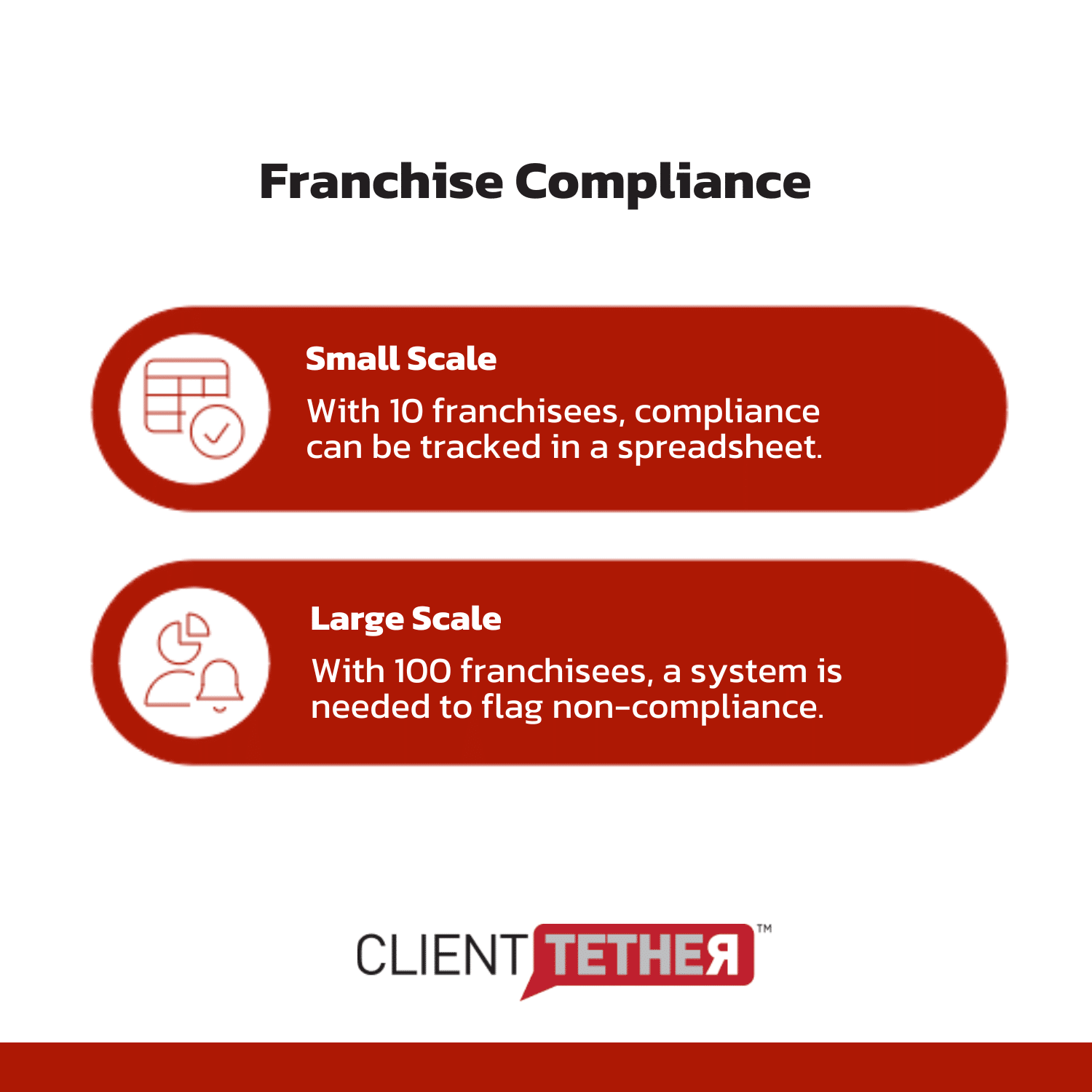
Management software is the operational backbone of the franchise network, but it’s not usually the system franchisees interact with daily. It’s built for corporate oversight, not location-level execution.
For more on how management software supports franchise growth and accountability, see How to Scale with the Right Franchise Management Software.
When Do Franchisors Outgrow Email and Spreadsheets?
Most franchisors outgrow email and spreadsheets when they need real-time visibility and enforceable follow-up across locations, because manual coordination doesn’t scale. At that point, accountability becomes inconsistent and reporting becomes unreliable.
Franchise systems are distributed execution networks. Corporate sets the strategy, franchisees execute locally. That structure only works if corporate can see what’s happening at the location level without micromanaging.
Email doesn’t provide that visibility. Spreadsheets don’t enforce follow-up. The result is lead leakage, inconsistent customer experience, and reporting gaps that make it impossible to identify which locations are struggling and why.
For more on why distributed execution creates unique challenges, see Understanding Franchise Systems: What Franchisors Should Know.
What does franchise software replace (and what it doesn’t)?
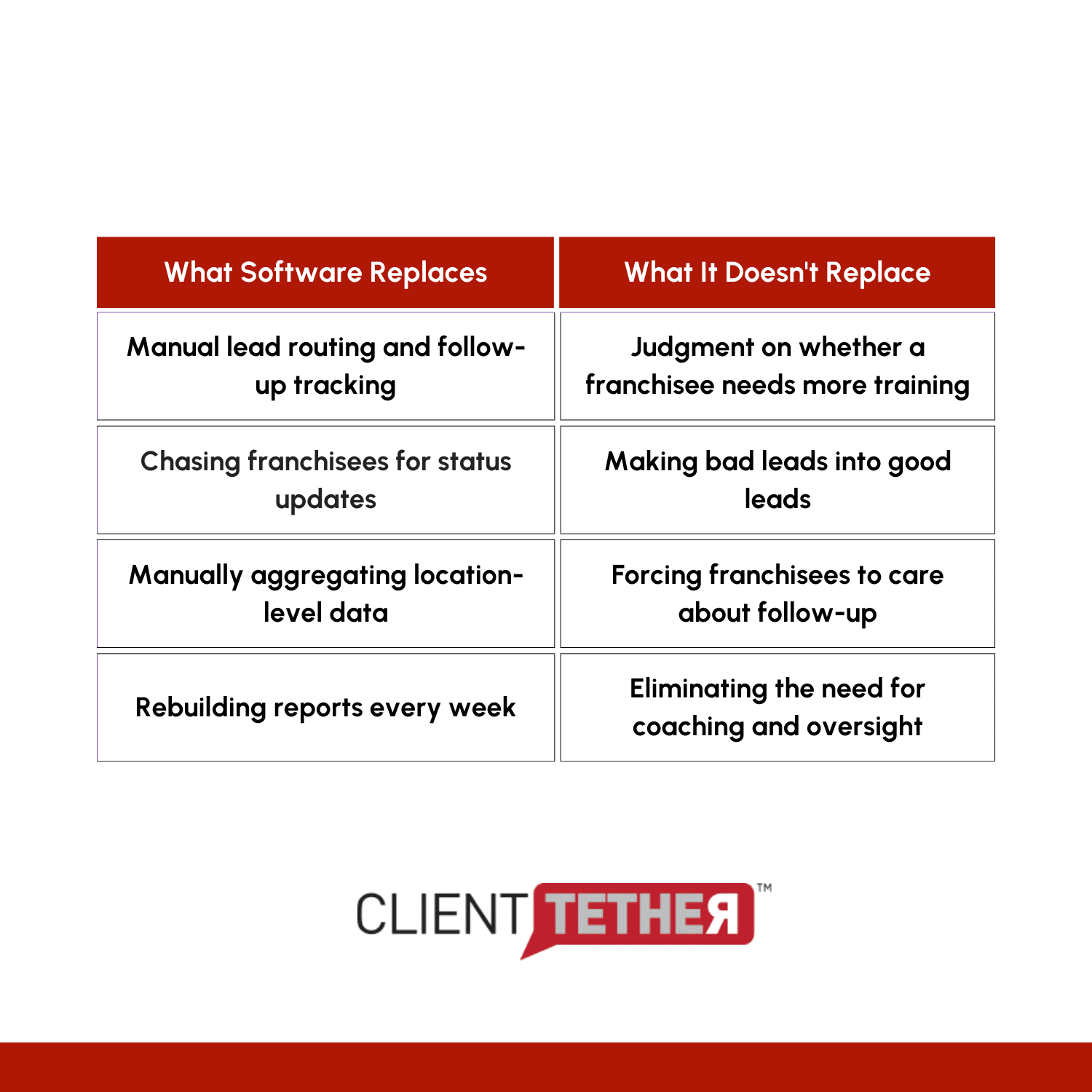
Here’s what software should take off your plate: chasing franchisees for updates, manually aggregating location-level data, rebuilding reports every week because someone’s spreadsheet didn’t sync, and wondering whether a lead got followed up or fell through the cracks.
Here’s what it won’t do: make bad leads good, force franchisees to care about follow-up if they don’t, or eliminate the need for training and oversight. Software is infrastructure. It makes execution visible and repeatable. It doesn’t make execution happen. For more on improving lead response mechanics, see How to Fix Your Lead Response Time and Close More Deals.
How to Decide What You Actually Need (Without Buying Yet)
Decide by mapping workflows and identifying friction points first — then choose the category that removes the most costly bottleneck. Start with adoption constraints before you worry about “advanced” features.
Map out your current process, broken or not. When a lead comes in, what happens next? Who gets notified? How do they log the follow-up? How does corporate know it happened? Where does that lead go if it converts? Where does it go if it doesn’t?
Once you’ve documented the current workflow, identify the friction points: manual handoffs, missing visibility, delayed reporting, inconsistent follow-up. Those friction points define your software requirements.
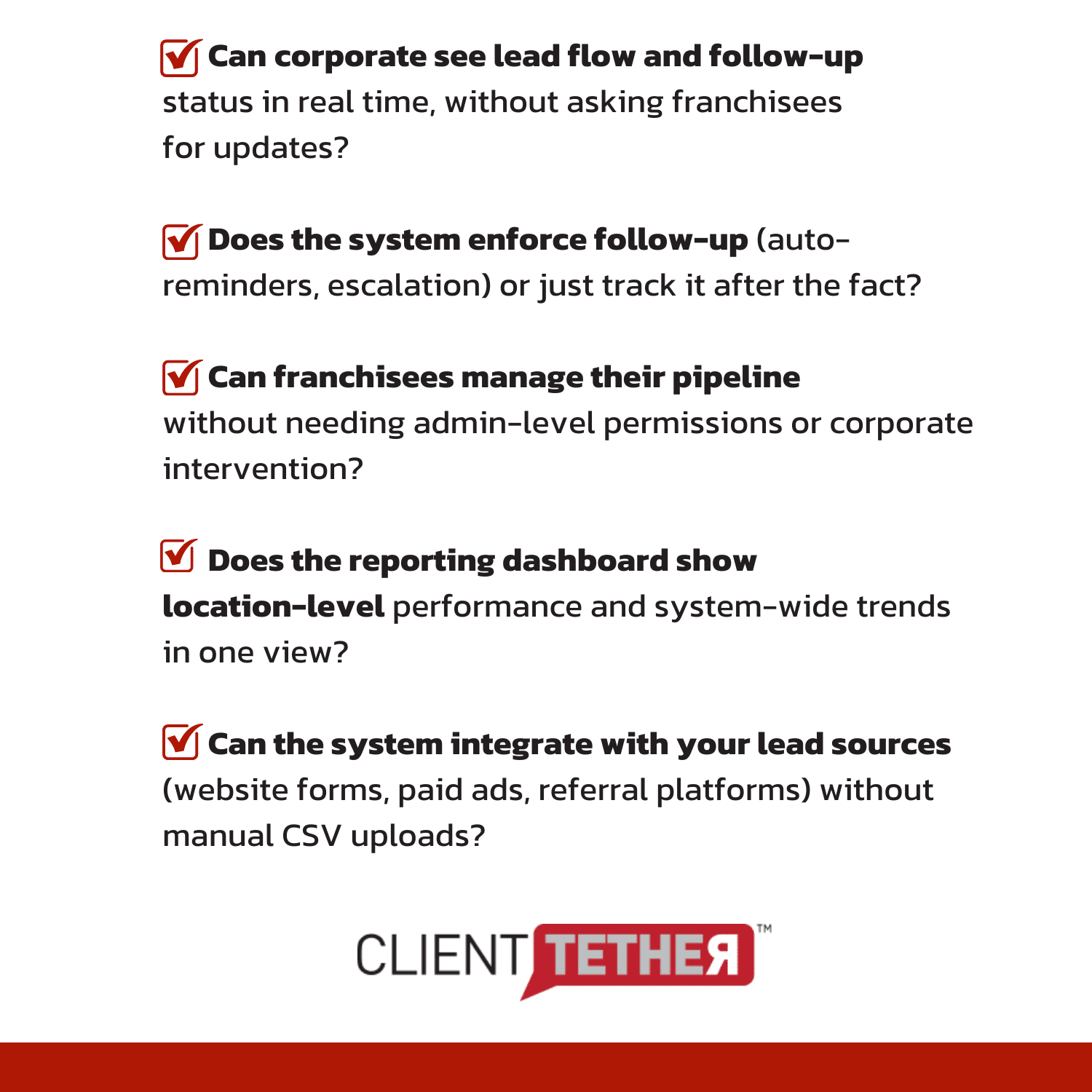
Here’s a diagnostic checklist:
Why does adoption matter more than sophistication in franchise software?
If basic tasks (like logging follow-up) are too hard, the data becomes unreliable and oversight collapses.
Ease of use isn’t a nice-to-have, it’s the implementation constraint. The best franchise software is the software your franchisees will actually open every day. That means intuitive UI, minimal training burden, and workflows that match how they already work. Sophistication comes later, once adoption is solid.
Start with the basics: lead capture, follow-up tracking, and corporate visibility. Add complexity only when the fundamentals are running smoothly.
For franchisors managing distributed lead flow and location-level accountability, ClientTether’s Franchise CRM provides the workflow automation and parent-child visibility that makes adoption simple and reporting automatic.