
Franchise marketing software promises to coordinate campaigns, manage assets, and share content across your system. But here’s the gap: most franchisors don’t lose revenue at the campaign layer. They lose it after the click.
That’s when leads hit local markets. Response is slow. Follow-up depends on franchisee discipline. And corporate has zero view into what actually converted.
Marketing automation only delivers ROI when it runs across the full lifecycle, from ad to response to follow-up to booking to revenue tracking. That’s a CRM job running inside a franchise platform, not a marketing tool job.
Franchise marketing software solves broadcast and brand control, but it doesn’t solve the revenue workflow. The real leak happens at local response, follow-up, and conversion. Slow execution, weak franchisee adoption, and split tools turn paid leads into wasted spend. So automation must connect marketing to the CRM layer that runs response, nurture, booking, and source tracking across corporate and local. Otherwise, you’re counting clicks, not closed deals.
Key Takeaways
- Franchise marketing breaks at the revenue workflow, not the campaign layer
- Marketing ROI depends on local response speed and franchisee follow-up execution
- Automation only works when it connects marketing, response, follow-up, conversion, and tracking in one system
- Franchise platforms balance corporate brand control with local freedom
- Source-to-revenue tracking shows what marketing spend actually produced by the location
Who This Is For
This article is for VPs and Directors of Marketing at multi-unit franchise brands. You coordinate corporate campaigns with local franchisee execution. You need to connect marketing dollars to booked revenue. And you need a click-to-close view across the entire system.
Where Does Franchise Marketing Actually Break?
Franchise marketing breaks after the click, when leads depend on local response, follow-up, and conversion to turn into revenue.
Franchise marketing software handles the top of the funnel well. It manages campaigns. It shares assets. It enforces brand rules. And it schedules social posts across locations.
That’s valuable. But it’s not where revenue leaks.
The leak happens after the click. A lead comes in from a corporate campaign. It routes to a local franchisee. Then one of three things happens. The franchisee doesn’t respond fast enough. Or follow-up depends on manual work and falls off after two tries. Or corporate never sees what happened next because the CRM and marketing tools don’t share data.
According to the 2025 IFA Franchisor Survey, labor limits and execution gaps remain top franchisor challenges. Marketing can produce leads all day. But if local teams can’t respond, nurture, and convert well, the spend is wasted.
This is the structural problem franchise marketing software doesn’t solve by itself. One corporate brand. Many local owners working independently. Each responsible for converting the leads that corporate campaigns produce. With compliance and brand rules on top.
Here’s why. Marketing ROI in franchising isn’t counted in impressions or clicks. It’s counted in booked revenue by location. And that requires the CRM layer running response, follow-up, and conversion. Not just the campaign layer.
What Automation Must Actually Connect
Marketing automation in a franchise system can’t stop at email sequences and content calendars. It has to connect four stages that span corporate and local work.
Marketing to Response
A lead comes in from Google Ads, Facebook, or Angi. The first revenue gate is response speed. Because if the lead waits two hours for contact, intent drops. Competitors move faster.
So automation must trigger fast response. Text, email, or call. Within seconds, not hours. And it must route right. To the franchisee who owns that territory. With brand messages. Without manual handoff.
This is where speed to lead becomes the mechanism that protects marketing spend. Systems built for this respond in 29 seconds or less. That’s not a feature. It’s the structure deciding whether paid leads convert or go cold.
Response to Follow-Up
Most leads don’t convert after one touch. In systems that automate response and follow-up, brands have reached contact rates as high as 95% of inbound leads. It takes six to nine tries to move a qualified lead forward. So the second revenue gate is follow-up discipline.
In franchise systems, follow-up depends on local operator adoption. The franchisee has to remember to text back, log the call, and schedule the next reminder manually. At scale, it doesn’t happen.
That means automation must handle the sequence. Text on day one. Email on day three. Call reminder on day five. Each step logged so corporate sees what’s moving and what’s stalled.
Take Rolling Suds. They coordinated corporate campaigns with local execution. They used automated follow-up sequences and central communication. Leads stayed warm without depending on franchisee memory. The result: higher contact rates and stronger conversion across locations.
Follow-Up to Conversion
The third gate is closing the deal. Quote sent. Appointment scheduled. Signature captured. Payment processed.
But if each step lives in a separate tool, handoffs create friction. Leads drop. CRM for contact tracking. Scheduling software for appointments. QuickBooks for invoicing.
So automation must carry the workflow from follow-up into booking, quoting, and payment. Without pushing revenue steps into split systems. This is the CRM and operations integration that franchise platforms are built to handle.
Conversion to Attribution
The fourth gate is view. Corporate needs to know: which marketing source produced revenue? Which locations convert at higher rates? Which campaigns are worth growing?
Marketing platforms show ad spend and clicks. CRMs show pipeline activity. But if they don’t share data, you can’t connect source to closed revenue.
That’s why automation must track the full chain. From campaign to lead to contact to booking to payment. So corporate sees ROI in dollars, not just leads sent.
How Do You Evaluate Whether a Platform Connects Marketing to Revenue?
You evaluate it by checking whether it connects campaign source, response, follow-up, and revenue in one system.
Not every platform that calls itself franchise marketing software connects the full workflow. Here’s what to verify.
Does It Run Marketing and CRM in One Place?
If your marketing tool and your CRM are separate systems with no shared data layer, tracking breaks. So ask: does the platform track campaign source, response activity, follow-up history, appointment scheduling, and payment status in the same place?
Here’s the test. Corporate launches a campaign. If you have to check three tools to see what happened at the local level, the platform isn’t connecting marketing to revenue. It’s managing campaigns, not workflow.
Does It Support Franchise View?
Franchise systems need corporate oversight and local freedom at the same time. Corporate sets the campaign. Local executes the follow-up. Both need a view into what’s working.
Check whether the platform supports parent-child account structure, meaning corporate can see system-wide performance while each franchisee manages their own leads and customer activity. Can corporate see system-wide pipeline performance while franchisees manage their own leads and customer activity? Or does everyone see the same flat view with no difference between Zor and Zee roles?
A platform built for franchise structure handles this natively. But a generic CRM with franchise features needs custom work.
Seeing What Your Marketing Spend Actually Produced
Tracking only matters if it connects to booked revenue, not just lead volume. So ask: can the platform show which marketing source produced closed deals by location? Can you see cost-per-deal by campaign and territory?
Take A&P Painting and Flooring, a seven-location operator. They centralized workflows with automation and integration across units. The result: view into which lead sources converted into booked jobs. Not just which sources produced the most inquiries.
Your platform should track marketing in clicks and CRM in pipeline stages. But it also needs to connect them to revenue. Otherwise, you’re counting activity, not outcomes.
Does It Handle Local Follow-Up Without Manual Work?
Franchisee adoption is the execution risk. Because if follow-up depends on the franchisee remembering to send the next text or log the call, consistency breaks down.
Look for this: does the platform automate follow-up sequences across text, email, and call reminders? Does it log every interaction on its own? Can corporate see which locations are following up and which aren’t?
Here’s what matters. Marketing produces leads. The CRM layer converts them. But only if local teams actually use the system. Platforms designed for franchising account for this. They make follow-up automatic, not optional.
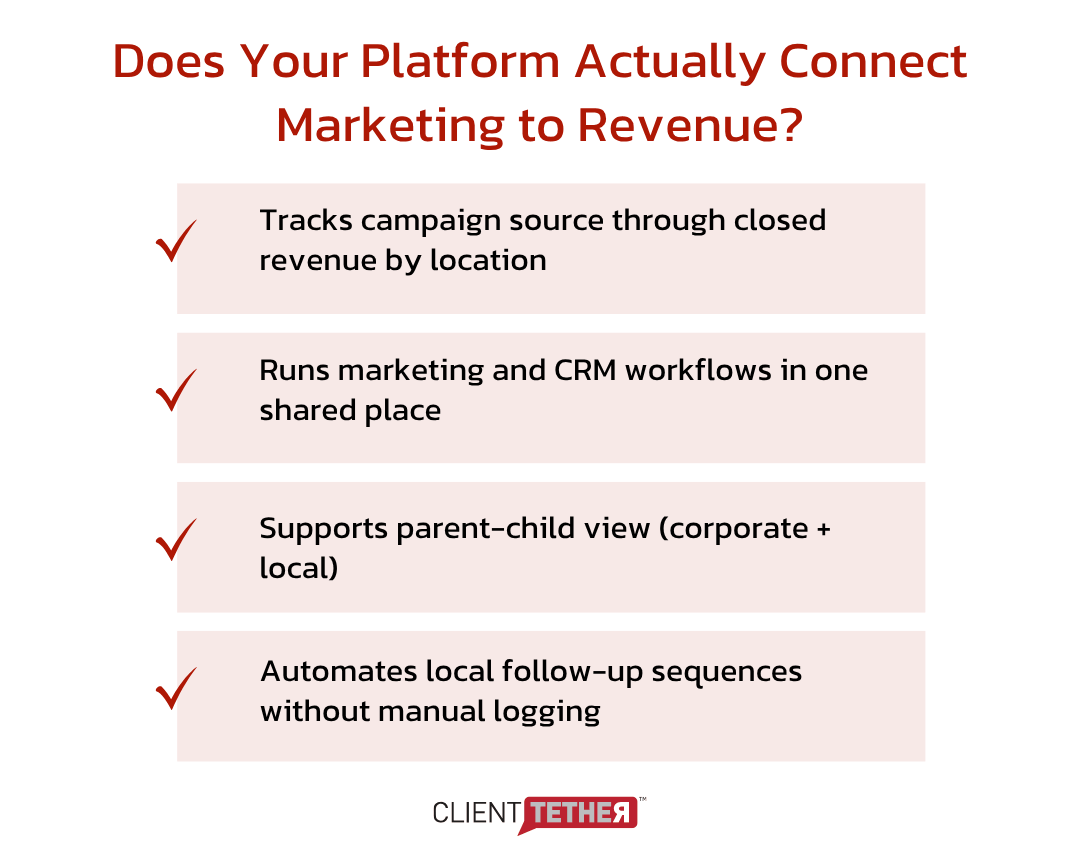
☐ Tracks campaign source through closed revenue by location
☐ Runs marketing and CRM workflows in one shared place
☐ Supports parent-child view (corporate + local)
☐ Automates local follow-up sequences without manual logging
☐ Counts marketing performance in booked deals, not just leads sent
The Real Job of Automation in Franchise Marketing
Franchise marketing software, as commonly defined, solves one part of the problem. Campaign execution. Asset sharing. Brand compliance.
That’s important. But it’s not the revenue leak.
The leak is structural. Corporate drives demand. Local converts it. And if the platform handling marketing doesn’t connect to the platform handling response, follow-up, and conversion, the gap costs you deals.
Here’s the fix. Automation only delivers ROI when it spans the full lifecycle. For franchisors managing marketing spend across independently working locations, ClientTether provides the franchise CRM and automation layer that connects corporate campaigns to local revenue. Speed-to-lead response. Automated follow-up. Source-to-close tracking. All in one system.