
A franchise CRM is designed for multi-unit complexity (hierarchical access, territory-based lead routing, and brand-consistent automation), so growth doesn’t depend on manual workarounds.
As the franchise grows, the CRM scales with it by enforcing the right controls while still giving local teams the flexibility to operate effectively in their markets.
Read the full article to see what separates a true franchise CRM from a standard CRM, and how the right system can improve speed-to-lead, adoption, and performance across every unit.
Key takeaways
- Franchise CRMs are built for hierarchy + territories, not just contacts and deals. Permissions must match the org chart: corporate, regions/area developers, franchisees, and unit staff all need different visibility. Automatic territory-based lead routing prevents revenue leakage caused by manual assignment delays.
- The Franchise CRM Maturity Framework explains how systems evolve from spreadsheets → automation → real-time ops → orchestrated intelligence.
- Lead response speed correlates with close rates (Roof Maxx network, ClientTether 2022–2024): 24 hours (5%), 1 hour (12%), 5 minutes (21%).
- “Dead” leads can be recovered when follow-up matches the lead’s preferred channel and timing. Implementation can be days for simpler setups and weeks for complex networks, especially when territory mapping and automations are handled upfront.
- Strong multi-unit trust requires hierarchical access, agreement-based data ownership, and compliance controls (RBAC, audit trails, protection).
Why don’t traditional CRMs work well for franchise systems?
Traditional CRMs struggle in franchising because they aren’t built for layered permissions, territory rules, and the need to balance brand control with local flexibility.
Corporate needs system-wide visibility. Area developers need regional data. Franchisees must see only their unit. Their employees need role-specific access.
The problem is, most generic CRMs still make you pick between security and functionality, and you shouldn’t have to.
How should a franchise CRM assign leads across territories?
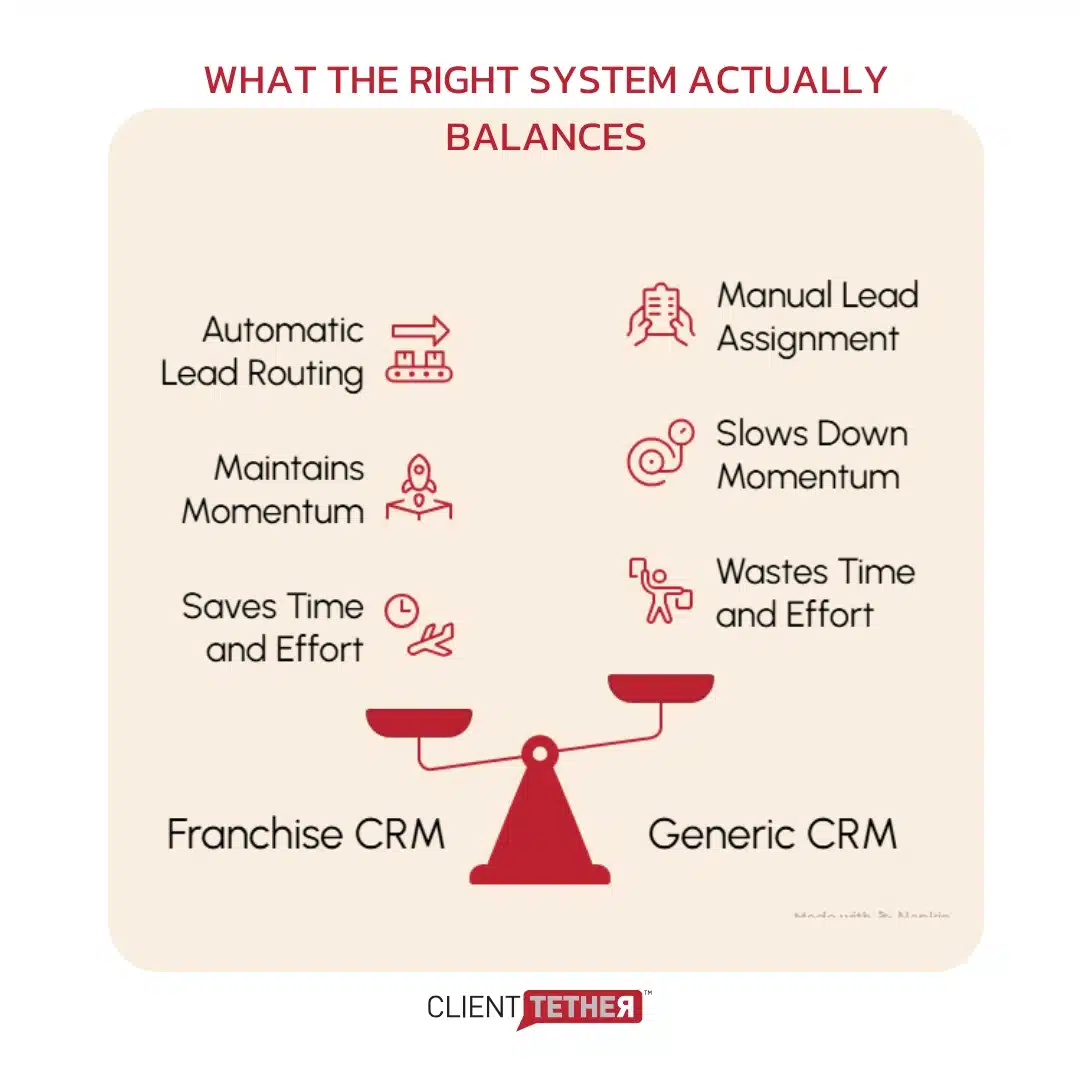
A franchise CRM should automatically route and re-route leads using your territory rules so the right unit gets the lead immediately without manual handoffs.
In a generic CRM, that’s where things start to slow down: someone jumps in to assign it manually, a few emails go back and forth, and before long, the opportunity slips away.
A franchise CRM designed for franchising handles this automatically; it follows your territory rules, keeps momentum going, and saves everyone the scramble.
How do you keep brand consistency while allowing local personalization?
You keep consistency by locking the right standards (templates, compliance elements, required steps) while allowing controlled personalization (local offers, timing, channel preferences).
Your franchisees need flexibility within structure. They must personalize messaging for local markets while maintaining brand standards.
Most generic CRMs only offer two extremes: lock everything down (and hurt adoption) or open everything up (and lose consistency). Neither setup really fits franchising.
What is the Franchise CRM Maturity Framework (and why does it matter)?
The Franchise CRM Maturity Framework is a four-level model that shows how operational systems evolve from manual coordination to orchestrated intelligence, and it predicts how scalable your growth can be.
Level 1: Manual Coordination
At this stage, most brands rely on spreadsheets and disconnected tools. Lead conversion averages between 2–5 %, with response times of 24–48 hours. Reporting happens monthly and often arrives too late to act on. Growth depends more on individual franchisees than on the system itself.
Level 2: Basic Automation
Franchises introduce shared CRMs and basic templates. Conversion rates typically climb to 10–20 %, and response times drop to 2–6 hours. Weekly dashboards offer more visibility, but manual follow-ups and bottlenecks can still slow things down.
Level 3: Data-Driven Operations
Automation becomes smarter and more consistent. Conversion rates rise significantly as teams respond in under an hour and track performance in real time. Growth becomes scalable and predictable because decisions are based on live data, not memory or instinct.
Level 4: Orchestrated Intelligence
This is where the most advanced systems operate. Tools like CT Concierge combine smart automation with human expertise. Brands like Painter One achieve conversion rates between 65–80 %, responding to leads in under five minutes and gaining predictive insight into their entire pipeline. Growth becomes far more dependent on market demand than on operational bottlenecks.
Most franchises still operate between Levels 1 and 2, which means the biggest wins often come from mastering the basics.
What does “conversion improvement” mean in practical terms?
It means the same lead volume produces materially more closed deals because response times drop and follow-up becomes consistent across every unit.
ClientTether’s 2022–2024 data from the Roof Maxx network show the impact clearly:
- 24-hour response: 5% close rate
- 1-hour response: 12% close rate
- 5-minute response: 21% close rate
How do you recover leads that look “dead”?
Many “dead” leads re-engage when you contact them on their preferred channel with relevant messaging at the right time, so the system should automate channel-aware follow-up.
CT Concierge is ClientTether’s AI-assisted qualification layer, built into the platform. It handles that qualification automatically, so franchisees spend their time on real, high-intent conversations instead of chasing cold contacts.
How long does it take to implement a franchise CRM?
Most implementations can go live in days for simpler setups and a few weeks for complex, multi-brand networks, because migration, territory mapping, and core automations are done upfront.
What happens during franchise CRM foundation and setup?
Foundation is where data is migrated, territories are mapped to agreements, and the core automations are built so lead handling and follow-up work correctly from day one.
As Jack Day from Meals of Hope put it, “We were able to get up and running in a matter of days, not weeks or months.”
What should be customized vs. standardized in a franchise CRM?
Standardize the playbook and required steps, then customize workflows only where territory rules, multi-state operations, or brand structures demand it.
Every franchise grows differently. Some, like Meals of Hope, launch quickly with standard configurations. Others require more advanced workflows, multi-state setups, or complex territory rules. Our full-featured and customizable platform adapts to your structure, not the other way around.
How do you roll out a franchise CRM without losing adoption?
Start with a pilot, roll out gradually, and enable advanced features only when teams are ready, so usage stays consistent instead of spiking and dropping.
Most franchisors are surprised by how quickly the setup wraps up. Simpler systems go live in just a few days, while multi-brand networks might take a few weeks. Either way, you’re in control of the pace and can see progress from day one.
What security and control features must a franchise CRM include?
- Hierarchical Access: Each level sees exactly what they need, no more, no less. Corporate gets full visibility with drill-down capability. Franchisees see their world clearly.
- Data ownership follows your franchise agreements: The system enforces your policies through role-based access and clear boundaries, ensuring every user operates within defined permissions.
- Compliance Architecture: Built to support enterprise best practices, including role-based access, audit trails, and data protection across franchise networks.
How does a franchise CRM turn software into scalable growth?
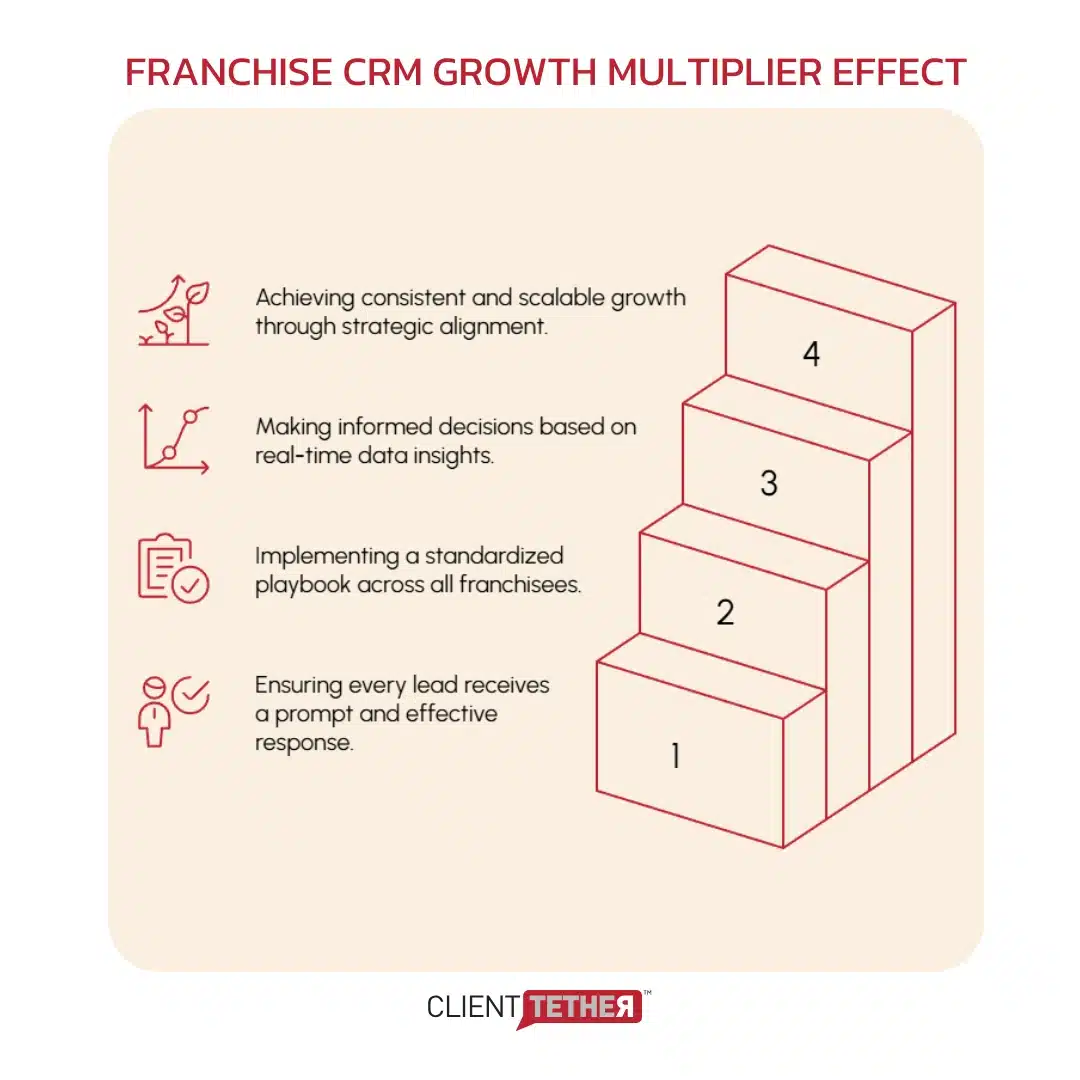
By ensuring every lead gets a timely response, every unit follows a proven playbook, and leadership decisions come from live data, so growth becomes predictable.
The best technology makes it easier for great operators to focus on what matters most, building relationships and growing their business.
In franchising, consistency is what scales.
If you’re evaluating what the right franchise CRM structure should look like for your brand, explore how a purpose-built franchise CRM supports multi-unit growth.