
Your franchise CRM shows cost per lead by channel. But here’s what it doesn’t show: which channels produced closed revenue, which locations converted those leads, and which sources send contacts who never book.
You’re spending on clicks. You need to track conversions.
This article explains why franchise marketing attribution breaks at scale—and what a franchise CRM does differently.
Franchise marketing attribution fails when lead source tracking stops at CRM entry and never connects to closed revenue. Here’s what changes:
- Performance varies significantly by location. Google Ads converts at 60% for one franchisee and 15% for another. And aggregate reporting hides that gap.
- Generic CRMs lose the revenue connection. Ad platforms track clicks. CRMs track contacts. Payment systems track revenue. Yet these three rarely talk.
- Slow follow-up distorts attribution. So poor source ROI often means poor response time—not poor lead quality.
Who This Is For
- VP/Director of Marketing managing paid demand across multi-location franchise systems
- Franchisor/CEO who suspects marketing budget waste but can’t connect spend to outcomes
This article is NOT for: Single-location businesses, e-commerce marketers, brands not running paid lead generation
Top use cases: Track which paid channels produce closed revenue vs. dead leads. Also identify location-level performance gaps. And connect budget decisions to revenue outcomes instead of click data.
Why Is Franchise Marketing Attribution Harder Than It Looks?
Franchise marketing attribution is harder than it looks because results differ across franchisees, and most systems cannot connect source performance to actual revenue outcomes.
A franchise marketing director running Google Ads across 30 territories needs to know which leads closed, which locations converted them, and what revenue each source produced.
That’s where most CRMs break.
Here’s why.
The same lead source performs differently across locations
Google Ads might convert at 60% for one franchisee and 15% for another. Yet aggregate reporting shows one blended number. So that number hides the gap. And you cut the budget from a channel that’s working in 20 locations because it’s failing in 10.
Ad platform performance ends at the click, while revenue lives somewhere else.
Google Ads shows cost per lead, your CRM captures the contact in the pipeline, and your payment system records the closed deal, but these systems rarely connect.
That’s the gap most systems leave open, and what platforms like ClientTether are designed to connect.
So you’re left optimizing for clicks without knowing which ones actually turned into revenue.
Franchisee follow-up speed varies—and that distorts your source data
Some franchisees respond in minutes. Others in hours or days.
Research from Kellogg School of Management shows that smaller operators often delay adopting profitable opportunities.
Execution barriers stop them—even when the ROI is clear. So when response time is inconsistent, you might cut budget from a channel that’s actually working—because the problem wasn’t lead quality. It was a follow-up.
Take Preston K., Owner of All Hours Plumbing, Drain Cleaning, Heating & Air. His booking rate went from 21% to 46% within one month. The leads didn’t change. The response speed did. Meanwhile, a home cleaning franchise deployed automated lead engagement across nearly 90 locations and saw conversion rates increase 278% within 90 days.
The pattern here: franchise attribution breaks when the CRM can’t connect source to outcome across multiple locations with different execution speeds.
What Does Lead Source Tracking in a Franchise CRM Actually Look Like?
Lead source tracking in a franchise CRM means capturing source data at entry and keeping it connected to the contact through every pipeline stage, all the way to closed revenue.
A franchise CRM that handles attribution correctly attaches source data to the contact record at entry, keeps it attached through every pipeline stage, and connects it to revenue at close.
This is how it works in practice: A prospect clicks a Google Ads link with UTM parameters. Then the prospect fills out a form. The CRM captures those UTM tags and writes them to the contact record. The contact moves through pipeline stages—contacted, quoted, booked, closed. And the source field stays attached. So when the deal closes, revenue connects back to the originating source.
Here’s the franchise-specific layer: the same UTM data is visible at two levels—across franchise development (FranDev) candidate sources and unit-level customer lead sources. System-level reporting shows total network performance by source. Location-level reporting shows this franchisee’s Google Ads leads vs. Angi leads vs. organic.
The four-stage attribution chain:
- Lead origin: Source, campaign, medium captured at entry
- Pipeline progression: Which stage, how long, what actions moved it forward
- Conversion outcome: Did it book, quote, close, or drop
- Revenue connection: What did the closed deal produce, which source produced it
Generic CRMs capture stages 1 and 2. But they lose the revenue connection because payments live in a separate system.
A franchise CRM with integrated quote-to-payment closes that gap. The proposal, signature, and payment record stay attached to the contact and source field. So QuickBooks integration closes the loop for finance teams who need system-level revenue-by-source data.
Location-Level vs. System-Level Attribution Reports
A franchise marketing director needs two views.
System-level: Which sources drive the most closed revenue across the whole network? This answers budget allocation questions.
Location-level: Which sources convert at each franchisee? This answers performance coaching questions. Like: why does location 12 convert Google Ads at 60% while location 18 converts at 15%?
Role-based dashboards enable this. The franchisor sees system-level. The FBC sees their territory. And the franchisee sees their location.
Here’s what matters: the same source performing differently across locations is only visible when location-level reporting exists. A generic CRM gives you one aggregate number.
For campaign execution, see How to Generate Leads for Franchise Development Using Google Ads.
The Response Time Problem—How Follow-Up Speed Distorts Your Attribution Data
When a lead enters the pipeline and doesn’t get contacted within the first few minutes, conversion probability drops sharply.
Why Response Time Matters More Than Lead Quality
In multi-location franchises, that lag happens inconsistently. Some franchisees respond in minutes. Others in hours or days.
Wharton research on workplace behavior shows that team adoption patterns and execution discipline vary significantly across distributed workforces—and franchise systems face this challenge at scale. So source attribution then shows different conversion rates for the same lead source.
Here’s the result: a marketing director cuts budget from channels that actually work—because the problem wasn’t the channel. It was the response.
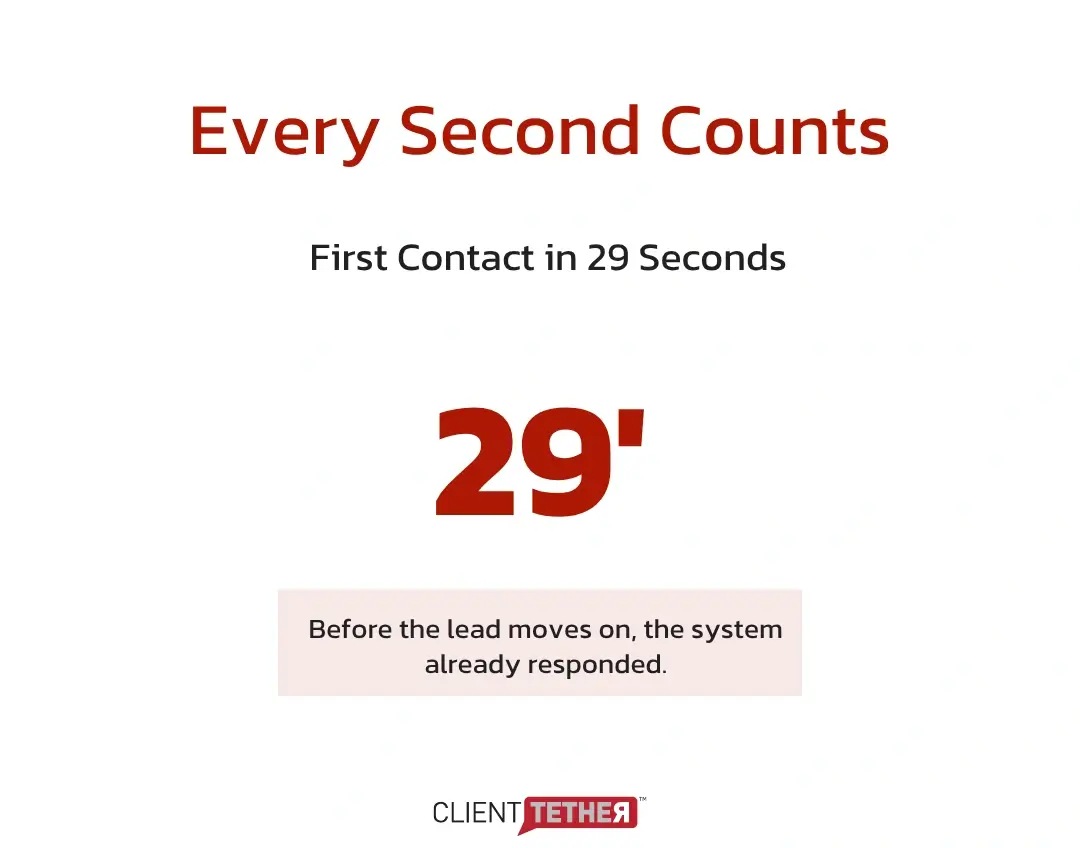
Action Plans resolve this. Automated triggers fire within 29 seconds of lead entry, regardless of which franchisee owns the territory. So the response becomes consistent. And attribution data becomes comparable.
How ClientTether Connects Lead Source to Revenue Across the Franchise System
Most platforms claim to track attribution, but very few connect it all the way to revenue. When evaluating a franchise CRM, ask:
☐ Does UTM and lead source tracking attach automatically to the contact record at entry?
☐ Can you view source performance at the location level?
☐ Does the attribution chain connect to revenue outcomes?
☐ Is the platform licensed by location so adding franchisees to reporting doesn’t add per-seat cost?
☐ Does the platform include native communication (SMS, email, call) so response activity is logged alongside source data?
Here’s how ClientTether handles it
UTM and lead source capture happens automatically. Pipeline dashboards show source performance at system level and location level. And role-based reporting gives franchise leadership, FBCs, and franchisees the views they need.
Action Plans enforce response speed within 29 seconds of lead entry. QuickBooks integration closes the revenue attribution loop. And the platform tracks leads from Google Ads, Angi, Thumbtack, and other sources without separate integrations.
What this lets a marketing director do: make budget decisions based on which channels produce revenue, not which produce the most clicks.
Start Tracking What Actually Converts
When lead source tracking connects every step, from first click to closed deal, across every location, you stop relying on fragmented insights and start seeing which locations convert, how quickly they respond, and which leads turn into revenue. Not just where leads come from, but what happens next, who follows up, how fast they engage, and which interactions lead to booked jobs and closed deals.
For franchise brands operating at scale, that level of visibility helps identify performance gaps between locations, improve follow-up consistency, and make budget decisions based on conversion and revenue data, not just clicks or lead volume. Without it, follow-up breaks down, execution varies by location, and revenue is lost due to disconnected systems and delayed responses.
The goal is to understand which actions, like response time, follow-up consistency, and quoting speed, drive revenue and optimize those across the system. That’s what ClientTether is built to do: connect the original lead source to follow-up activity, conversion, and final payment in one franchise-native platform.