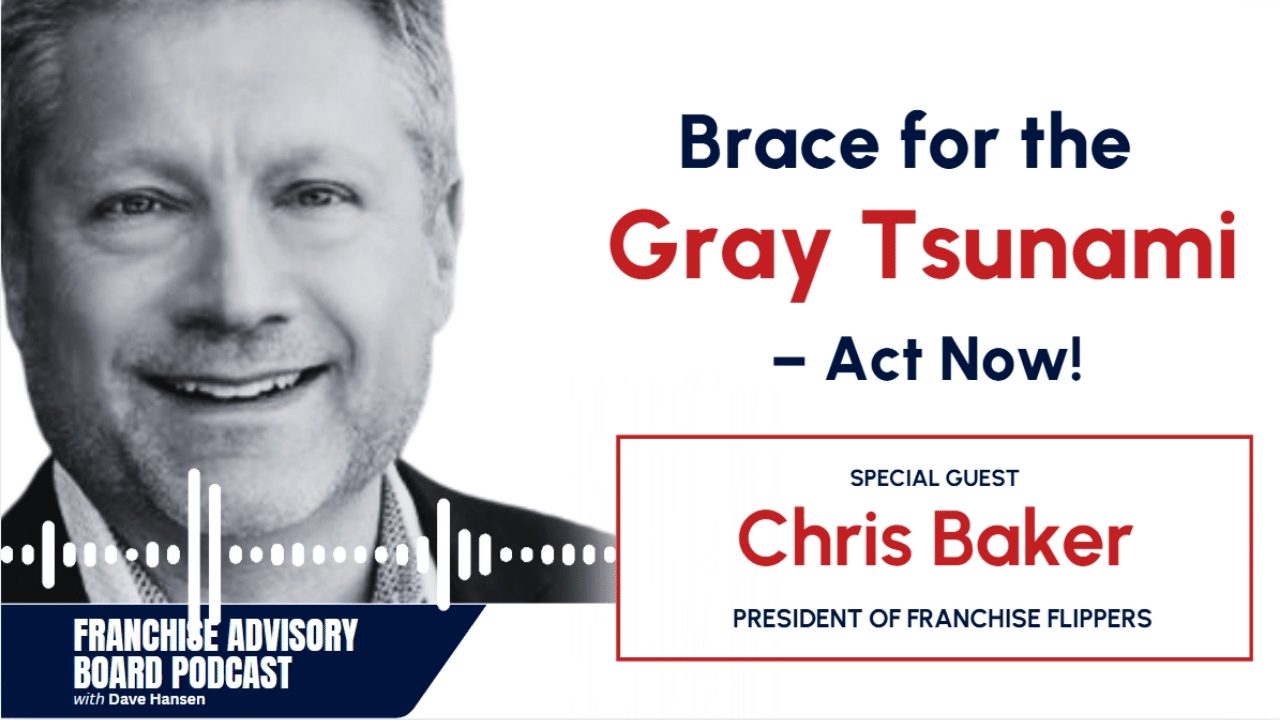
On The Franchise Advisory Board Podcast, I had the chance to sit down with my friend Chris Baker, President of Franchise Flippers, for a conversation I think more franchisors need to have right now.
This one matters because it is not just about franchise growth. It is about franchise continuity.
A lot of brands are still focused almost entirely on opening new units, improving AUV, and pushing top-line development. All of that matters. But if you are not paying attention to what happens when long-time franchisees are ready to step away, you are leaving a major part of your brand’s future to chance.
That is what Chris and I unpacked in this episode. We talked about the coming wave of boomer retirements, why franchise transfers are becoming a much bigger issue than many brands realize, and what smart franchisors can do now to avoid getting caught flat-footed later.
Meet Chris Baker
Chris is one of the people I trust most on this topic because he is in it every single day. Through Franchise Flippers, he and his team work with hundreds of brands and franchisees on one of the most overlooked parts of franchising: resales and transfers. Franchise Flippers positions itself as a resale-focused marketplace and advisory resource for franchise buyers and sellers.
As I said in the episode, Chris is “building the world’s largest resale network or platform for franchise resells.”
That is exactly why I wanted him on the show. He brings a grounded, practical view of a problem that a lot of brands know is coming, but still have not built a process for.
The gray tsunami is real, and it is going to touch almost every mature franchise system
“62% is the latest survey of 830-something thousand franchise units across the country. 62% are being run by boomers.” — Chris Baker
That number is the place to start, because it changes the whole conversation. This is not a niche issue. It is not a future problem for somebody else. If a majority of franchise units are being run by boomers, then franchisors need to assume a meaningful percentage of their system will face ownership transition pressure in the coming years.
That does not always mean failure. In many cases, it simply means life stage. People are tired. Health changes. Priorities shift. Some owners are ready to enjoy the back half of the American dream. But whether they want to exit or need to exit, the outcome is still the same: if the brand does not have a path for transition, the system absorbs the friction.
Franchisees will eventually leave. The question is whether the brand helps them do it well
“Outcomes are inevitable.” — Chris Baker
One of the smartest things Chris said in this conversation is that every franchisee is going to leave eventually. The only real question is how.
Some people are going to want to sell. Others are going to need to sell. If a brand waits until someone is under pressure, out of cash, facing a lease renewal, or bumping up against the end of a franchise agreement, the odds of a clean transition go down fast.
The better path is to normalize transition planning early. Mature franchise systems need to stop treating exits like an uncomfortable exception and start treating them like a natural part of the business lifecycle. When brands do that, they protect the unit, the territory, the customer base, and the dignity of the franchisee at the same time.
Waiting too long to sell is one of the costliest mistakes franchisees make
“The reality is it takes six to nine months on average to get a franchise business sold.” — Chris Baker
This is where timing becomes everything.
Too many owners do not think seriously about an exit until they are already in a tough spot. By then, they are hoping for a fast answer to something that rarely moves fast. Buyers need time. Financing takes time. Due diligence takes time. Brand approvals take time. A realistic process is measured in months, not weeks.
That is why Chris kept coming back to planning ahead. Even a year out is not too early. In fact, for some franchisees, that is when the best work starts: getting clear on valuation, identifying gaps between current performance and exit goals, and making operational improvements that can increase the eventual sale price.
The strongest brands do not bury their heads in the sand. They build transfer programs
“The smartest brands are engaging with us… to be able to share with their franchisees all of the options for moving on when the time is right.” — Chris Baker
This is the real dividing line for franchisors.
Some brands are still hoping the problem solves itself. Others are proactively building education, support, and processes around resales. Those are the brands that are going to preserve continuity and reduce friction over the next several years.
Chris talked about the best systems bringing resale education into conferences, webinars, and franchisee communication. Some are helping offset costs. Some are creating better pathways for transfer conversations. The common thread is simple: they are not pretending this issue is going away.
That is the posture I think more brands need. If you know you have aging operators, underperforming units, or franchisees who are likely nearing a third renewal decision, this is the time to build the process, not later.
A good exit strategy protects the franchisee, the buyer, and the brand
“The greatest brands are there alongside the selling franchisee all the way.” — Chris Baker
I really liked this part of the conversation because it moves the issue from theory to responsibility.
A resale is not just a transaction. It is a brand moment. If the franchisor disappears during that process, the seller feels abandoned, the buyer feels unsupported, and the deal becomes harder than it needs to be. But when the brand is present, helping educate the buyer, supporting discovery, clarifying expectations, and making the transfer smoother, everybody wins.
Chris also made a point that deserves more attention: some of the best resale buyers are already in the system. Existing operators know the model, understand the playbook, and can often unlock performance in territories that have gone flat under the wrong owner. That is a win for the seller, a win for the buyer, and a win for the brand’s long-term economics.
Brands need to let people leave with dignity and grace
“We want to bless and release you.” — Chris Baker
That line stuck with me.
Franchisees who are ready to move on do not need shame. They do not need to feel like a problem. They need options, clarity, and respect. Some of them have spent years building their business. Even if the outcome is not perfect, they still deserve a process that honors the work they put in.
That is one of the biggest mindset shifts from this conversation. A well-run transition is not a sign of weakness in the system. It is a sign of maturity. Great brands want happy, successful franchisees all the way through the finish line, including the day it is time for them to move on.
Wrap Up thoughts
What I appreciated most about this conversation is that Chris did not speak about resale strategy like some side issue sitting off to the edge of franchise development. He talked about it like what it really is: a core part of brand health.
And I agree with him.
If you are a franchisor, you cannot just think about who is coming in. You also have to think about who is nearing the point of transition, and whether your brand has built a path that protects everyone involved.
That is especially true for mature systems. When a market is tied up by a disengaged or aging operator who is no longer growing, the cost is higher than one unit. It affects territory potential, customer experience, valuation, validation, and momentum across the brand.
That is why I think this topic deserves a lot more attention than it gets.
Listen & Watch the Full Conversation
Watch the full episode on YouTube
Check out the Podcast hub Channel
Connect with Chris Baker and Franchise Flippers