If you’ve been in franchising for any amount of time, you already know this truth: brands are built on conversations. And as much as our industry embraces automation, AI, and digital tools, the companies winning today are the ones that understand a simple, enduring principle — people still want to talk to people.
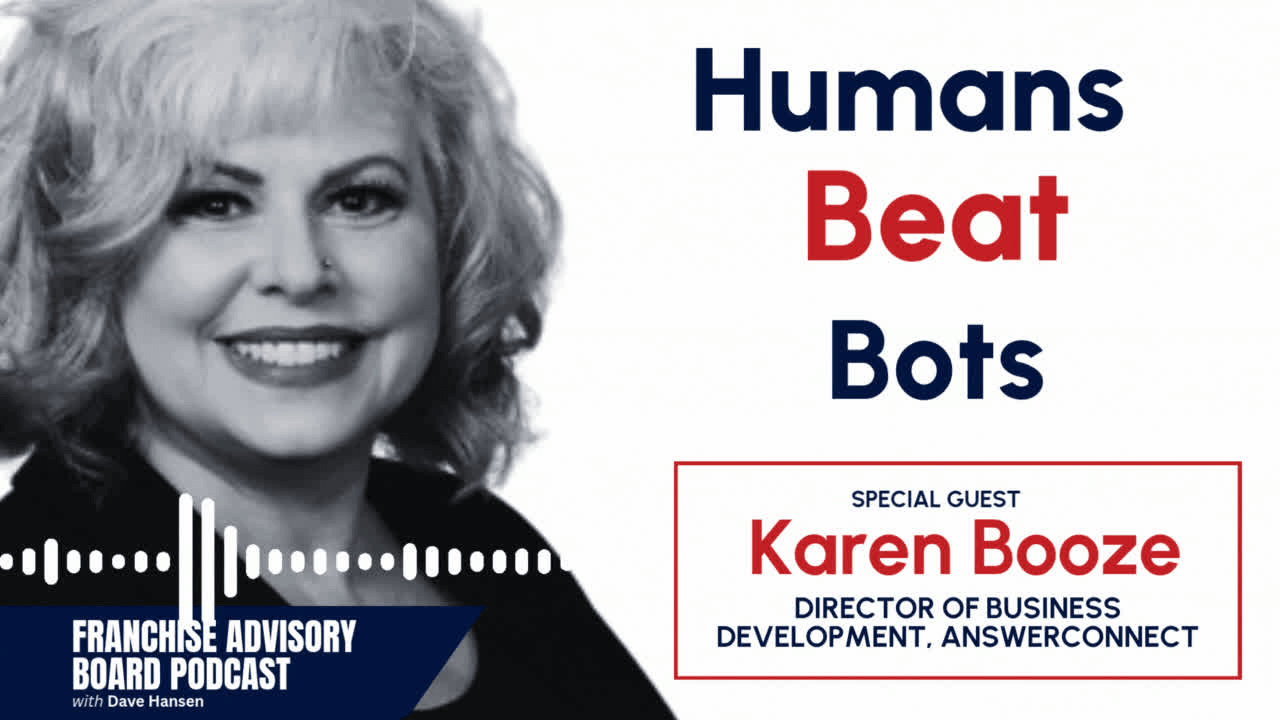
In this episode of The Advisory Board Podcast, I sit down with someone who has devoted her entire career to defending and elevating that human connection: Karen Booze, Director of Business Growth & Partnerships at AnswerConnect and AnswerForce.
Meet Karen Booze
Before we dive into the lessons, you need to know who Karen is — because her background makes her perspective impossible to ignore.
Karen has spent 30 years in the answering service and customer experience industry, and eight years focusing specifically on franchising. She helps lead AnswerConnect and AnswerForce across the U.S., Canada, and the U.K., overseeing teams that handle 73,000+ calls every single day — with human beings, not bots.
But her story goes far beyond job titles:
- She’s a classically trained musician
- She played on the White House lawn with the Beach Boys in 1984
- Her grandfather performed in the Glenn Miller Band
- She was in high school band with Kurt Cobain
- She’s had blue hair for 25 years, making her one of the easiest people to spot at any franchise conference
- She’s a wife of 35 years, a mom of two, and attends 30–45 events a year
And she believes something foundational:
“We are a global company that is human-powered because we believe humans are precious.”
AI Isn’t the Problem — Misusing It Is
AI is powerful. AI is valuable. But AI is not a replacement for relationships.
When companies use AI to eliminate human interaction — especially in franchise development, home services, or any brand built on trust — they create friction instead of efficiency.
Karen calls this out clearly:
“When was the last time you had a relationship with a bot?”
Exactly. AI should support humans, not replace them.
Younger Generations Aren’t Avoiding Phone Calls — They’re Avoiding Bad Experiences
There’s a myth that Gen Z and Millennials don’t want to talk on the phone.
Not true.
They’ll text when they can. They’ll Google when it’s easy. But when they need something resolved — they call.
And when that call leads to a bot that can’t understand them? They leave. Karen shares the story of her son moving $10,000 in investments because he couldn’t get past an automated phone system.
This isn’t generational. It’s experiential.
Not Listing a Phone Number Is Quietly Killing Revenue
If someone wants something quickly, they call. If they want something eventually, they text. If they’re indifferent, they submit forms.
And yet — around 50% of franchise brands don’t list a phone number on their website.
Franchise Update Media’s secret shopping confirmed it. Businesses are literally hiding the fastest path to revenue.
If your minimum investment is $50K, losing even a single investor because they couldn’t reach you isn’t a small error — it’s a business failure.
Missed Calls Are the Most Expensive Mistakes in Franchising
Karen shared a painful but truthful example: she called four franchise locations who used her answering service — and not one returned the call. One location didn’t even have their line forwarded properly.
One of those franchises lost a $25,000 furnace replacement job because no one called her back.
This is happening every day across franchise systems. Lost calls = lost trust = lost revenue.
Phone Scripts Aren’t Limiting — They’re Liberating
A script isn’t about sounding robotic. It’s about ensuring:
- A consistent customer experience
- Accurate information gathering
- Empathy that isn’t left to chance
- A clear direction for every call
- A higher likelihood of conversion
Harvard Business Review even found that scripted agents capture more data and deliver better outcomes than unscripted ones.
A script doesn’t restrict authenticity — it protects it.
Speed-to-Lead Isn’t a Best Practice — It’s Survival
Data tells us that if you haven’t reached a lead within five minutes, your chances of connecting drop by 90%.
Most franchisees don’t have the infrastructure, bandwidth, or discipline to hit that window consistently — and that’s exactly why so many leads silently die.
That’s also why rollover answering services, automated routing, and integrated systems like ClientTether are indispensable.
After-Hours Calls Are the New Prime Time
When do most people shop for home services?
Not during lunch. Not while juggling meetings. Not between carpools.
After 5:00 p.m.
That’s when they’re home, calm, and ready to make decisions. For many industries, the highest-intent leads come in during these hours — and failing to answer them is the equivalent of closing your doors during your busiest time of day.
AI Should Follow Humans, Not Replace Them
AI is incredibly useful when:
- Delivering basic information
- Routing requests
- Eliminating repetitive tasks
- Supporting human agents with data
But AI breaks down in emotional, urgent, or relational contexts — which describes most franchise service calls.
Karen puts it clearly:
“AI should be used by the human to support the human. It should not replace the human.”
And she’s right. Franchise brands built on trust cannot afford to automate the very moments where trust is earned.
Wrap-Up Thoughts
At the end of the day, franchises don’t rise or fall because of software, branding, or even strategy alone. They rise or fall because of how well they connect with the humans they serve. And that connection almost always starts with a conversation — a real one.
What Karen reminds us is something we’ve all felt but sometimes forget: business is personal. People remember how you made them feel. They remember who picked up the phone. They remember who helped them on their worst day, or their busiest day, or the day they were ready to buy and simply needed someone to say, “I’ve got you.”
Technology is evolving faster than ever, but the fundamentals haven’t changed. Trust still wins. Responsiveness still wins. Humanity still wins.
And if we can keep those principles at the center of how we build, scale, and support our franchise brands, we won’t just grow — we’ll thrive.