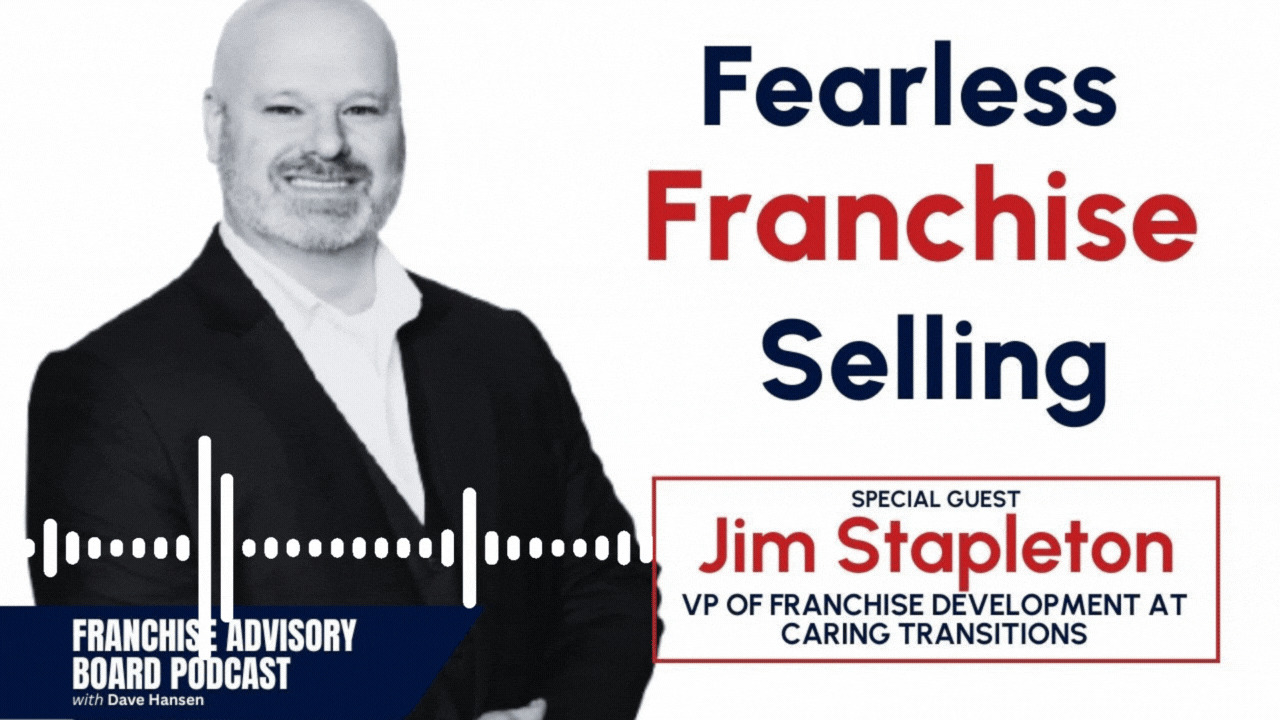
Some conversations feel less like interviews and more like a masterclass you wish your younger self had. My time with Jim Stapleton was exactly that. He’s helped double Caring Transitions, teaches with empathy, and puts clear language around the moment candidates stand at the end of the diving board: everything they want is in the pool—yet fear still freezes the jump.
Meet James Stapleton
You’ve likely seen James (“Jim”) Stapleton at franchise conferences. He’s spent 30 years in sales, six in franchise development, and brings a performer’s clarity to buyer psychology (eight years of musical theater doesn’t hurt). What I admire most is his ability to turn big ideas into usable behaviors for teams: anticipate objections, validate fear, and keep candidates emotionally connected to their “why.”
Fear is primal—love is powerful
“We buy on emotion and keep because of logic… fear and love are the two most primal emotions driving every decision we make.”
People buy on emotion and justify with logic. Fear is baked into the decision process, but love—the “why” behind ownership—can be just as catalytic when we connect candidates back to what matters to them.
The high-dive moment
“Everything they want is in the pool. I can’t push them in—but I can turn the light on and show it’s just a pile of laundry, not a monster.”
As candidates progress (intro call → education → FDD → meet-the-team), they inch toward the end of the board. The longer they stare down, the louder fear gets. Our job isn’t to push—it’s to turn on the light, show there’s no “monster,” and remind them that support (lifeguards) is ready when they jump.
Feed the dream, starve the fear
“If the dream is the focus, fear goes down. We have to feed into that dream—paint it until they can see it clearly.”
Make ownership tangible. Paint the day-in-the-life and layer clarity like a Bob Ross canvas—from vague colors to “happy trees.” As the picture sharpens, fear drops and excitement rises.
Objection handling is a tennis match
“It’s like tennis. You can’t just keep the ball in the air on your side—you’ve got to serve it back.”
Don’t juggle objections on your side of the net—serve them back. Anticipate the top 3–5 roadblocks in your flow, validate concerns, and prevent analysis paralysis by focusing on action and the candidate’s X-factor: their effort.
The red zone is where fear shows up
“We’re great at getting to ‘meet the team’—then we stall in the red zone. Momentum disappears right when it should accelerate.”
Most teams are great at moving the chains but stall inside the 20. Pre-wire confidence early so the last yards aren’t a scramble. Think “window shopping → trying it on → card in hand”; keep candidates in their heart (why) while you feed their head (how).
Wrap Up Thoughts
Jim sharpened a principle I’ll keep front-and-center: keep people in their hearts while you feed their heads. Practically, that means I’ll name fear without shaming it, address common objections earlier, and paint ownership in rich, specific detail—not bullet points.
Listen & Watch the Full Conversation
Watch the full episode on YouTube
Check out the podcast hub channel:
Connect with James (“Jim”) Stapleton and Caring Transitions