Franchising has a way of hiding its biggest constraint in plain sight.
You can have a strong concept, a healthy unit model, and a growth plan that looks great on paper—and still feel the system strain as you scale. Most of the time, it’s not because franchisees “aren’t executing.”
It’s because the relationship starts drifting toward something transactional: less partnership, more policy. Less “we,” more “me.”
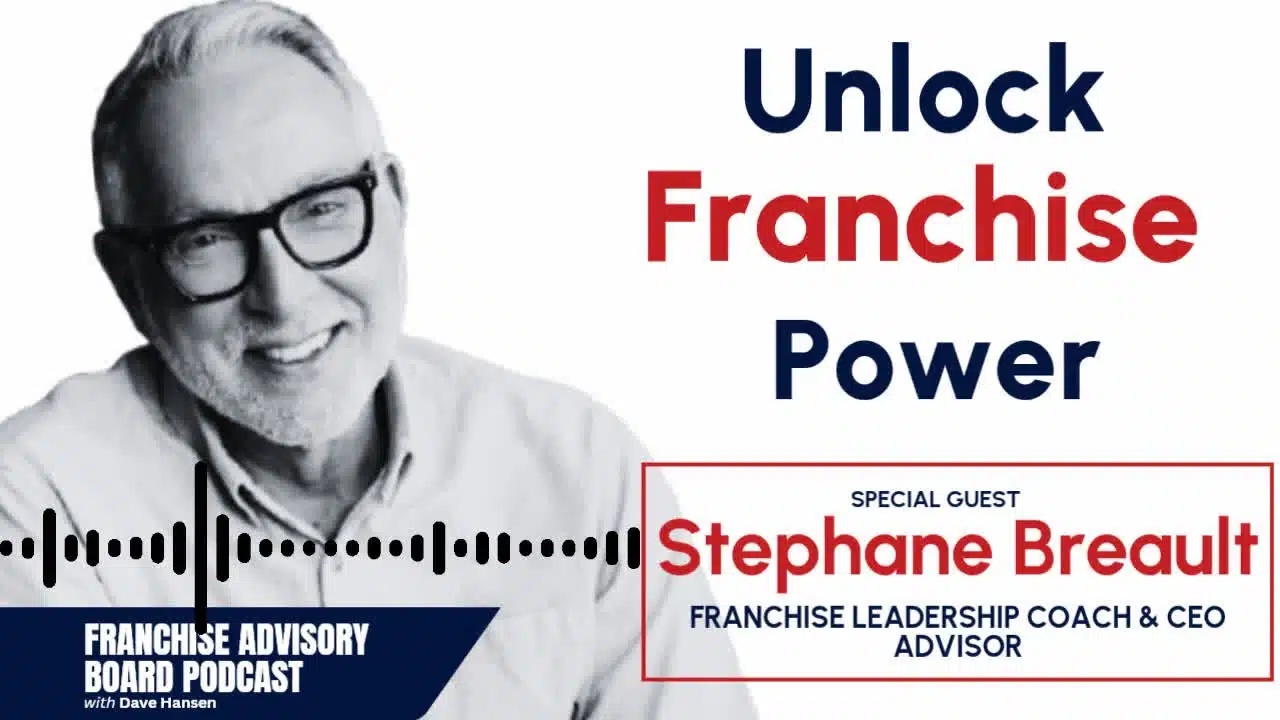
That’s why I sat down with Stephane Breault—a longtime leader in the Canadian franchising space and founder of Imagine Franchise Consulting—to talk about something that gets mentioned a lot but rarely built with discipline:
Leadership is a franchise growth strategy.
Stephane’s premise is direct and uncomfortable (in the best way):
“The franchisor is 100% responsible for the results he gets.”
If you internalize that one idea, it changes how you communicate, how you coach, how you hire, how you handle misalignment, and how you earn trust over time.
Meet Stephane Breault
If you’ve spent time in Canadian franchising, there’s a good chance you’ve heard Stephane’s name. He’s been in franchising since 1985, served in senior leadership and CEO roles across multiple brands, and founded Imagine Franchise Consulting in 2008 to help founder-led franchise organizations strengthen leadership and scale without losing alignment.
But here’s what stood out to me most: Stephane doesn’t talk about leadership like it’s motivational—he talks about it like it’s operational.
And he frames franchising in a way that immediately raises the standard:
“For me it’s not a family, it’s a team because we have objectives… we want to create value and we want to win.”
That “team” framing matters. Families can tolerate ambiguity. Teams can’t. Teams need clarity, alignment, and consistency—especially when you’re growing fast and adding new operators who don’t have years of shared history.
Franchise leadership stands on three pillars—competency, connection, and trust
Stephane broke franchise leadership down into three pillars: competency, connection, and trust.
“Leadership in franchise is based on three pillars… competency… connection… and… building trust.”
Here’s how I translate that into what I see inside real franchise systems:
- Competency is the baseline. Franchisees are making one of the biggest bets of their professional lives. They need to know the franchisor understands the game—unit economics, operations, marketing, training, and the realities of what happens in the field.
- Connection is the multiplier. Without it, competency doesn’t land. You can be right on the strategy and still lose the room if franchisees don’t feel heard, seen, and included.
- Trust is the compounding asset. When trust is high, you get speed—faster adoption, smoother change management, better validation, higher participation, and more multi-unit growth.
And the important nuance Stephane called out: connection is usually the one franchisors underinvest in—and it costs them the most (often in time, friction, and rework).
Publishing isn’t communicating—and technology can’t replace human connection
This one hit home because it’s so common.
A lot of franchisors will tell you they communicate constantly. And technically, they do. But what they’re often doing is publishing—posting updates, sending emails, running webinars, uploading videos.
Stephane put it simply:
“Communication is a human thing.”
Here’s what I see: when communication becomes one-way, franchisees don’t necessarily rebel—they disengage. They stop showing up. They stop responding. They stop volunteering. They stop believing their input matters.
And then the home office interprets that as “they don’t care,” when in reality they’re signaling, “This isn’t a conversation anymore.”
Stephane also challenged a common comfort blanket:
“You cannot nourish a relationship with one event a year.”
Annual conventions are great. They’re not a relationship strategy.
If the only time franchisees feel connected is once a year, the rest of the calendar will fill up with assumptions, side conversations, and frustration. Real alignment requires repeated touchpoints that feel human—not just informational.
When the “we” weakens, execution gets expensive
Stephane made a sharp observation: franchisee values are evolving, and the sense of “we” has weakened in many systems.
“The we is not as strong as it used to be… the we doesn’t exist.”
When “we” is strong, franchisees can disagree with a decision and still trust the intent. They’ll say, “I don’t love it, but I get it—and I’m in.”
When “we” is weak, every change feels like something done to them. And that’s when compliance starts replacing commitment. You get half-hearted adoption, selective execution, and the slow erosion of culture.
This is why leadership isn’t separate from operations. Leadership is the system that determines whether operations can actually be executed at scale.
Rebuilding trust starts by replacing transactional culture with shared mission and alignment
I asked Stephane a question I hear all the time: How do you rebuild trust when it’s gone?
He started with a diagnosis: trust breaks down when the relationship turns transactional.
“Franchisee–franchisor relationship is not transactional.”
The warning sign here is subtle: when franchisees feel like they’re treated as “unit numbers,” communication becomes policing, and the home office posture becomes “you do as I say.” That’s not leadership—that’s administration.
Stephane’s first major step is one most brands skip because it feels slow:
Redefine the mission—and include franchisees in it.
“Have you ever talked about a mission for your franchises?”
That’s a powerful question. Most brands can articulate a mission for customers. Fewer can articulate a mission for franchisees that feels real.
And if you want alignment, you can’t just unveil a mission statement. You have to co-create it in a way that franchisees recognize themselves in. Then, you translate that mission into “best practices” and behaviors—and you keep showing up consistently until trust starts to rebuild.
Connection requires assertive communication—and sometimes a clean exit path
Stephane made a distinction I love: connection doesn’t mean avoiding hard conversations. In fact, avoiding hard conversations is one of the fastest ways to lose trust.
He teaches assertive communication—respectful, direct, and solution-oriented.
“Assertive communication is very respectful, but… at the end of this conversation, we have a solution.”
In a franchise system, ambiguity is expensive. If someone is undermining culture, dragging the brand, or refusing to align, you can’t just label them “a grumbler” and hope it disappears.
Stephane also emphasized a very human sequence when misalignment becomes irreconcilable: don’t lead with legal. Lead with leadership.
“Before calling the lawyer, get on the plane, go see that guy… and say… You cannot be a franchisee here anymore. So, let’s find a solution.”
That’s not “soft.” That’s responsible. It protects the brand while still treating people like people.
And it reinforces a key leadership message to the network: standards matter, alignment matters, and we’re not going to normalize behavior that pulls the whole system down.
Rituals beat occasional check-ins—the Alignment Ritual is CEO-led, repeated, and franchisee-driven
Stephane used a word we don’t hear enough in business: ritual.
Rituals are the repeatable practices that keep connection alive—especially in a fast-growing network where it’s easy to become “all operations, no relationship.”
His go-to system is the Alignment Ritual, built around CEO-led town halls three times a year.
“Three times a year, the CEO… goes to the franchises… and… 80% comes from the franchises… based on coaching questions.”
There are a few leadership details buried in that structure:
- The CEO shows up personally. That signals partnership.
- The franchisees drive most of the agenda. That signals respect.
- The format uses coaching questions, not speeches. That signals curiosity and collaboration.
And Stephane’s coaching to CEOs is something every leader needs to hear sometimes:
“You’ve got to shut up, listen.”
If you want real feedback and real alignment, you don’t get it by defending every decision. You get it by listening long enough to understand what franchisees actually experience—and then acting on what matters.
The most costly scaling mistake is the wrong leadership team around the founder
When we talked about scaling, Stephane went straight to leadership team composition.
“The first one I see is they don’t get the right people with them.”
This is a tough one because founders are often loyal to early team members—and early team members might be excellent at the first stage of growth.
But scaling changes the game. The leadership demands shift. The systems become more complex. The stakes get higher. And sometimes the team that got you to 30 units isn’t built to get you to 200.
Stephane’s remedy is practical and, frankly, a great filter for leadership character:
“Instead of trying to tell people what to do… you’re going to become a franchisee… for 3 months… you’ll live the franchisee life, and then we’ll talk.”
That’s how you build credibility quickly. It creates shared context. And it prevents a common failure mode: executives importing their previous brand’s culture and trying to force-fit it into yours.
Field coaching can’t be “nice”—it has to be productive and performance-oriented
Field support is one of the most important—and most misunderstood—roles in franchising.
Stephane described a mindset trap many field teams fall into: being “nice” so they don’t get rejected by franchisees.
But that’s not the role. The role is to build performance.
“It’s not about a good relationship. It’s about a productive relationship.”
Here’s what “productive” looks like in the field:
- Coaching franchisees toward standards and outcomes
- Creating clarity when things are messy
- Building leadership capability inside the unit (not just fixing problems)
- Helping franchisees lead their teams and communities
And Stephane made another point that’s easy to overlook: field coaches can’t explain the “why” if they’re not included in strategy. If they’re left out, they become messengers without context—and franchisees feel it immediately.
If you want franchisees aligned, you can’t under-resource the people who represent your brand every day.
Wrap Up Thoughts
Stephane’s “rule” is simple, but it’s not easy to live by:
“The franchisor is 100% responsible for the results he gets.”
If you internalize that, leadership stops being a soft concept—and becomes a system you build:
competency, connection, trust, alignment rituals, the right leaders around the founder, and field coaching that actually multiplies leaders across the network.
Listen & Watch the Full Conversation
Watch the full episode on YouTube
Check out the Podcast hub Channel
Connect with Stephane Breault and Imagine Franchise Consulting