Most people hear “influencer marketing” and picture a celebrity doing something flashy on TikTok.
But in franchising, the real opportunity isn’t celebrity reach—it’s local trust, built through the right mix of smaller creators who already have credibility in the community. And when you do it right, influencer marketing isn’t some “nice-to-have” brand play. It can become a repeatable local growth engine that supports unit economics, strengthens awareness, and drives measurable traffic.
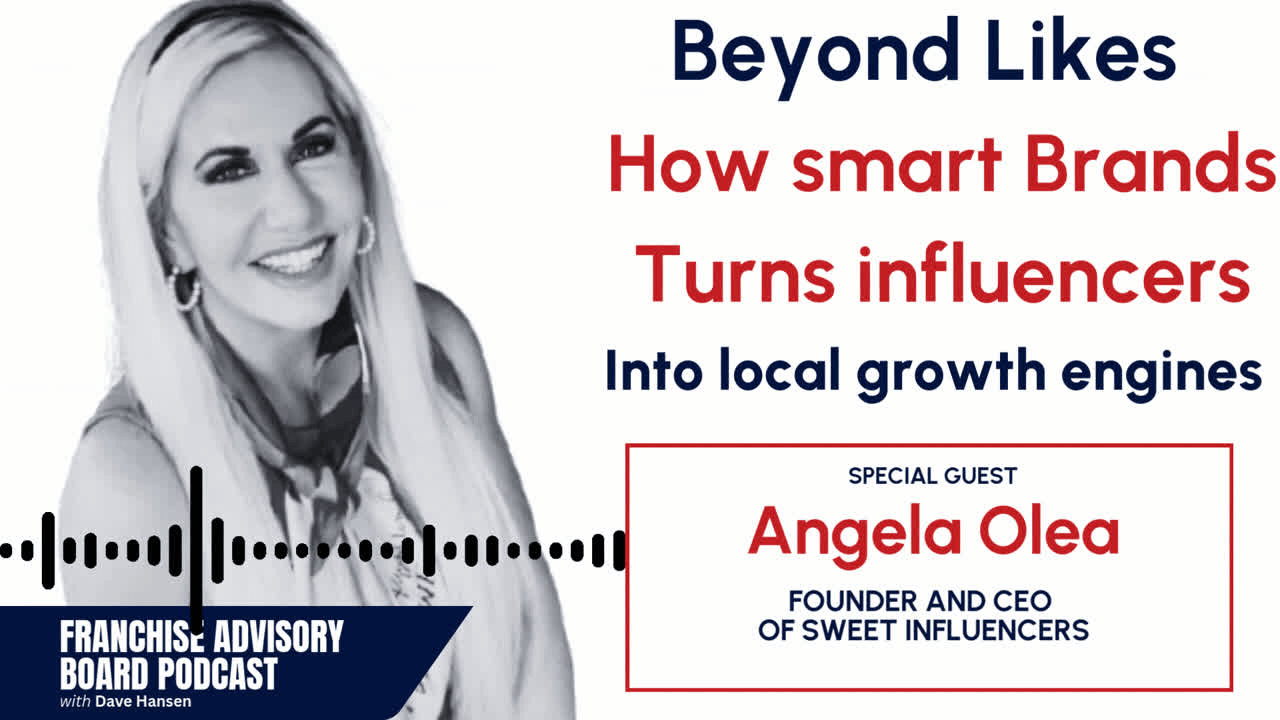
That’s what I unpacked with my guest, Angela Olea, founder and CEO of Sweet Influencers—a platform designed to make influencer marketing more systematic, trackable, and scalable for franchise brands.
Meet Angela Olea
Angela Olea is a proven franchise operator and builder. She’s the founder of Assisted Living Locators (scaled to 166+ units) and now the founder and CEO of Sweet Influencers, an influencer marketing platform focused on turning creator partnerships into local growth engines.
What stood out to me in this conversation is that Angela didn’t come into influencer marketing from the “content creator” side—she came into it from operations, franchising, and systems. That matters, because franchising requires repeatability, guardrails, and predictable outcomes across markets. Sweet Influencers is built with that lens.
In the episode, she shares how the entire Sweet Influencers idea started with a plane conversation that turned into a full-blown obsession—and eventually, a company.
“I met Andrew on a plane… I absolutely just drained his brain dry of everything, all things influencer marketing, and I was inspired.” — Angela Olea
The highest-converting influencers are often the smallest ones
Angela breaks down the creator ladder—nano → micro → macro → celebrity—and explains why Sweet Influencers focuses on a hybrid of nano and micro influencers. Their audiences may be smaller, but they’re typically more authentic, more local, and often convert at a higher rate.
Here’s why that matters for franchises: local brands don’t need national awareness to win. They need the right people in a 10–25 mile radius to hear the message, trust it, and act. Nano and micro creators tend to feel like “someone you know” or “someone in your backyard.” That familiarity creates a trust advantage that celebrity campaigns can’t replicate.
It also gives franchise brands a portfolio strategy. Instead of betting everything on one expensive creator, you can spread the investment across multiple local voices and learn what works faster.
“Their following is small, but it’s real.” — Angela Olea
Authenticity isn’t scripted—it’s selected through vetting
One of the biggest misconceptions brands have is that they can “manage” authenticity. Angela’s approach is the opposite: you vet for brand-fit and past behavior, including sentiment, prior brand mentions, and whether follower engagement looks real.
For franchise brands, this is critical because authenticity is what creates velocity. If the content feels forced, it won’t perform—and worse, it can create backlash that hurts local reputation. Angela’s team evaluates past posts, checks whether followers appear legitimate (not bot-driven), and looks for signals that the creator can naturally talk about a product or service without sounding like a commercial.
This is also where franchise leaders can protect the brand without shutting down local marketing efforts. You can establish a system that selects the right creators and gives franchisees the ability to participate safely, without creating chaos or inconsistency.
“We are looking for the sentiment. We’re looking for their past post… [and] making sure that the followers are authentic.” — Angela Olea
Landmines are real: FTC disclosures, contracts, and even music licensing
This is where a lot of influencer programs fail—not because the strategy doesn’t work, but because people don’t respect the rules of the road. Angela flags three major risk areas: FTC disclosure requirements, the contract terms around usage/repurposing, and unlicensed music.
For franchisors and franchisees, those issues can scale fast. One creator’s mistake can become a brand-wide issue if content gets reused or amplified across markets. That’s why contract clarity matters—especially around what the brand can do with the content (repurpose it, turn it into ads, “slice and dice” clips, etc.). It’s also why disclosure matters: the relationship must be transparent.
Angela’s point here is simple: influencer marketing can be powerful, but it needs the same level of operational discipline you’d apply to any other marketing channel.
“You have to put that it’s an ad, or it’s sponsored.” — Angela Olea
Franchising makes influencer marketing easier, not harder (because of geography + testing)
Franchising is inherently geo-specific, which makes it a strong fit for localized creator campaigns—if you approach it with strategy. Angela’s framework starts with reverse engineering: understand your end user, where they spend attention, and who sits in their circle of influence.
In practice, this means answering questions like:
- Who is the buyer (and who influences the buyer)?
- Which platforms do they actually trust?
- What type of creator would feel credible to them locally?
Then you build momentum through repetition and AB testing. Instead of guessing what works, you run controlled experiments. You watch which creators drive engagement and comments, identify patterns, and then you double down on what performs.
That ability to adjust quickly is one of the biggest advantages of nano/micro campaigns versus a single macro influencer. You’re not locked into one big bet—you’re building a learning system.
“It’s a lot of reverse engineering and… creative thinking. You start with your end user… [and] what social medias are they on?” — Angela Olea
ROI can be measured—but you need baseline data and the right tracking setup
Angela explains why ROI looks different across categories (high-ticket one-and-done vs recurring services), and how they’re building tools to model outcomes based on average ticket, frequency, and lifetime value.
For franchises, here’s the key: you can’t measure lift if you don’t know what “normal” looks like. Brands should come into campaigns with baseline data (foot traffic, leads, conversion rates, average ticket, frequency, etc.). That becomes the reference point for evaluating whether a creator campaign produced real impact.
From there, tracking can include discount codes, QR codes, campaign-specific landing pages, and tracking links—depending on the type of business. Some use cases (like franchise development) may have “looser” attribution, but even then you can track awareness lift, inbound mentions, and lead flow changes over time.
“We’ve got an ROI tool… because each job… is going to be different.” — Angela Olea
Budgeting is more accessible than most brands assume
If you’re thinking you need celebrity money, you’re missing the play. Angela shares that $2,000 is a realistic minimum to run a meaningful local mix of nano/micro creators—enough to stagger content, test performance, and optimize.
That number matters because it reframes the conversation. Local influencer marketing doesn’t have to be “a massive campaign.” It can start as a structured pilot with a handful of creators, a defined goal (grand opening, seasonal promotion, brand awareness), and a process for reviewing and approving content.
And once you find creators who perform well, there’s an upside path: those creators can become ongoing ambassadors—consistent local voices that represent the brand in a way that feels natural and community-rooted.
“I would say 2,000 is… that minimum amount that we want to… adjust and play with.” — Angela Olea
Wrap Up Thoughts
If you’re a franchisor, franchise marketer, or multi-unit operator, here’s my takeaway:
Influencer marketing isn’t a trend—it’s a local distribution channel for trust. The brands winning with it aren’t chasing vanity metrics. They’re building repeatable systems around:
- choosing the right local creators,
- protecting the brand with clear guardrails,
- tracking lift against baseline performance,
- and iterating fast to find what works in each market.
The opportunity is real, and the cost to start is lower than most people assume—but it still requires discipline. When you combine authenticity with structure, you get something powerful: scalable local growth that doesn’t feel like “marketing.”
Listen & Watch the Full Conversation
Watch the full episode on YouTube
Check out the Podcast hub Channel
Connect with Angela Olea and Sweet Influencers