Franchise systems love to talk about support.
They talk about tools, training, innovation, and value creation for franchise owners. But every once in a while, you come across a founder who has actually built those things into the operating model from the ground up—not as talking points, but as the core of how the business works.
That’s what stood out to me in my conversation with Brigham Dallas.
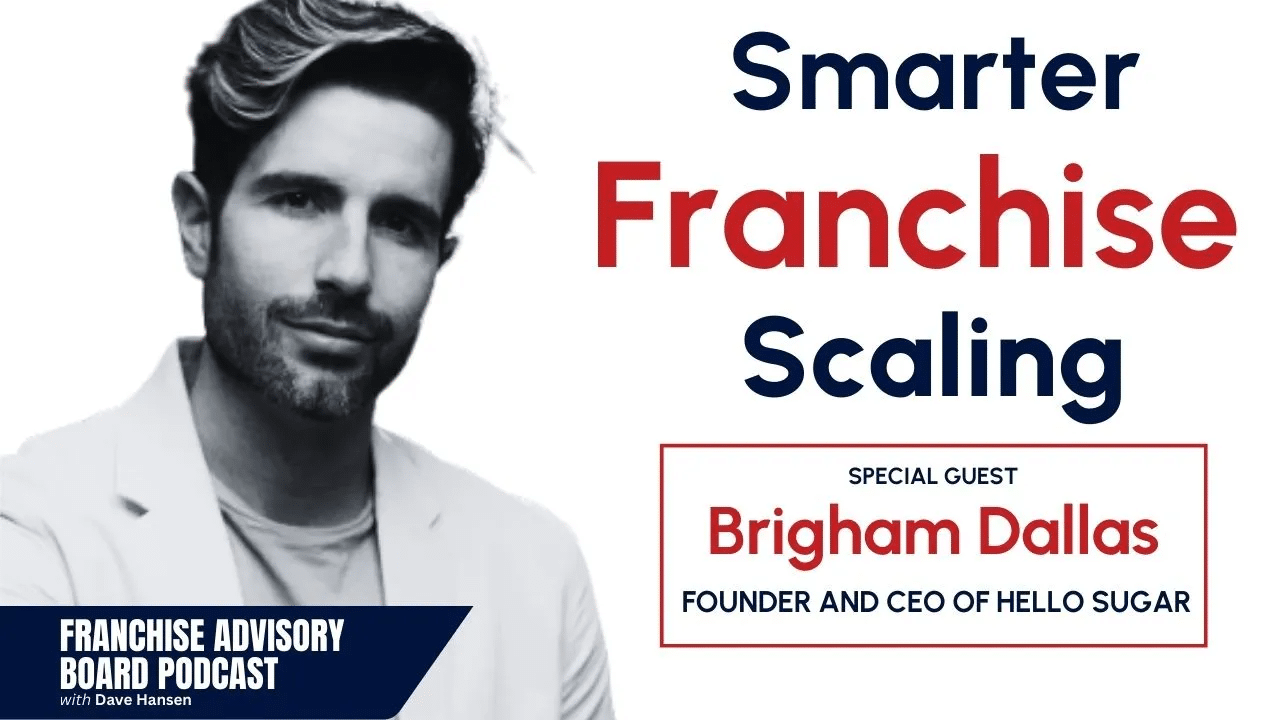
Brigham is the founder and CEO of Hello Sugar, and what he and his team have built is hard to ignore. Yes, the growth is impressive. Yes, the numbers turn heads. But what really caught my attention was the thinking underneath it all: how do you remove friction, reduce failure points, and create a better system for franchisees at scale?
That question runs through everything Hello Sugar is doing—from AI-driven customer communication to app adoption to supply chain strategy to marketing models designed around completed appointments rather than vanity metrics.
If you care about franchisee success, operational leverage, and the real-world application of AI in a growing system, this is a conversation worth paying attention to.
Meet Brigham Dallas
If you’ve spent time around franchising lately, there’s a good chance you’ve heard Brigham Dallas’s name.
He’s the founder and CEO of Hello Sugar, one of the fastest-growing beauty salon brands in the country, and he’s built a reputation for thinking differently about how franchise systems should operate. Hello Sugar has scaled quickly, but what’s more interesting is how that growth has happened: with a model built around lowering risk, simplifying execution, and building systems that franchisees can actually win with.
As I said in the episode:
“He’s the founder and CEO of Hello Sugar… a serial entrepreneur from earthworms to waxing to skin care.”
That line gets a laugh, but it also tells you something real about Brigham. He’s not precious about where he starts.
He’s focused on what works, what scales, and what helps operators succeed.
And the philosophy behind Hello Sugar shows up early in the conversation:
“A lot of the risk mitigation that we’ve done in Hello Sugar has come out of necessity.”
That one line frames the rest of the episode really well.
Many Great Franchise Models Start with Constraint, Not Comfort
One of the things I appreciated most about Brigham’s story is that it didn’t begin with a polished growth strategy or a perfectly capitalized rollout plan.
It started with limited resources, a deep discomfort with the work he was doing at the time, and a willingness to build something better from whatever opportunity was in front of him. In his case, that meant pitching a plastic surgeon on using an empty room in the back of the office to open a one-room salon.
That kind of beginning matters because it shapes the operator.
When you build from necessity, you tend to think differently about risk. You pay more attention to what breaks. You focus on what has to work before you add complexity. And that discipline often becomes the foundation for a much stronger franchise system later.
Brigham’s early strategy—build small, validate demand, then convert into a larger flagship—wasn’t flashy. It was practical. And that practicality turned into a repeatable model.
“If I could just make $5,000 a month, I could get out of this job.” (2:16)
There’s something refreshingly honest about that. No giant vision statement. Just a clear goal, a real problem, and the discipline to build from there.
Reception Isn’t a Small Problem—It’s an Operating System Problem
A big part of this conversation centered on something a lot of brands probably underestimate: reception.
In beauty, Brigham explained, reception can account for a surprisingly large percentage of labor. And because those roles are often part-time, lower-paid, and high-turnover, they can become a major source of inconsistency in the customer experience.
That’s not just a staffing issue. That’s an operating model issue.
What Brigham did was challenge the assumption that reception had to look the way it always had. Instead of continuing to pour energy into a role that created handoff friction and uneven service quality, he began redesigning the process around a better customer journey.
That meant using technology more intelligently and pushing the rebooking interaction closer to the actual service experience—where the esthetician, not a disengaged front-desk employee, could guide the next step.
That shift is a lot more strategic than it sounds at first glance.
“In the beauty space 40% of your staff are reception… and they don’t care about the business.”
Brigham’s point wasn’t simply that reception is expensive. It was that the traditional setup creates friction in one of the most visible parts of the customer experience. And when you’re building a franchise system, those visible friction points matter.
AI Works Best When It Solves a Real, Repetitive Problem
There’s no shortage of people talking about AI right now. But a lot of those conversations stay pretty shallow.
What I liked in this episode is that Brigham approached AI the way good operators approach any tool: start with a real problem, identify repeatable workflows, train around those workflows, and measure whether the system is actually making the business better.
In Hello Sugar’s case, the problem was customer communication.
Appointment bookings, cancellations, membership questions, common service issues—those interactions happen over and over. They’re important, but they’re also highly processable if you build the right knowledge base and training structure behind them.
Brigham walked through how they built a deep company wiki, segmented customer requests into instances, trained the system to recognize those instances, then trained response quality before rolling anything out broadly. That level of discipline is probably why their use of AI feels practical instead of gimmicky.
And the result is significant.
“Today, you know, fast forward two years, 70% of all communication outside of phone is handled entirely through completed AI.”
That’s not a toy. That’s a serious operating layer.
He also made an important distinction that I think a lot of people miss: text-based AI is much easier to make feel natural than voice. Voice still has to solve for interruption, pacing, hesitation, timing, and conversational rhythm.
Text gives you a little more grace.
That kind of nuance is what separates experimentation from implementation.
Aligned Incentives Change Everything
One of the strongest business lessons in the episode came when we shifted into how Hello Sugar thinks about revenue streams and franchisor value creation.
Brigham made the case that franchisors should be thinking beyond royalties—but not in a way that extracts value from franchisees. In his view, the right additional revenue streams are the ones that lower cost, improve outcomes, and create enough margin to keep innovating.
That only works if incentives are aligned.
His marketing example was especially sharp. Rather than following the traditional path of charging a brand fund and optimizing around leads, Hello Sugar structured its internal media model around completed appointments. Not impressions.
Not website form fills. Completed appointments.
That’s a much healthier definition of value.
“We charge a pay-per-completed-appointment… so that the incentives of the media company are aligned with your incentives.”
That is exactly the kind of structure more brands should be thinking about.
Because once a system gets paid for activity instead of outcomes, misalignment starts creeping in fast. Leads become the goal instead of revenue. Reports look better than results. And franchisees end up paying for motion instead of value.
Brigham’s model doesn’t eliminate complexity, but it does put the incentives in the right place.
Transparency Builds More Trust Than Forced Compliance Ever Will
There was another theme in this conversation that I think matters just as much as the AI and operations side: transparency.
Brigham was very direct about margins, support models, and how Hello Sugar thinks about the economics of the system. He talked openly about targeting healthy margins in different parts of the business so the company can keep investing in support, innovation, and improved franchisee outcomes.
That honesty matters.
Because if a franchise system is going to create additional services, revenue streams, or infrastructure layers, franchisees need to understand how and why those things exist. They need to know that the system isn’t just profitable—it’s useful.
And one of the strongest lines in the episode came when Brigham explained how they keep themselves accountable:
“You don’t make it mandatory to buy from you. That checks you as well as a franchisee.”
That’s a strong operating principle.
If your service is truly better, cheaper, or easier, adoption will follow. If it doesn’t, then that’s useful information too. Either way, the market gives you feedback.
Later in the conversation, Brigham connected that back to one of Hello Sugar’s internal principles:
“Radical transparency is one of the principles of our company.” (26:51)
That came through clearly in how he described their disclosures, their expectations, and the trust they try to build with franchisees from the beginning.
A Great App Doesn’t Just Improve Convenience—It Changes the Operating Modelv
One of the most eye-opening parts of this conversation was Brigham’s breakdown of the Hello Sugar app.
A lot of brands treat apps like a nice add-on. Something useful, maybe even expected, but not something central to the economics of the business.
That’s not how Brigham sees it.
For Hello Sugar, the app became a meaningful lever for reducing service load, increasing customer self-sufficiency, and shifting behavior in ways that improved operations system-wide. Customers could book, manage memberships, access rewards, and handle routine tasks without needing help from staff.
That’s not just a better digital experience. That’s leverage.
And the adoption numbers were real.
“Fast forward today, 55,000 clients, 45,000 unique active users on the app.”
Those are meaningful usage numbers by any standard.
What I also appreciated is that Brigham didn’t present this as a case for building everything from scratch. In fact, later in the episode, he was very clear that brands shouldn’t try to reinvent core systems like scheduling software if mature tools already exist. The opportunity, in his view, is to build smart layers and integrations on top of strong infrastructure.
That’s a much more mature way to think about tech.
Great Franchise Systems Remove Failure Points for the Franchisee
Toward the end of our conversation, Brigham introduced a concept he calls “revenue capture rate,” and it was one of the most interesting strategic frameworks in the episode.
At a high level, he’s asking a simple question: how much of the franchisee’s operational world can the franchisor support more effectively through scale, systems, and shared infrastructure?
That might mean marketing. It might mean supply chain. It might mean reception, training, offshore management, or analytics. The point isn’t to own every piece of the business. The point is to reduce the number of places the franchisee can fail alone.
That’s a really important distinction.
Because if the franchisee is left carrying too many disconnected burdens—marketing, hiring, process design, supply sourcing, customer communication, analytics—then the franchisor hasn’t really reduced complexity. It has just licensed a brand.
Brigham’s philosophy pushes much further than that.
“Franchiseor should be obsessed about a metric that I coined. I call it the revenue capture rate.”
And then, later, he distilled the broader philosophy into a line that I think will stick with a lot of listeners:
“Play in as many markets as you can, do it cheaper than the competitors, don’t force, and you’ll build a very successful business.” (39:40)
Whether or not someone agrees with every detail of the Hello Sugar model, that line captures a real strategic posture: create value, lower friction, align incentives, and let adoption validate the system.
Wrap-Up Thoughts
As someone who spends a lot of time talking with founders, operators, and franchise leaders, I walked away from this conversation thinking about one question more than any other:
Where are franchisees still carrying operational burdens that the system should already be solving?
That, to me, is the bigger conversation behind AI and automation.
This isn’t really about whether a brand has a chatbot, an app, or a better reporting dashboard. It’s about whether the system is designed in a way that helps owners execute more consistently, make better decisions, and avoid common failure points.
What Brigham and the Hello Sugar team are building is interesting not just because it’s modern, but because it’s structured. Their approach reflects a belief that technology should simplify, incentives should align, margins should fund innovation, and support should be tangible—not theoretical.
That kind of thinking raises the bar.
And for franchise systems that want to grow without simply becoming more complicated, there’s a lot in this conversation worth paying attention to.
Listen & Watch the Full Conversation
Watch the full episode on YouTube
Check out the Podcast hub Channel
Connect with Brigham Dallas and learn more about Hello Sugar