
Service brand franchisors face a software problem that most franchise software wasn’t built to solve.
You’re running two distinct pipelines at the same time. One tracks franchise candidates from the first inquiry through the territory award. The other tracks B2C customers at every unit: quote requests, job scheduling, invoicing, and reviews. Both pipelines need to move fast. Both need to be visible at the system level.
The generic all-in-one tools that claim to handle both are often two products sharing a login, with the data still siloed underneath. They try to cover everything and end up doing the critical parts poorly.
This article covers what the dual stack problem actually costs, what software built for both pipelines needs to do, and what results look like when it’s done right.
Service brand franchisors operate two separate pipelines: franchise development and unit-level B2C operations. Most franchise software only handles one. Running separate tools for each creates data gaps, cost sprawl, and no unified view for HQ. The right franchise software connects both pipelines through the capabilities that drive the whole lifecycle: speed, automated follow-up, visibility, and consistency. It provides separate views for each level of the system and pricing by location that keeps costs predictable at scale.
Key Takeaways
- Service brands need franchise software that handles both FranDev and B2C unit ops. Most platforms only do one.
- Running five separate tools for one franchise stack creates data gaps HQ cannot see across.
- The right franchise software connects FranDev and Unit Ops not because it covers everything, but because both pipelines depend on the same core capabilities: speed, follow-up, and visibility.
- Pricing by location keeps costs fixed as the system grows. Per-seat fees compound fast at unit scale.
- Service brands using ClientTether report results from 278% more lead conversion to 300% franchise sales growth.
Who This Is For
- Best for: Franchisors in home services, cleaning, painting, pest control, and personal services, where each unit manages B2C customers and the franchisor is actively growing through FranDev
- Not ideal for: Restaurant or retail brands where the unit ops model differs significantly
- Top use cases: Deciding whether to consolidate tool stacks; building the case for a platform change; comparing single platform vs. multiple tool cost and reporting
Why Service Brands Have a Different Software Problem
Most franchise software is built for one job: managing franchise growth. It tracks candidates, runs the FranDev pipeline, and helps the development team hit award targets.
Service brands need that. But they also need something entirely different running in parallel.
At every unit, franchisees are managing B2C customers. Someone requests a quote. A tech needs to be scheduled. An invoice goes out after the job. A review request follows. Each of those steps is its own pipeline. It runs every day across every location.
That’s the gap. Most franchise software leaves unit ops to a second tool, or a third, or a fourth. The result is a fragmented stack where HQ has to export data from multiple systems just to get a clear view of the business.
What the Tool Sprawl Actually Costs
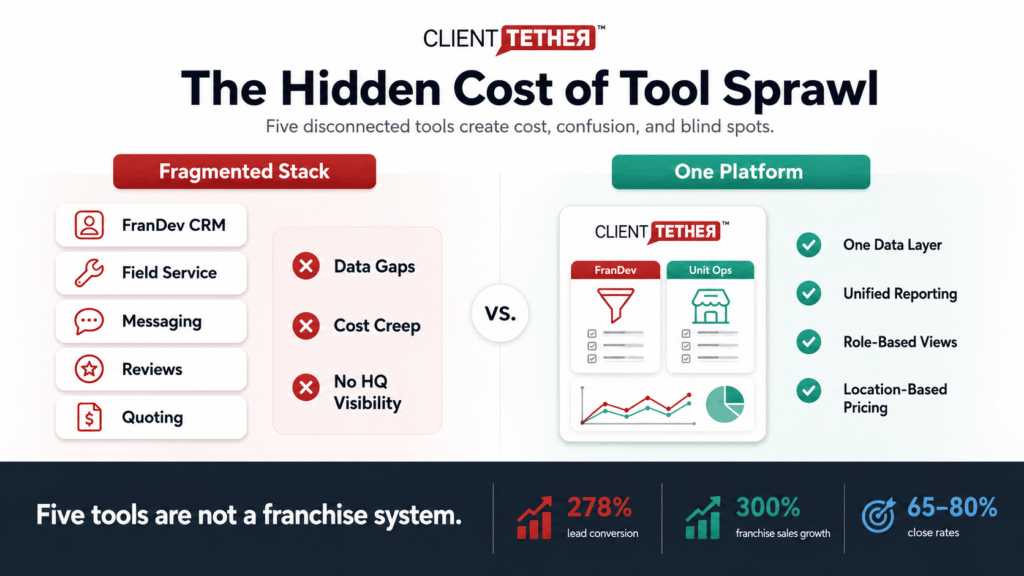
Here’s what the typical service brand franchise stack looks like when tools get added one at a time:
| Need | Tool |
|---|---|
| FranDev pipeline | Dedicated franchise CRM |
| B2C customer management | Separate job or field service platform |
| Automated follow-up | Separate messaging tool |
| Review management | Separate review platform |
| Quoting and estimates | Separate quoting tool |
Five tools. Five logins. Five data sets that don’t talk to each other.
The dollar cost is real. Each platform charges separately, and most charge by user seat. At 50 locations with multiple staff per unit, per-seat fees build fast.
The data cost is worse. When FranDev data lives in one system and unit ops data lives in another, HQ can’t answer basic questions without pulling reports from both. Which locations are behind on follow-up? Which franchisees have the highest customer close rates? Which lead sources produce the best unit operators? None of those questions gets answered on a single screen.
The 2025 IFA Franchisor Survey ranks technology adoption and operational efficiency among the top growth priorities for franchise brands. Yet most service brands are still running fragmented stacks that work against both goals.
What Franchise Software for Service Brands Needs to Do
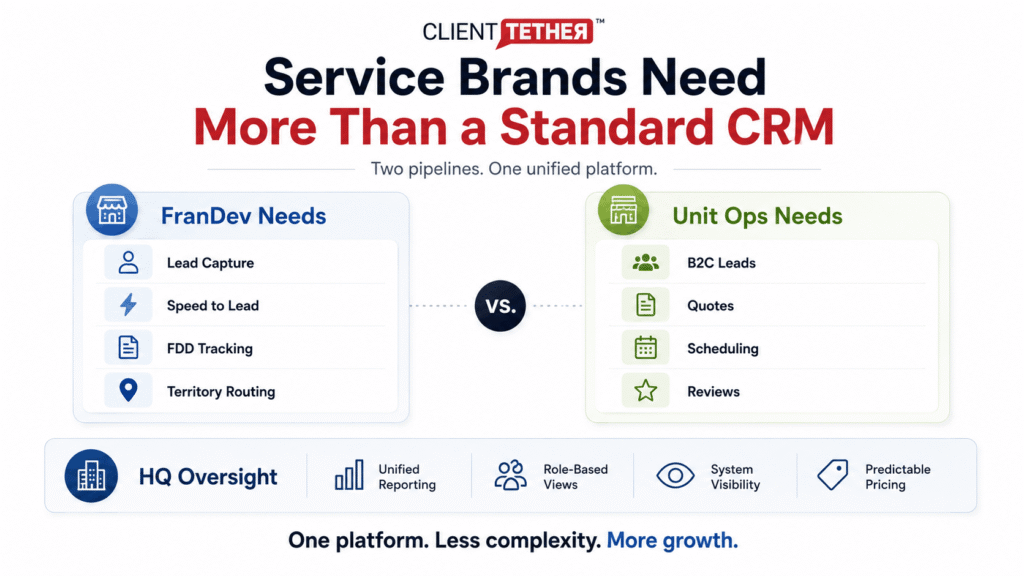
Software that works for service brands has to cover two distinct workflows without compromise. Not as an extra tool bolted on. Not as a feature set stretched to approximate what field service and FranDev actually need.
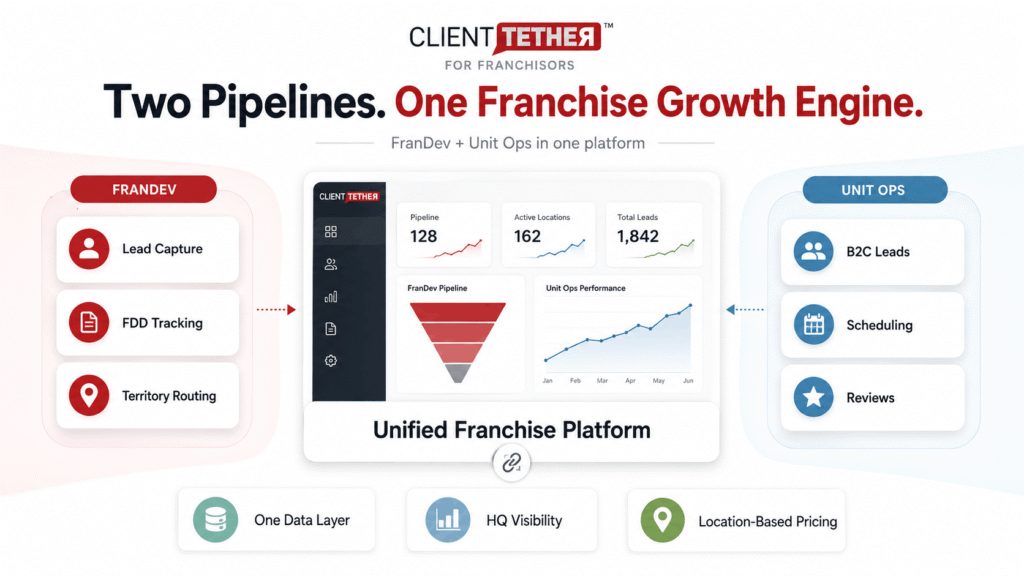
FranDev Side
The FranDev pipeline is about moving franchise candidates from first contact to signed agreement. The software needs to handle:
- Lead capture and routing from all inbound sources
- Automated response within seconds of inquiry, before the qualification window closes
- Full pipeline tracking from candidate to FDD to territory award
- FDD delivery and disclosure tracking is built into the workflow
- Territory routing that assigns leads to the right rep without manual steps
Unit Ops Side
At the unit level, the software needs a completely different set of workflows:
- B2C lead capture from web, chat, and referral sources
- Quoting and estimates with automated follow-up if no response
- Job scheduling with route logic for field teams
- Invoicing and payment after each completed job
- Automated review requests after each completed job
- Ongoing customer follow-up for repeat service
These are field service features, not CRM features. A platform that only does CRM will handle the FranDev side and leave units running a second tool for everything else.
HQ Oversight
The third layer is unified visibility for HQ.
This means system-level reporting across both pipelines. Franchisors should be able to see FranDev pipeline health and unit-level customer data in the same dashboard. A connected system gives franchisors, multi-unit owners, and individual unit staff separate views without overlapping access.
Pricing by location makes this work at scale. When each location can add estimators, schedulers, and frontline staff without increasing software costs, adoption goes up, and data quality improves across the whole system.
What Real Lifecycle Coverage Actually Looks Like
Not every platform that says it handles both actually does. Here’s how to tell the difference.
The test isn’t whether a vendor calls it one platform. The test is whether FranDev and Unit Ops share the capabilities that drive the whole lifecycle: speed to lead, automated follow-up, real-time visibility, and consistent execution at every stage. A product bundle has two back-end databases and a shared login screen. The reporting gap is the tell. A system built for this has one data layer, and both sides of the business report from it.
For service brands, the unit ops side has to be built for field service from the start, not adapted from a generic CRM trying to stretch into field service territory. Quoting workflows, scheduling logic, and follow-up sequences built around each job are different enough from lead nurturing that tools trying to cover everything end up covering the field service side poorly. That’s the all-in-one trap: broad coverage at the cost of depth where it matters.
The pricing model is the third signal. Generic CRMs are priced by user seat. A home services franchise with 50 locations and three staff per unit is looking at 150 seats at minimum. That number grows every time a unit adds a team member. A platform priced by location keeps the cost fixed at each stage of growth.
For a deeper look at how the cost comparison works across platform types, see the ROI of switching to a franchise CRM. The same math applies when evaluating a full-service brand stack.
Franchising trends research from FranchiseWire points to platform consolidation as one of the defining operational shifts for franchise brands in 2026, with service brands specifically named as the segment most likely to move away from fragmented tool stacks this year.
What Service Brand Franchisors See When It Works
The results below come from ClientTether case studies. These are real outcomes, not projections.
The common thread is speed and consistency. Faster response, structured follow-up at every stage, and full visibility across the system. Not because one tool does everything, but because the right software connects the parts of the lifecycle that can’t afford to be separate. For service brands, that connection has to cover both pipelines. Without it, you’re managing half the business blind.
For a closer look at what a strong FranDev pipeline looks like inside one of these platforms, see franchise candidate pipeline management.
For the broader question of what to look for in a software review, franchise management software vs a CRM covers the core distinctions. And for an overview of what franchise software is at its most basic level, the pillar article covers the full scope.
Frequently Asked Questions
What franchise software do service brands typically use?
Most service brands start with a general CRM for FranDev and a separate field service platform for unit ops. As they scale, the cost and data gaps from running both push them toward software built specifically for franchise systems.
Can one platform handle both franchise development and unit-level operations?
Yes, but not all platforms that say they can actually deliver it. A true single platform has one data layer covering both FranDev and unit ops, with separate views for each level. Ask a vendor to show you a unified system-level report across both pipelines in a demo before accepting the answer as yes.
What is the difference between franchise software and a standard CRM for service businesses?
A standard CRM tracks contacts and deals. Franchise software for service brands also handles parent-child architecture, territory routing, FDD workflow, multi-unit owner views, and unit-level B2C operations, all from one system. The structural difference comes down to how each platform handles the franchisor-to-franchisee data relationship at the system level.
How does franchise software handle quoting and scheduling for service brand units?
In a platform built for service brands, quoting and scheduling are part of the unit-level workflow. A unit receives a B2C lead, the platform sends an automated quote request, and follow-up runs until the job is booked. After the job, invoicing and review requests fire automatically.
Do service brand franchisors need separate tools for FranDev and operations?
Only if their franchise software does not cover both natively. The cost and reporting penalty for running separate tools grow with unit count. At 10 units, it is manageable. At 50 or more, the data gaps and per-seat fees make the case for consolidation clear.