
Most decisions about a franchise CRM focus on features and price. Almost none focus on projected revenue impact.
That gap is costly.
Before you switch platforms, you need three things: a baseline of what your current system costs you, a method for estimating post-switch gains, and a formula you can apply to real franchise numbers.
I’ve been inside franchise systems running FranDev on spreadsheets. The ROI case for a purpose-built franchise CRM is almost always clear once you run the numbers. The problem is most franchisors never do.
Here’s how to do it.
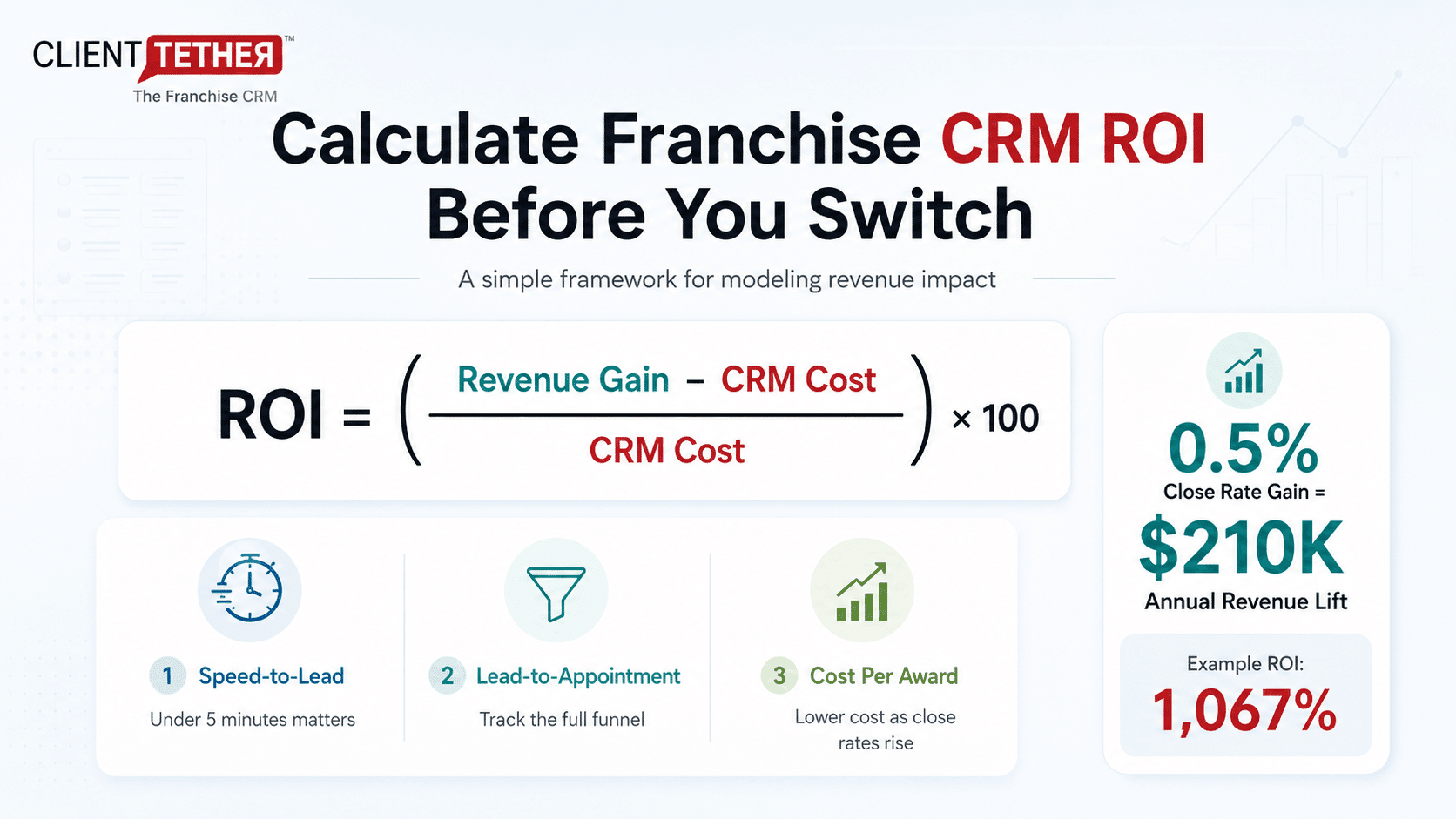
The ROI of a franchise CRM is measurable before you commit to a platform. The three metrics that drive it are speed-to-lead rate, lead-to-appointment rate, and cost per awarded franchise. To calculate it, record your current performance, apply safe benchmarks, and run this formula: ROI = (Revenue Gain minus CRM Cost) / CRM Cost x 100.
Key Takeaways
- A franchise CRM’s ROI is driven by three clear metrics: response speed, pipeline contact rate, and cost per award.
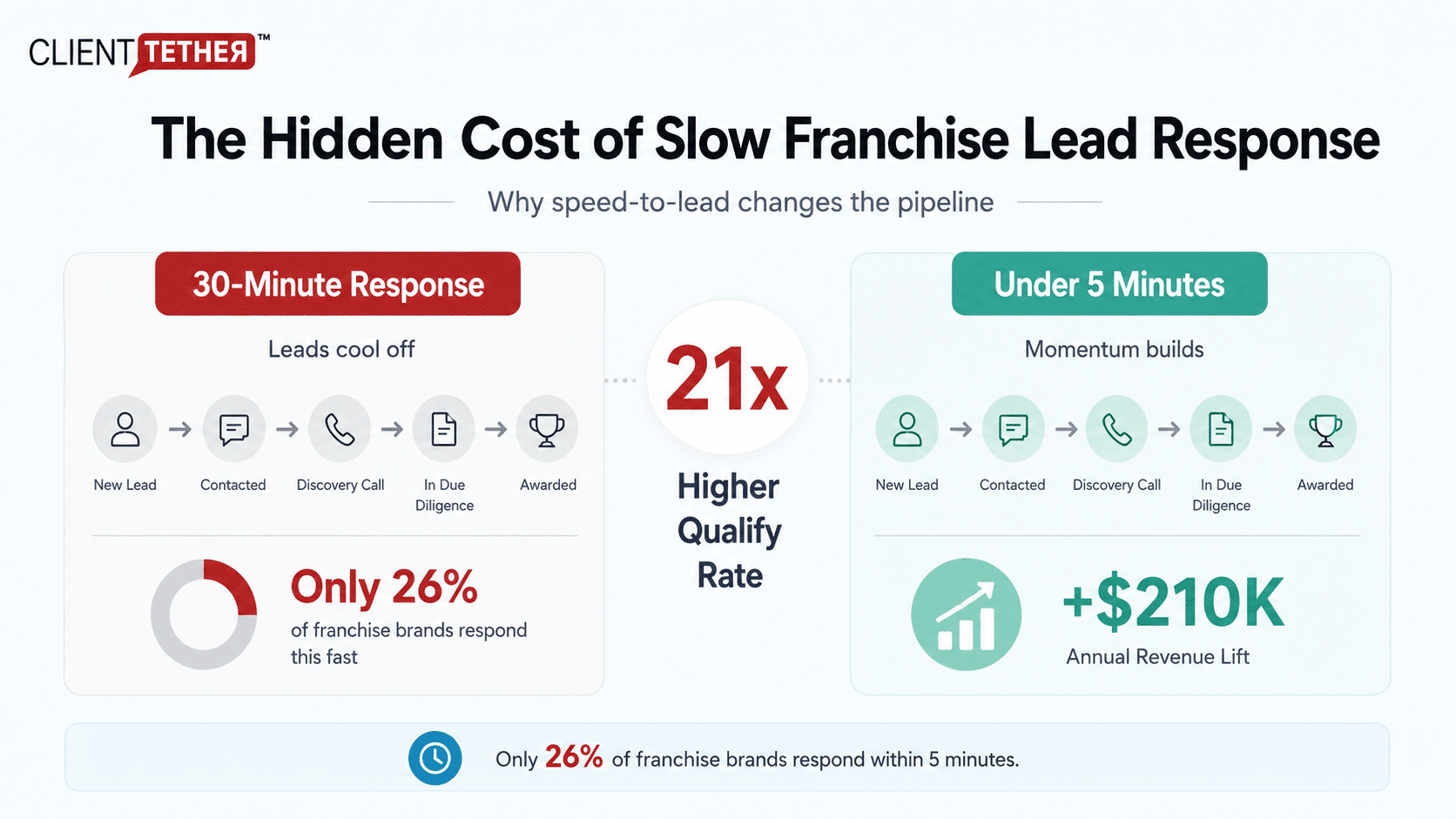
- Responding to a lead in under 5 minutes vs. 30 minutes raises the qualification rate by 21 times.
- To calculate ROI, you need a baseline and a safe estimate of the gains after you switch.
- Tool sprawl and per-seat fees at scale make the status quo look cheaper than it is.
- Franchise systems that have made the switch report results from 278% more lead conversion to 300% sales growth in 14 months.
Who This Is For
- Best for: VP or Director of FranDev preparing a platform review; CEO or Franchisor making the case to ownership; systems with 10 or more active development candidates
- Not ideal for: Emerging franchisors with fewer than 5 awarded units. At that stage, manual tracking is still manageable, and the ROI formula in this article won’t move the needle yet.
- Top use cases: Pre-purchase ROI modeling; post-switch performance benchmarking; building the internal business case for a platform change
Why Most Franchisors Can’t Measure What a CRM Is Actually Worth
Generic CRMs track activity. They log calls, store contacts, and note when a follow-up was sent. What they don’t do is tie that activity to revenue.
That’s the gap.
When your CRM can’t link a lead to a signed franchise deal, you have no real close rate. Without that baseline, you have no starting point for an ROI model. You’re comparing “before” to nothing.
Franchise CRMs work on a different model. On the FranDev side, they connect the full pipeline: lead entry, response speed, stage movement, FDD delivery, and territory award. On the Unit Ops side, they track what happens after the award: customer lead response, job completion rates, and revenue per location.
When that data rolls up across every unit in one system, the revenue impact of every change becomes visible at the franchisor level, not just inside a single location.
But you don’t have to wait until after you switch to model the ROI. The steps below let you build a solid estimate before you commit.
The 3 ROI Metrics That Drive Franchise CRM Value
ROI for a franchise CRM shows up in three places. All three are trackable.
Speed-to-Lead Rate
Speed-to-lead is the most controllable lever in your pipeline, for FranDev and Unit Ops alike. It’s also the one most systems can’t enforce.
Research from Forbes and Harvard Business Review found that responding to a lead in 5 minutes vs. 30 minutes raises the qualification rate by 21 times. A ClientTether audit of 250 franchise locations across 63 brands found that more than 1 in 4 leads receive zero response, a total loss on lead acquisition spend before a single conversation begins.
The dollar impact is direct. If your franchise fee is $35,000, each extra award adds $35,000 in gross revenue, before broker fees and cost of sale. Add royalties over the life of that franchisee relationship and the lifetime value of a single awarded unit compounds well beyond the initial fee.
Speed matters. That’s the core driver.
Lead to Appointment Rate
Most FranDev teams only track their close rate. Two stages sit above it: how many leads you contact, and how many of those contacts book a call. Both are where most volume is lost. Most CRMs don’t show them.
Here’s why this matters.
If you contact 40% of inbound leads and book 30% of those to a discovery call, you have two levers above the close rate. A franchise CRM with auto follow-up and stage tracking makes both visible and fixable. Without that view, you tune the close and ignore the full funnel above it.
Cost Per Awarded Franchise
As close rates rise, the cost per awarded franchise falls. It’s the core return driver.
A system that closes 3% of inbound leads vs. 2% produces 50% more output from the same lead volume. If your ad spend is $10,000 per month, your cost per award drops from $5,000 to $3,333 without touching your budget. That gain builds across every month and every location.
Research from Kellogg School of Management found that firms often delay adopting high ROI tools. The barrier is not the math but the work of change. That’s worth knowing when you build the internal case. For a look at how this plays out in practice, see the Kellogg study on why smaller firms pass on profitable tools.
How to Calculate Franchise CRM ROI in 3 Steps
Step 1: Record Your Baseline
Before you model any gain, collect your current numbers for the last 90 days:
- Average response time to new leads
- Lead contact rate (what share of inbound leads get a first reply)
- Contact to appointment rate
- Close rate (calls that turn into franchise awards)
- Cost per award (monthly ad spend divided by monthly awards)
If your current system can’t show you these numbers, that’s already a data point. A system that can’t report on response time, contact rate, or stage movement can’t tell you where the funnel is leaking, which means you can’t fix it, and you can’t measure what fixing it is worth.
ClientTether tracks each of those metrics natively: where every lead came from, how it moved through the pipeline, and where it converted or stalled. That’s the data layer the ROI formula in this article runs on. For a deeper look at what your pipeline data should show at each stage, see franchise CRM pipeline visibility.
Step 2: Estimate the Gain After You Switch
Use real results as safe benchmarks, not ceiling targets.
Franchise systems using ClientTether have reported a 278% lift in lead conversion within 90 days, 300% franchise sales growth in 14 months, and close rates reaching 65 to 80% vs. a 25 to 35% baseline.
For a safe internal estimate, use a 0.5 to 1 percentage point gain in close rate. That’s well below what strong franchise systems have achieved, and it holds up when you present to ownership.
Step 3: Run the Formula
ROI = (Revenue Gain minus CRM Cost) / CRM Cost x 100
Here’s what that looks like with real franchise numbers:
| Metric | Baseline | After Switch |
|---|---|---|
| Monthly inbound leads | 100 | 100 |
| Close rate | 2.0% | 2.5% |
| Awards per month | 2.0 | 2.5 |
| Revenue at $35K average fee | $70,000 | $87,500 |
Annual revenue gain: $210,000
Estimated CRM cost: $18,000 per year
ROI = ($210,000 minus $18,000) / $18,000 x 100 = 1,067%
That’s a 0.5% gain on 100 leads per month. Most franchise systems with strong speed to lead and follow up see larger results.
For a detailed look at the lead source tracking behind these numbers, see franchise CRM marketing ROI tracking.
The Hidden Costs That Skew Most Franchise CRM ROI Calculations
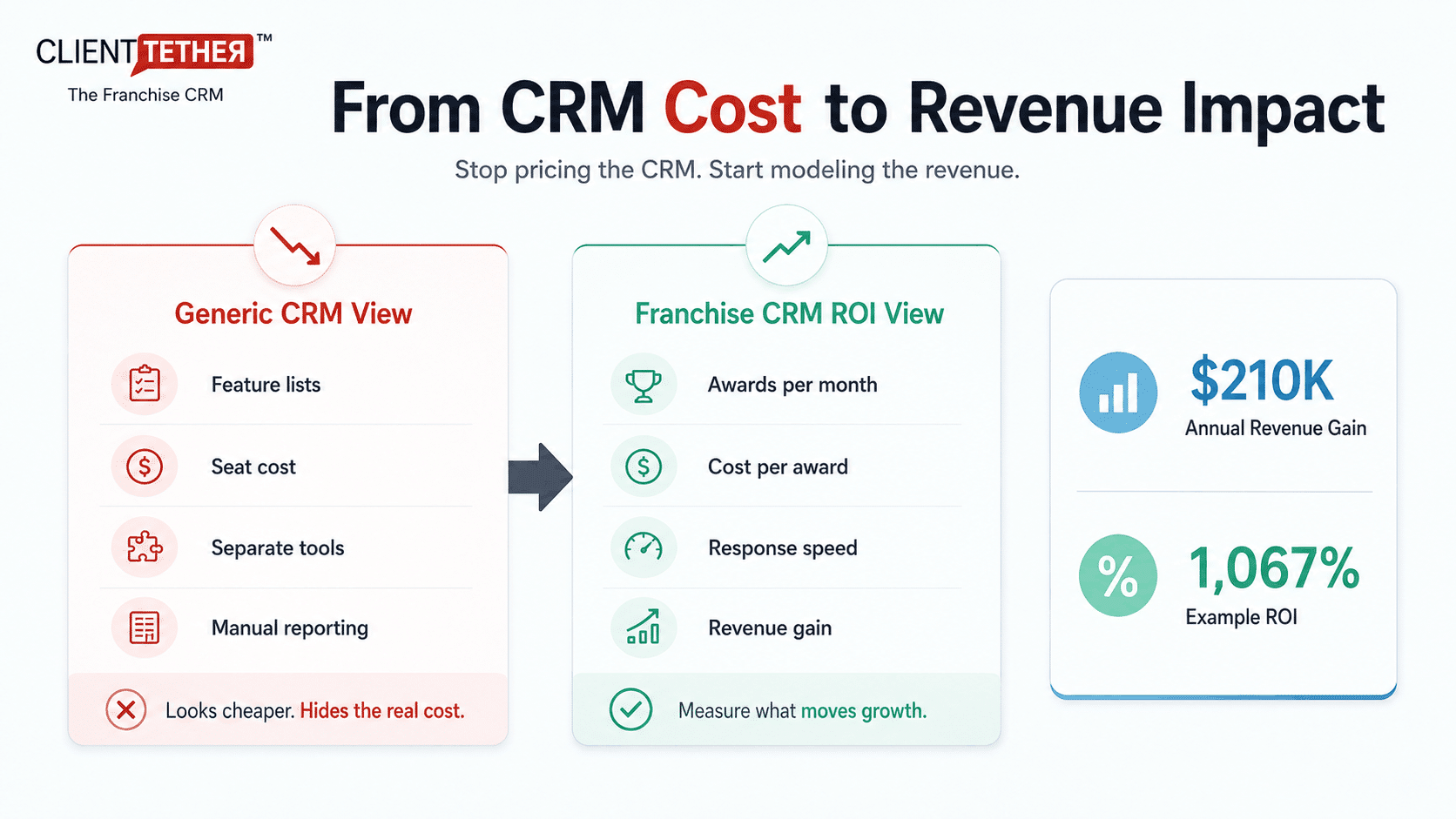
Most franchise ROI models only count the CRM subscription cost. That makes the status quo look cheaper than it is.
Here’s what to add to the real cost model.
Tool sprawl: The typical franchise brand running a generic CRM also pays for a separate review tool, a quoting tool, a messaging layer, and system-level reports. A platform that replaces all four changes the math a lot.
Per-seat fees at scale: Generic CRMs are priced by user seat. At 50 locations with multiple users per location, that cost builds fast. A platform priced by location keeps costs fixed as the system grows.
Setup time: Enterprise CRMs take 3 to 6 months to configure. A system that goes live in under 30 days starts generating ROI months earlier. That lag has a real dollar cost.
For a broader look at how total cost of ownership shapes ROI across multi-unit systems, see the FranchiseBrief analysis of hidden ROI drivers in franchise networks. The real comparison is never CRM A vs. CRM B. It’s full tool stack A vs. full tool stack B.
What High Franchise CRM ROI Looks Like in Practice
The results below come from ClientTether case studies. These are real outcomes, not projections.
Two Maids, a home cleaning franchise, increased franchisee lead conversion by 278% within 90 days after rolling out across nearly 90 locations. That’s a full funnel gain: response speed, follow-up, and pipeline view all addressed at once.
The Maids International grew franchise sales 300% in 14 months while cutting 70% of manual FranDev work. The cost savings and the revenue gain happened at the same time.
The pattern is the same across both results: faster response, structured follow-up, and full pipeline view drive the ROI. The platform is the tool. The outcome is always in awards per month and cost per award.
The pattern is the same across both results: faster response, structured follow-up, and full pipeline view drive the ROI. The platform is the tool. The outcome is always in awards per month and cost per award.
If you’re still at the stage of learning what makes a franchise CRM different from a generic CRM, start there. Once you’re ready to review specific features, the franchise CRM features checklist covers what matters most for FranDev teams.
Frequently Asked Questions
How do you calculate the ROI of a franchise CRM?
Use the formula: ROI = (Revenue Gain minus CRM Cost) / CRM Cost x 100. Start by recording your current close rate, then apply a safe gain estimate of 0.5 to 1 percentage point. Multiply the extra awards per month by your average franchise fee to get the annual revenue gain.
What metrics should I track before switching franchise CRM platforms?
Track response time, lead contact rate, contact to appointment rate, close rate, and cost per award. If your current system can’t show you these numbers, that’s a signal that the system is the constraint.
How long does it take to see ROI from a franchise CRM?
It varies by system size and how fast the team adopts it. Franchise brands that hit their speed to lead targets within the first 30 days tend to see clear gains within 60 to 90 days. Slower rollouts push the ROI timeline back.
How is franchise CRM ROI different from generic CRM ROI?
A generic CRM tracks activity. A franchise CRM tracks outcomes: awards, close rates, cost per award, and results by location. The more precise your data, the more precise your ROI calculation.
What does a realistic ROI look like for a franchise CRM?
For a system with 100 monthly leads, a $35,000 average franchise fee, and a 0.5% close rate gain, the annual revenue gain exceeds $200,000. At a mid-range CRM cost of $18,000 per year, that’s over 1,000% ROI. Results go up with higher lead volume and strong adoption.
Who should be tracking franchise CRM ROI?
The VP or Director of FranDev typically owns the metrics. The CEO or Franchisor owns the business case to ownership. Both should work from the same baseline numbers before any platform review begins.