
When you’re staring at a high monthly quote from an enterprise CRM platform, the thought crosses your mind: What if we just built our own? It’s a tempting idea—especially when you’re managing a growing franchise network and convinced your operations are too unique for packaged software.
The pitch sounds great: own your data, avoid vendor lock-in, build exactly what you need. But here’s the friction most franchisors don’t see coming: custom CRM development rarely costs what you think it will, and the maintenance burden doesn’t stop after launch.
Before you commit to building custom or signing a long-term platform contract, you need a clear framework for evaluating total cost of ownership, hidden variables, and whether configurable off-the-shelf platforms might be the middle path you’re overlooking.
TL;DR
Custom CRM development for franchises typically requires substantial upfront investment plus continuous maintenance costs that extend well beyond initial build timelines. For most franchisors managing 10-200 units, configurable off-the-shelf platforms with parent-child architecture and territory routing provide the flexibility of custom builds without the long-term cost burden or developer dependency. The real question isn’t whether custom CRMs are technically possible—it’s whether your franchise can sustain the development resources, opportunity costs, and feature velocity limitations over 3-5 years while your network scales.
Key Takeaways
- Custom CRM builds involve substantial upfront investment plus ongoing maintenance, updates, and developer retention costs
- Off-the-shelf platforms distribute costs through subscription licensing with lower implementation overhead and continuous vendor-driven updates
- Configurable platforms bridge the gap between rigid packaged software and expensive custom development
- Scale thresholds, proprietary IP requirements, and competitive advantage needs determine when custom investment is justified
- Total cost of ownership over 3-5 years reveals true economic comparison beyond sticker price reactions
Who This Is For
Best for: Franchisors managing 10-200+ units evaluating CRM options for the first time, multi-location operators considering custom development due to perceived “unique needs,” franchise leadership facing sticker shock from enterprise CRM quotes, and operations teams needing parent-child architecture, territory routing, and HQ rollup reporting.
Not ideal for: Single-location businesses unless planning multi-unit expansion, franchisors with dedicated in-house dev teams and substantial budgets where enterprise custom builds are viable, or brands with truly proprietary workflows requiring competitive IP protection via custom software.
Top use cases: Evaluating custom CRM build after receiving high off-the-shelf quotes, assessing total cost of ownership over 3-5 years, determining if “unique franchise needs” justify custom development, and finding a middle path between rigid packaged software and expensive custom builds.
The Real Cost of Custom CRM Development
Most franchisors underestimate what custom CRM development actually costs because the initial quote only captures part of the story.
Like building a house, the foundation and framing are just the beginning—you’re also committing to years of maintenance, renovations, and the constant risk that your builder might move on to other projects.
Upfront Development Costs
Custom CRM projects begin with discovery and scoping phases where developers translate your franchise operations into technical requirements.
This phase alone can stretch over weeks as teams map out parent-child account structures, territory-based lead routing, franchisee permission levels, and HQ reporting dashboards. From there, you’re funding design, development, testing, and deployment phases that span multiple months.
Development timelines depend on complexity, but franchise-specific features like multi-location rollup reporting and territory assignment add layers that generic CRM builds don’t face.
You’re not just building contact management—you’re building a system that mirrors your franchise hierarchy, handles location-level data permissions, and scales as you add units. Each of these requirements extends the timeline and increases the investment required before you see a functioning system.
Ongoing Maintenance and Updates
Here’s the part most franchisors miss: the build phase is just the entry fee. Once your custom CRM launches, you’re responsible for bug fixes, security patches, infrastructure costs, and feature additions as your franchise evolves.
When a franchisee requests a new dashboard widget or your ops team needs automated territory reassignment, that’s another development cycle you’re funding.
You’ll also need to retain developers who understand your codebase. Losing a key engineer mid-project or post-launch creates knowledge gaps that slow down everything from bug fixes to new feature rollouts.
Maintenance typically represents a significant portion of your initial build cost annually, and that burden compounds as your system ages and technical debt accumulates.
Hidden Costs of Custom Development
Beyond the obvious expenses, custom CRM projects carry hidden costs that surface during and after implementation. Scope creep is common—what starts as a “basic CRM” expands once franchisees see prototypes and request workflow tweaks.
Project delays push timelines from months to quarters, extending the period before you see ROI.
Integration maintenance is another ongoing expense. Your CRM needs to connect with email platforms, phone systems, advertising tools, and accounting software.
Each integration requires initial development plus ongoing updates as third-party APIs change. When a platform updates its authentication protocol or deprecates an endpoint, you’re paying developers to patch those connections while off-the-shelf platforms handle those updates automatically as part of their service.
The Case for Off-the-Shelf CRM Platforms
Off-the-shelf platforms take a different approach: you’re buying into a system that’s already built, tested, and supported by a vendor whose entire business depends on keeping that platform functional and competitive.
Instead of funding development from scratch, you’re sharing the cost of a mature system with hundreds or thousands of other users.
Time to Value
Pre-built CRM platforms can be deployed substantially faster than custom builds. Implementation timelines are measured in weeks rather than months because the core infrastructure already exists.
You’re configuring existing features—setting up parent-child account relationships, defining territory boundaries, customizing dashboards—rather than building those capabilities from the ground up.
This speed advantage matters when you’re trying to improve lead response times or standardize franchisee workflows across your network.
The faster you implement, the sooner you start seeing improvements in conversion rates and operational consistency. For more on how to scale with the right franchise management software, see How to Scale with the right Franchise Management Software.
Continuous Product Improvement
When you buy an off-the-shelf platform, you’re also buying into continuous vendor-driven feature releases and automatic updates. The platform vendor invests in R&D, pushes security patches, and adds new capabilities based on feedback from their entire customer base.
You benefit from features and improvements without funding individual development cycles. This shared R&D model means you’re not bearing the full cost of innovation.
When AI-powered lead scoring becomes table stakes or new compliance requirements emerge, platform vendors absorb those development costs across their user base.
Your subscription includes access to those improvements as they roll out, keeping your system current without dedicated dev resources.
Where Off-the-Shelf Falls Short
But packaged software isn’t perfect. Some platforms impose workflow rigidity that doesn’t match how your franchise operates.
You might face limitations on custom field structures, report formatting, or automation logic that force you to adapt your processes to fit the software rather than the other way around.
Vendor dependency is real—you’re reliant on their product roadmap, support responsiveness, and long-term viability.
Feature gaps exist where the platform doesn’t quite cover your edge cases, and you’re waiting on vendor prioritization rather than directing your own dev team. For franchisors with truly unique operational requirements, these constraints can feel like trading one problem for another.
Total Cost of Ownership Framework
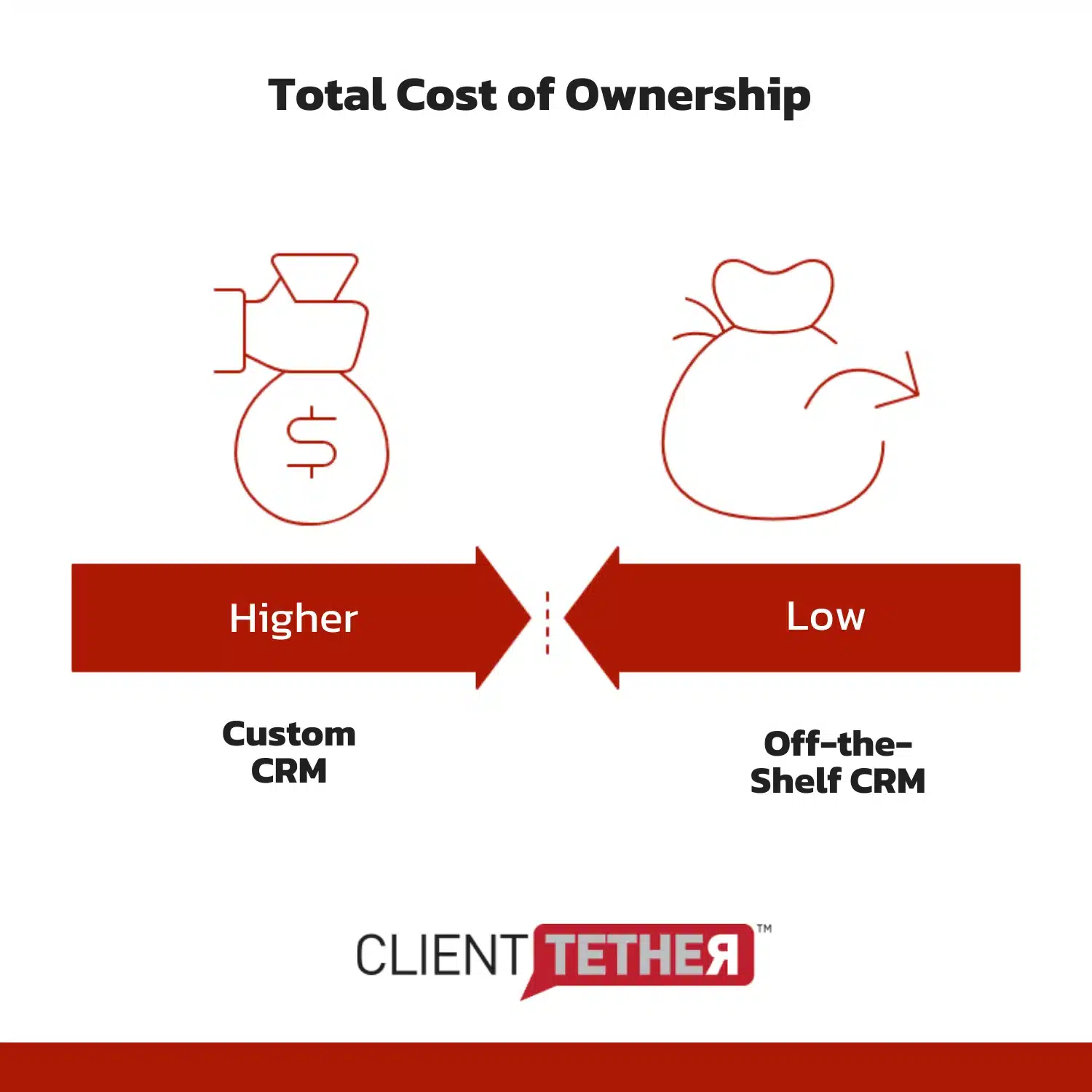
Comparing custom versus off-the-shelf solely on sticker price misses the bigger picture. Total cost of ownership captures the full economic impact over 3-5 years, including costs that surface after implementation and opportunity costs that never appear on invoices.
5-Year TCO Comparison
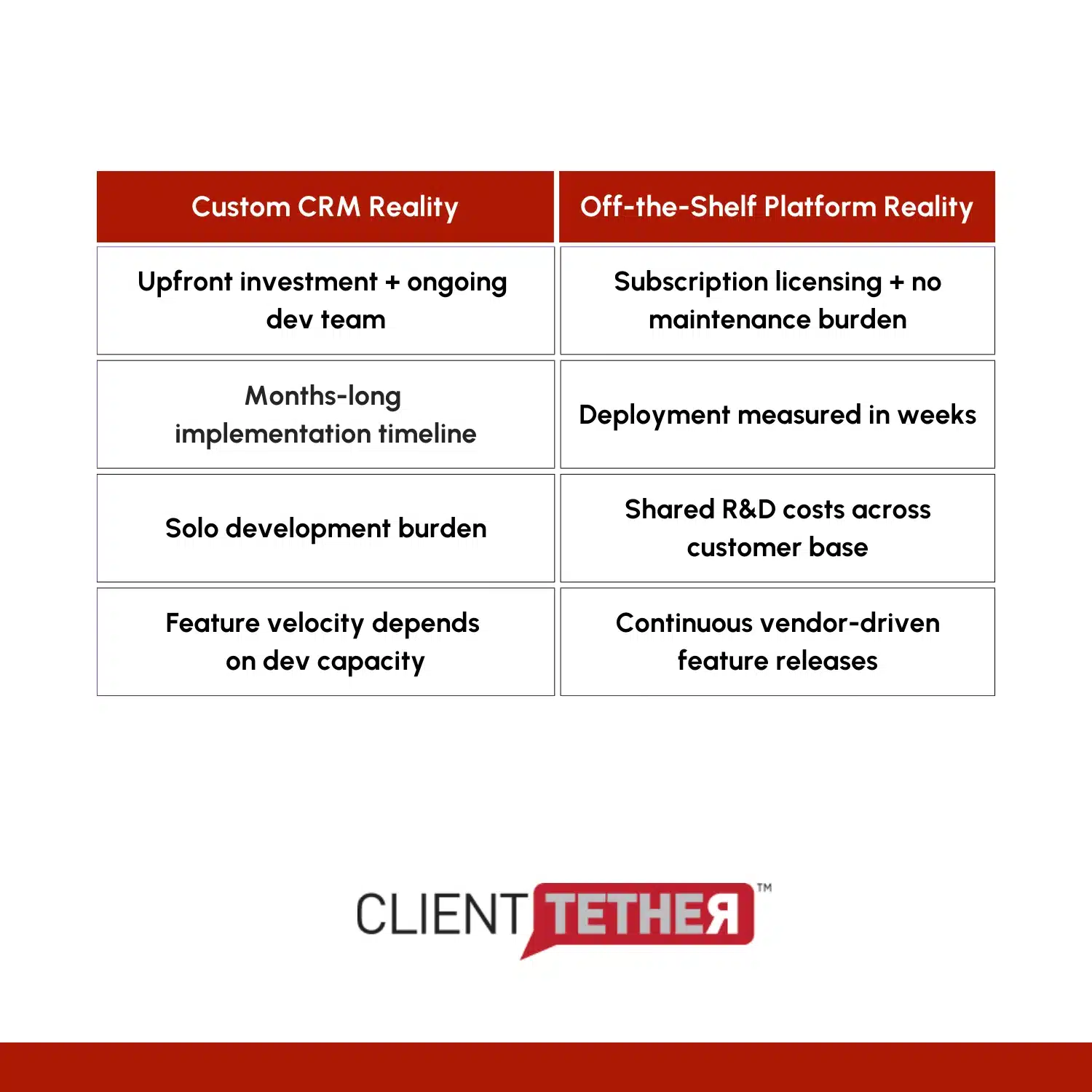
Custom CRM projects involve substantial upfront investment for development plus ongoing costs for maintenance, infrastructure, and feature additions.
You’re funding developer salaries or contractor fees, cloud hosting, security audits, and every enhancement request that emerges as your franchise grows.
Research indicates custom CRM builds can carry significantly higher total cost of ownership than equivalent off-the-shelf solutions over multi-year periods.
Off-the-shelf platforms distribute costs differently through subscription licensing plus implementation and training expenses.
Your monthly or annual subscription covers platform access, automatic updates, security patches, infrastructure maintenance, and vendor support. Implementation costs depend on configuration complexity, but you’re not funding ground-up development.
Over time, the TCO gap between custom and off-the-shelf often widens as custom builds accumulate technical debt and require ongoing developer retention.
Hidden Variables in TCO
Beyond direct costs, several non-financial factors affect true ROI. Opportunity cost matters—the months you spend building a custom CRM are months your franchise operates without improved lead management, automated follow-up, or HQ visibility.
That delayed value compounds as leads leak through manual processes and franchisees lack tools to close deals faster.
Feature velocity is another hidden variable. With custom builds, your ability to add features depends on developer availability and budget allocation. If your market shifts or competitors adopt new engagement tactics, you’re queuing development cycles rather than enabling features immediately.
Off-the-shelf platforms push features to all users simultaneously, keeping your franchise competitive without individual investment in every new capability.
Technical debt accumulates in custom systems as quick fixes and workarounds pile up. What starts as a clean codebase degrades over time, making future changes slower and more expensive.
Switching costs also factor into TCO—if your custom CRM underperforms or your dev team dissolves, migrating to a new system means data extraction, process remapping, and implementation from scratch.
The Middle Path: Configurable Off-the-Shelf Platforms
The custom versus off-the-shelf debate often presents a false binary. A third option exists: configurable off-the-shelf platforms that combine the speed and support of packaged software with the flexibility to adapt to franchise-specific workflows.
What Makes a Platform Configurable
Configurable platforms provide custom fields, workflow automation, API extensibility, and permission structures that let you build franchise-specific logic without coding from scratch.
You can define parent-child account hierarchies that mirror your franchise structure, set up territory-based lead routing by zip code, and create role-based dashboards that show HQ rollup reporting while giving franchisees location-level views.
API access lets you integrate with existing tools and extend functionality as your needs evolve. White-labeling options allow franchisees to see branded interfaces that feel purpose-built even though they’re running on shared platform infrastructure.
The key difference from rigid packaged software is adaptability—you’re configuring workflows to match your operations rather than forcing your team to adopt generic processes. For a complete feature evaluation framework, see The Essential Franchise CRM Checklist.
Evaluating Platform Flexibility
Not all platforms claiming “configurability” deliver equal flexibility. Look for robust API access that supports both inbound and outbound data flows, not just basic data exports.
Check the integration ecosystem—pre-built connectors to email platforms, phone systems, and advertising tools save implementation time and reduce maintenance burden.
Assess customization limits upfront. Can you add unlimited custom fields, or are you capped? Can you build multi-step automation workflows, or are you limited to simple triggers?
Verify that upgrades and new feature releases won’t break your customizations—platforms that separate configuration from core code minimize this risk and keep your system stable as the vendor evolves their product.
When Custom Development Makes Sense (and When It Doesn’t)
Custom CRM development isn’t inherently wrong—it’s a question of fit. Certain franchise operations justify the investment, while others are better served by configurable platforms that deliver similar outcomes without the development burden.
Scale and Complexity Thresholds
Large-scale franchise operations with significant unit counts, multi-brand portfolios, or complex regulatory requirements may reach thresholds where custom development makes economic sense.
If your franchise handles highly sensitive data with compliance obligations beyond standard platforms, custom builds give you control over security architecture and audit trails.
Proprietary workflows that create competitive differentiation can also justify custom investment.
If your franchise model includes unique operational processes that competitors can’t easily replicate, embedding those workflows in custom software protects your intellectual property and maintains your market position. Learn more about franchise system architecture requirements.
Build vs Configure
There’s a meaningful distinction between “built from scratch” and “highly configurable off-the-shelf.” True custom development means writing code, managing databases, building UI from wireframes, and maintaining everything long-term.
Configurable platforms let you achieve similar specificity by leveraging existing infrastructure with extensive customization layers.
Most franchises fall into the configurable category. You need parent-child hierarchies, territory routing, and branded franchisee portals—but you don’t need proprietary algorithms or novel data structures.
Configurable platforms deliver those capabilities through setup and configuration rather than months of development, giving you franchise-specific functionality without the custom CRM cost structure.
Questions to Ask Before Building Custom
Before committing to custom development, work through these critical questions:
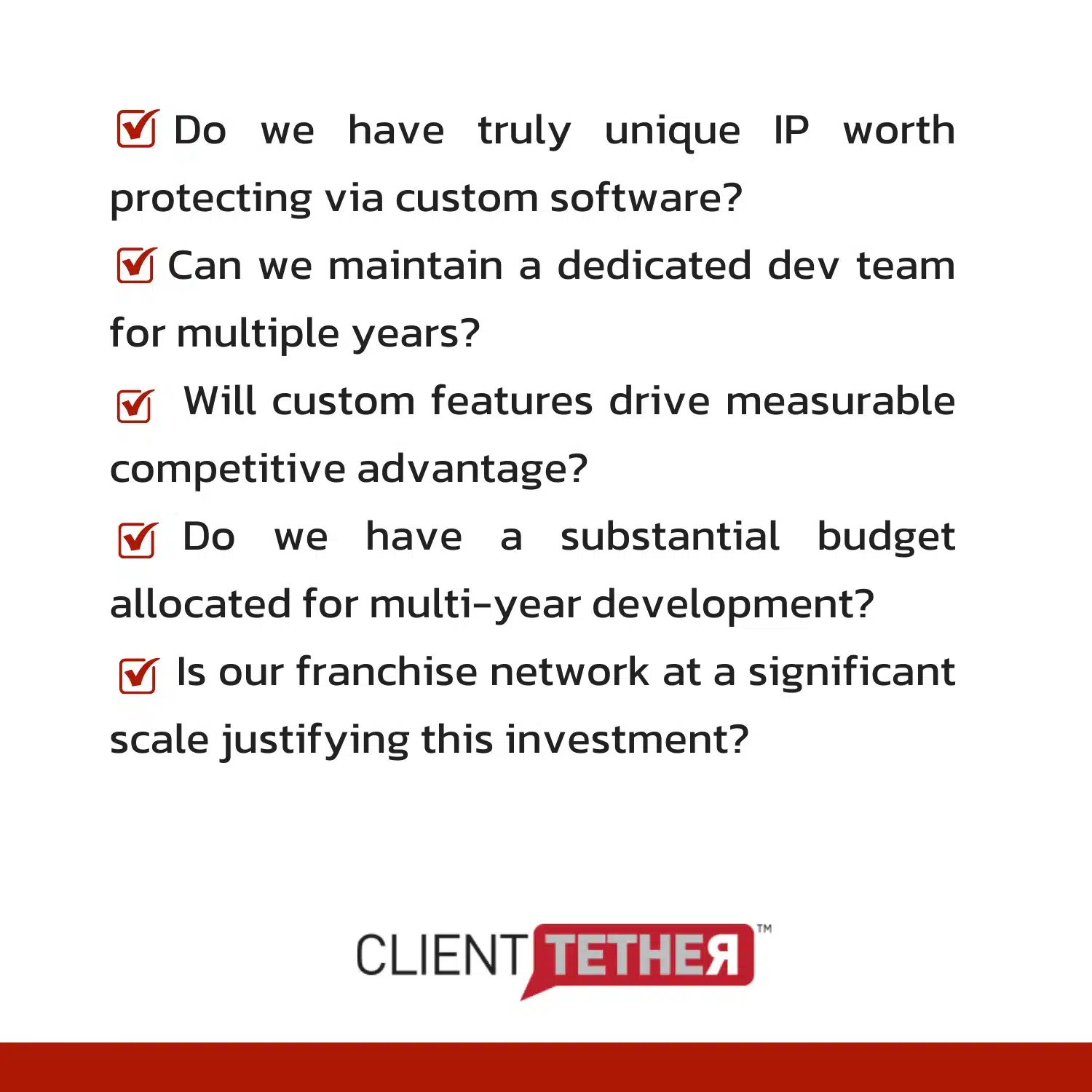
If you’re answering “no” to most of these questions, you’re likely better served by a configurable platform. The real question isn’t whether you can build a custom CRM—it’s whether you can sustain one long-term while your franchise network grows.
Red Flags for Custom Development
Several warning signs indicate that custom CRM development will create more problems than it solves.
Limited budget makes ongoing maintenance unsustainable—you might fund the initial build, but annual maintenance costs accumulate.
Small IT teams lack the bandwidth to support custom systems alongside other infrastructure needs.
Tight timelines conflict with custom development realities. If you need a functioning CRM within weeks, custom builds won’t meet that deadline.
Unproven workflows are also risky—building custom software around processes you haven’t validated means rebuilding when you discover better approaches.
For franchisors managing growth across multiple locations, ClientTether provides the configurability of custom builds with the speed and support of off-the-shelf platforms.