
Generating leads is one thing. Turning them into paying customers is another.
For home service businesses and franchise brands, a successful lead generation strategy doesn’t end when someone submits a form or makes a phone call. What happens next can make all the difference.
How quickly does your team respond? Are prospects receiving relevant follow-up? And how many opportunities are slipping through the cracks without anyone realizing it?
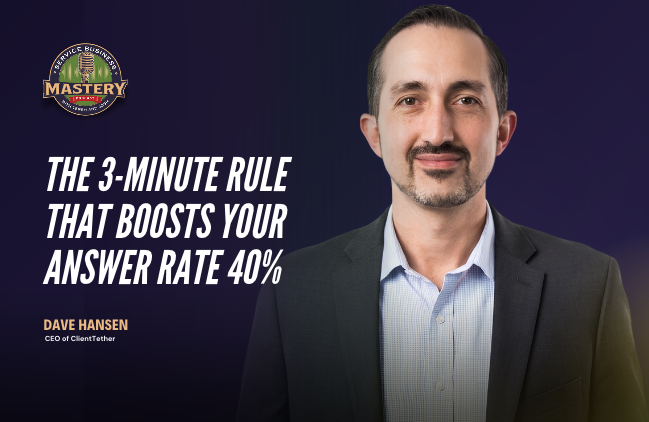
These are some of the questions ClientTether CEO Dave Hansen discussed during a recent appearance on the Service Business Mastery podcast, hosted by Tersh Blissett and Josh Crouch.
The conversation covered practical ways businesses can improve their speed to lead, automate communication, address common sales objections, and make better use of the leads they’re already generating.
Here’s a closer look at the key takeaways and how they apply to home service businesses and growing franchise networks.
Watch the full episode: Dave Hansen, Tersh Blissett, and Josh Crouch
1. Speed to Lead: Why the First Three Minutes Matter
When a homeowner needs a service, they aren’t necessarily waiting around for one company to respond.
They may be comparing providers, requesting multiple quotes, or trying to schedule an appointment as quickly as possible.
That makes speed to lead, the time it takes a business to respond to a new inquiry, an important part of the sales process.
Research published in the Harvard Business Review has long highlighted the importance of responding quickly to incoming leads. Businesses that delay their initial outreach risk missing opportunities to connect with interested prospects.
But how fast is fast enough?
During the podcast, Dave shared an approach centered on responding within three minutes of receiving a new inquiry.
His recommended sequence is straightforward:
- Immediately: Send an automated email acknowledging the inquiry.
- Within one minute: Follow up with a personalized text message.
- Within two to three minutes: Make a phone call while the inquiry is still fresh.
The reasoning behind this sequence is simple. A quick email confirms that the inquiry was received, a text introduces the business, and a timely phone call creates an opportunity for a real conversation.
Sending a text before calling can also help prospects recognize who’s contacting them, potentially improving the likelihood that they answer.
In fact, ClientTether has seen call answer-rate improvements of 40% or more with effective lead engagement strategies.
The key takeaway? Responding quickly shouldn’t depend entirely on someone being available to manually send a message or make a call.
With the right processes and automation, businesses can follow up consistently, even when their teams are busy.
What This Means for Franchise Brands
For franchisors overseeing multiple locations, speed to lead presents an additional challenge: consistency.
One franchisee might respond within minutes, while another takes several hours. Without visibility into how leads are being handled, these differences can be difficult to identify and address.
A franchise CRM can help standardize initial outreach by automating emails, text messages, and follow-up tasks while giving franchisors greater visibility into lead response performance across their network.
The goal isn’t simply to respond faster. It’s to create a more consistent experience for every potential customer, regardless of which location they contact.
2. Not All Leads Should Receive the Same Follow-Up
Responding quickly matters, but so does what you say.
Think about the different ways someone might contact a home service business.
A homeowner searching Google for an emergency plumbing service may be ready to schedule an appointment immediately.
Someone who clicks on a Facebook ad might still be gathering information or considering their options.
Both are potential customers, but their level of interest and expectations may be very different.
During the conversation, Dave emphasized the importance of tailoring follow-up based on where a lead originated.
Start by Reminding Prospects Where They Found You
One of Dave’s suggestions is surprisingly simple: mention the original lead source in your first message.
For example:
“Hi Sarah, this is Mike from ABC Plumbing. Thanks for reaching out to us through Angi! We’d be happy to help with your project. When would be a good time to connect?”
That small detail can help prospects remember their inquiry, especially when they’ve contacted multiple businesses.
Instead of receiving a generic message from an unfamiliar number, they have context for who’s reaching out and why.
Match Your Follow-Up to the Lead’s Intent
Dave also discussed why businesses should consider the source when determining their follow-up strategy.
Leads generated through organic search may demonstrate stronger purchase intent, particularly when someone is actively searching for a specific service.
Social media leads, on the other hand, may require additional engagement before they’re ready to make a buying decision.
That doesn’t mean every lead from a particular channel will behave the same way.
It means businesses should understand how different sources perform and adjust their communication accordingly.
For franchise brands, using franchise CRM software to organize leads by source, track engagement, and automate relevant follow-up can help teams create more personalized customer experiences without adding unnecessary manual work.
3. Missed Calls Could Be Costing You More Than You Think
Here’s a question every home service business owner should be asking:
How many incoming calls does your team actually miss?
It’s easy to assume that having someone responsible for answering the phone means every call gets handled.
But what happens when multiple customers call at once? Or when staff are assisting someone else, scheduling appointments, or handling other responsibilities?
During the episode, Josh Crouch raised an important point about the gap between what business owners believe is happening and what their call data might reveal.
Even businesses with established customer service teams can miss incoming calls, particularly during busy periods.
And when a potential customer can’t reach someone, they may move on to another provider.
Speed to Lead: Start With a Simple Audit
Before investing more in lead generation, take a closer look at how your existing inquiries are being handled.
Consider asking:
- How many incoming calls go unanswered?
- What happens when a customer calls outside business hours?
- How quickly does someone follow up on a missed call?
- Are web form submissions receiving timely responses?
- Can you identify where potential customers are dropping out of the process?
Testing your own customer experience can also reveal opportunities for improvement.
Try calling your business during a busy period or submitting a form through your website.
How long does it take to receive a response?
For multi-location franchise brands, this kind of visibility becomes even more important.
Franchise management software with centralized reporting and lead tracking can help franchisors identify differences in response activity across locations and determine where additional support or training may be needed.
Sometimes, improving conversion starts with fixing the opportunities you’re already missing.
4. Measure Which Lead Sources Are Actually Working
Many businesses invest in multiple lead generation channels, from paid Google campaigns to social media advertising and third-party marketplaces.
But generating inquiries isn’t the same as generating revenue.
During the podcast, Dave discussed the value of comparing lead sources rather than relying on a single channel or assuming that the channel producing the most leads is automatically the most successful.
For example, a business might receive more inquiries from Facebook than from Google.
However, if Google leads consistently turn into paying customers at a higher rate, the smaller volume could still deliver greater value.
The important thing is understanding what happens after each lead comes in.
Look Beyond Lead Volume
When evaluating marketing channels, businesses should consider several factors:
- Lead volume: How many inquiries is each channel generating?
- Lead response: How consistently is the team engaging those inquiries?
- Conversion rate: What percentage of leads become customers?
- Cost per acquisition: How much does it cost to gain a paying customer?
- Revenue generated: Which channels are contributing the most to business growth?
Comparing these metrics can help businesses make more informed decisions about where to invest their marketing budgets.
For franchisors, this also creates opportunities to identify successful approaches across different locations.
When lead source information and conversion activity are tracked consistently, franchise leadership can better understand what’s working and share those insights with the broader network.
The result is a more informed approach to marketing, grounded in actual performance rather than assumptions.
5. Let Your Customers Help Address Sales Objections
Not every sales challenge can be solved with faster follow-up.
Sometimes, a prospect is interested but still has questions.
Is the service worth the price? Can the business deliver the promised quality? What kind of experience should they expect?
That’s where customer testimonials can make a difference.
During the conversation, Dave shared a practical strategy for using customer videos to address common objections in the sales process.
Rather than simply asking customers to leave a general review, identify the questions or concerns that frequently prevent prospects from moving forward.
Then, find customers who have experienced those same concerns and are willing to share their stories.
Speed to Lead: Turn Common Objections Into Customer Stories
For example, if prospects frequently question your pricing, consider featuring a customer who initially had similar concerns but ultimately felt the service delivered value.
If customers are concerned about quality or craftsmanship, share a testimonial from someone who can speak directly to their experience.
These stories help potential customers hear from people who have already been through the decision-making process.
And because the message comes from an actual customer rather than the business itself, it can feel more relatable and credible.
For franchise brands, this approach can be particularly valuable.
Customer testimonials can support local marketing efforts while helping franchisees address common objections with real examples.
The key is authenticity. Give customers the opportunity to share their experiences in their own words, rather than scripting the message for them.
6. Don’t Overlook the Value of Your Business Network
One of the broader themes from the conversation was the importance of connecting with other business owners.
Running a business comes with challenges that aren’t always easy to navigate alone.
From staffing and customer service to sales performance and growth decisions, business owners often benefit from hearing how others have approached similar situations.
Dave discussed the value of mastermind groups, local networking organizations, and peer relationships as opportunities to exchange ideas and learn from one another.
These connections can also become meaningful referral sources.
A plumbing business, for example, may build relationships with HVAC or electrical contractors who serve similar customers without directly competing for the same services.
For franchise owners, the same principle applies.
One of the advantages of being part of a franchise network is the opportunity to learn from other owners who understand the business model and face many of the same day-to-day challenges.
Building those relationships, sharing successful practices, and learning from peers can create opportunities for growth that extend beyond any individual marketing campaign.
7. Turning These Strategies Into a Consistent Franchise Sales Process
The common thread throughout the episode is that improving lead conversion requires more than generating additional inquiries.
It requires a process that helps businesses respond quickly, communicate effectively, track performance, and follow through consistently.
For independent home service businesses, that might begin with reviewing missed calls or implementing automated follow-up.
For franchisors, the challenge often involves making those processes repeatable across an entire network.
That’s where the right franchise software can make a meaningful difference.
At ClientTether, we help franchise brands streamline lead management, automate communication, and gain greater visibility into sales activity across locations.
Our franchise CRM software is built specifically for franchising, helping franchisors and franchisees manage customer interactions while supporting more consistent processes across their networks.
Because when your team has the right systems in place, more opportunities get the attention they deserve.
Final Thoughts: Better Lead Conversion Starts With Better Follow-Up
If there’s one takeaway from Dave’s conversation with Tersh Blissett and Josh Crouch, it’s this:
Before spending more money generating leads, make sure you’re making the most of the ones you already have.
Responding within minutes, personalizing outreach, tracking missed calls, understanding lead sources, and sharing authentic customer stories can all contribute to a stronger sales process.
And for franchise brands, putting consistent systems behind those strategies can help create a more reliable customer experience across every location.
Want to hear the full discussion?
Watch Dave Hansen on the Service Business Mastery podcast.
Frequently Asked Questions About Speed to Lead
What is speed to lead?
Speed to lead refers to how quickly a business responds to a new inquiry from a potential customer. It is an important part of lead management because prompt communication increases the opportunity to connect with prospects while their interest is still fresh.
How quickly should a home service business respond to a new lead?
ClientTether CEO Dave Hansen recommends aiming to respond within three minutes. His suggested approach includes an immediate email, a text message around the one-minute mark, and a phone call within two to three minutes. This is a recommended strategy rather than a universal industry requirement.
Can automated follow-up improve lead conversion?
Automated follow-up can help businesses respond more consistently and reduce delays in communication. By automatically sending emails, text messages, and follow-up reminders, businesses can improve their ability to engage potential customers. Results depend on factors such as lead quality, messaging, timing, and the overall sales process.
Why should businesses personalize lead follow-up?
Personalized follow-up helps make communication more relevant. Mentioning where a prospect originally contacted the business can provide useful context, while adjusting follow-up based on lead source and buying intent can help teams communicate more effectively.
How can franchise CRM software help with speed to lead?
Franchise CRM software can help franchisors and franchisees automate initial responses, organize incoming inquiries, track lead activity, and monitor follow-up performance. These capabilities can support more consistent communication across multiple franchise locations.
How can home service businesses reduce missed leads?
Businesses can begin by reviewing missed calls, testing their website forms, monitoring response times, and establishing reliable follow-up procedures. Automated communication and centralized lead tracking can also help teams identify and respond to inquiries that might otherwise go unanswered.
Why are customer testimonial videos useful for lead conversion?
Customer testimonial videos allow prospects to hear directly from people who have used a business’s services. When testimonials address common concerns about price, quality, or customer experience, they can help build trust and support buying decisions.