Franchise management software shows up as one line item on your finance report. But your real stack is probably six.
CRM. Quoting tool. Payment processor. Review platform. Messaging system. Franchise reporting dashboard.
The numbers add up to something manageable. But you know — intuitively — that the figure on the report isn’t the full cost.
What about the hours your team spends keeping those tools talking to each other? What about the leads that fall through the cracks at every handoff? What about the franchisees who avoid using half the stack because it’s too fragmented to navigate?
If you’re a CEO, founder, or COO at an emerging or mid-market franchise brand, you’re probably asking: What is this stack actually costing me?
This article gives you a decision framework that surfaces the real total cost of ownership — not just the license fees, but the integration work, adoption drag, and revenue leaking between tools that most cost comparisons miss.
Franchise management software often looks cost-effective when you compare license fees alone. But the real cost includes integration overhead, franchisee adoption drag, and revenue lost between disconnected tools — which changes the total cost of ownership entirely.
Key Takeaways
- License costs are only one layer of total cost — integration, adoption, and revenue leakage matter just as much
- Franchise systems have unique cost dynamics that standard SaaS comparisons miss
- Fragmented point solutions create hidden costs at every handoff
- Integrated platforms reduce total cost by eliminating system fragmentation, not just lowering license fees
- A full TCO evaluation requires mapping all four cost layers across your current stack
What Is the Real Cost of Franchise Management Software?
The real cost of franchise management software goes beyond license fees. It includes integration overhead between tools, franchisee adoption challenges across locations, and revenue lost when systems don’t connect.
In franchise systems, total cost of ownership depends on how well software supports both corporate visibility and local execution in a single workflow.
License fees are visible. They show up on your finance report every month.
Layer 1: Direct license cost
These are the subscription line items that appear on your finance report. CRM platform. Quoting tool. Payment processor. Review software. Messaging system. Franchise reporting dashboard.
This is the cost everyone sees.
Layer 2: Integration and maintenance cost
Keeping those tools talking to each other requires time, technical effort, and vendor management.
Someone has to set up the integrations. Someone has to troubleshoot when data doesn’t sync. Someone has to manage API changes, version updates, and support tickets across multiple vendors.
That’s engineering time, admin time, and opportunity cost — even if no one’s billing it as “integration overhead.”
Layer 3: Adoption cost
Franchisees have to learn each tool. Log into each system. Remember which platform handles what.
When the stack is fragmented, adoption drops. Franchisees skip steps. They fall back on spreadsheets or manual workflows. They call HQ for help because they can’t figure out where data lives.
That drag compounds across every location. The bigger the system, the more it costs.
Layer 4: Revenue leakage cost
Revenue leaks at every handoff.
A lead enters the CRM but doesn’t trigger follow-up because the messaging tool isn’t connected. A quote gets sent but doesn’t convert to payment because the handoff breaks. A job finishes but the review request never fires because the workflow spans three platforms.
That’s not a software problem. That’s a revenue problem.
According to the 2025 IFA Franchisor Survey, franchisors are managing operational pressure while pursuing growth targets — which means every leak matters.
When you calculate TCO, all four layers matter. Not just the first.
Why Franchise TCO Works Differently Than General SaaS TCO
A franchise management software isn’t a single-location business with a shared inbox.
That structural difference changes the math.
Costs scale with locations, not just users
A per-seat CRM in a 50-location franchise brand scales differently than the same CRM in a 50-person company.
Each franchisee needs access. Each FBC needs visibility. Each location might have multiple staff members. If you’re paying per user, those seats stack fast.
Franchisee adoption is a compounding cost
When you add a tool to the stack, you’re not just adding one learning curve. You’re adding a learning curve that multiplies across every franchisee.
If adoption drops at the local level, it’s not just a training problem. It’s a revenue problem. Franchisees who don’t use the system execute inconsistently. Leads don’t get followed up on. Jobs don’t get logged. Revenue falls through the gaps.
Shelfware costs money — but in franchising, shelfware at the franchisee level costs revenue.
Corporate visibility is a structural requirement
A franchise can’t trade visibility for local autonomy.
The franchisor needs system-level reporting. Franchisees need local execution tools. Both layers have to work at the same time.
If your tools don’t support that structure natively, someone has to build the integration. That’s where generic SaaS stacks break.
Handyman Connection — a 100+ location franchise — uses integrated workflows with real-time reporting across the network. That visibility doesn’t happen by accident. It happens because the platform was built for franchise structure.
A standard SaaS TCO calculator won’t catch these realities. Franchise systems need a framework that accounts for location scaling, franchisee adoption, and corporate visibility — not just user seats and license tiers.
The Point-Solution Stack: What It Looks Like and Where It Leaks
Here’s what the typical franchise management software stack looks like:
- A generic CRM for pipeline management
- A separate review platform for reputation
- A separate quoting tool for estimates
- A separate payment system for invoicing
- A separate messaging layer for SMS and calls
- A separate franchise management or reporting system for HQ visibility
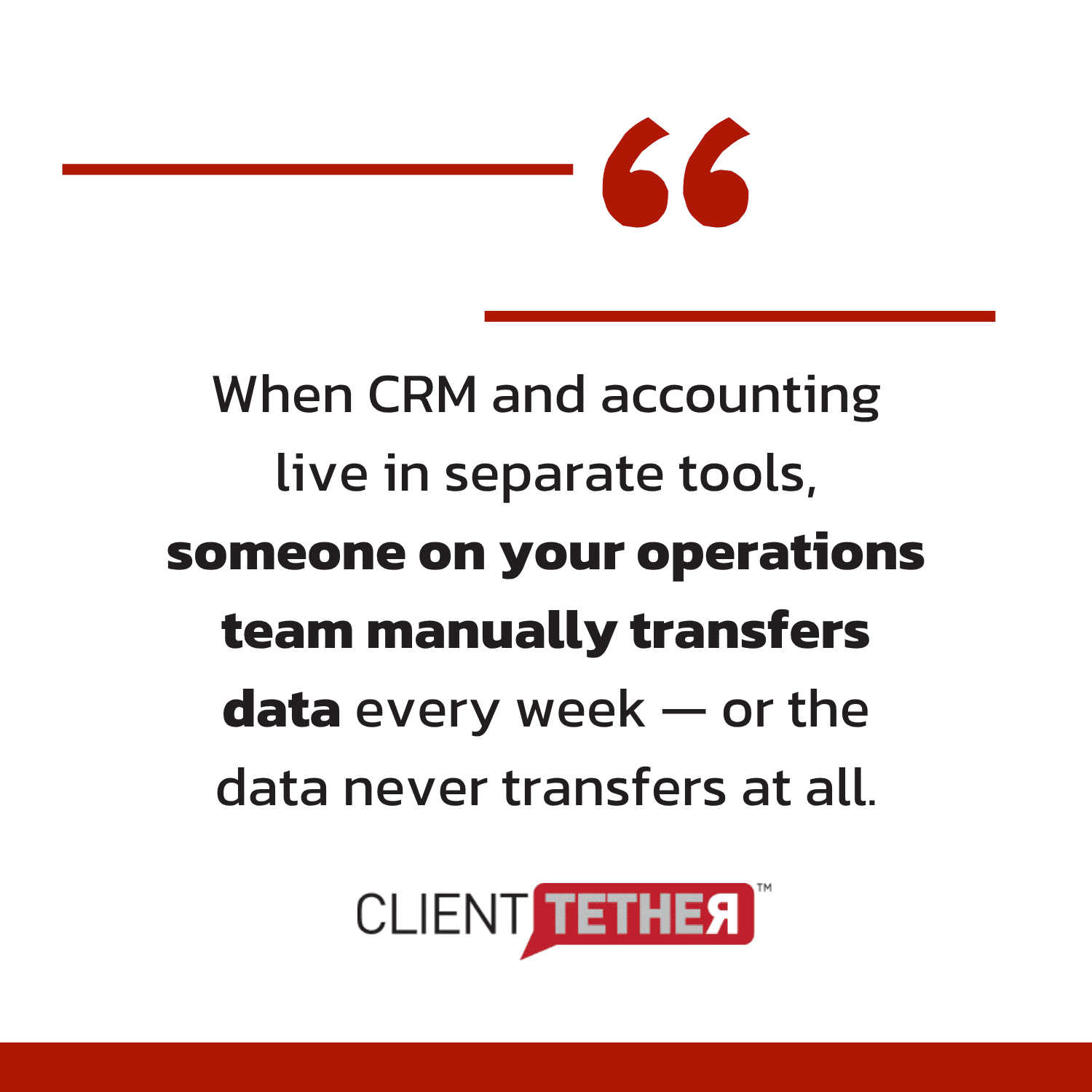
That’s three to five tools. Each with its own login, its own data model, its own support contract.
And each handoff is a place where things break.
Where the leaks happen
Lead comes in. It enters the CRM. But if the messaging tool isn’t connected, no one sends a text. The lead waits. Intent cools. Conversion drops.
Quote gets generated. It goes out via email. But if the payment system isn’t linked, the customer has to find a separate portal to pay. Friction increases. Close rates drop.
Job finishes. The franchisee marks it complete. But if the review platform isn’t triggered automatically, the review request never goes out. Trust signals never build. Future conversion suffers.
Activity happens across locations. But if the reporting tool pulls from separate sources, HQ can’t see the full picture. Decisions slow. Visibility gaps widen.
Color World Painting — a national painting franchise — replaced a prior CRM that lacked automation and multi-location visibility. The decision wasn’t just about features. It was about removing the seams where execution broke.
The stack works — until you add it up. Then you see where the handoffs cost you.
The Integrated Platform: What Changes in the Math
An integrated franchise management software consolidates the stack.
CRM, communication, scheduling, proposals, payments, reviews, reporting, and franchise sales workflow — all in one operating environment.
Here’s what changes in each cost layer:
Direct license cost
Instead of three to five subscription line items, you get one. The license might not be cheaper per month — but you’re not stacking tools.
Integration cost
The tools are already connected. There’s no middleware to maintain. No API versioning to track. No vendor finger-pointing when data doesn’t sync.
Integration overhead drops toward zero.
Adoption cost
Franchisees work in one system. One login. One place to manage leads, quotes, payments, and follow-up.
The learning curve flattens. Adoption increases. Execution improves across locations.
Revenue leakage
The handoffs disappear.
A lead enters the system, and follow-up triggers automatically. A quote converts to payment in the same workflow. A job completes, and the review request fires without manual intervention.
Revenue stops falling out between tools.
The International Franchise Professionals Group (IFPG) — a 1,500+-member franchise broker organization — replaced its prior CRM and white-labeled ClientTether as its Franchise Sales CRM 2.0, consolidating its entire broker network into a single system. That decision removed the fragmentation layer entirely.
One of the structural factors in the cost shift: location-based flat pricing. More on that below.
Licensed by Location, Not Per User: What That Changes
Per-seat pricing scales badly in franchise systems.
Every franchisee employee. Every FBC. Every corporate role. Every staff member at every location. If you’re paying per user, those seats compound fast.
Location-based pricing changes the math.
You pay per location — not per person. A franchise adding staff across franchisees, FBCs, executives, and corporate roles doesn’t see the license cost stack. The math holds flat regardless of headcount.
That’s a structural advantage in TCO comparisons. Not just a discount.
ClientTether uses a flat monthly rate per account — licensed by location, not per user. Unlimited users per account. One-time setup fee. No hidden fees for database size, integration connections, or ongoing support.
Pricing is customized based on the number of brands, number of units, and modules in use.
Disclaimer: Costs and pricing may vary based on specific business needs and configurations. Consult with your provider for accurate estimates.
How Do You Evaluate the Real Cost of Your Franchise Software Stack?
You evaluate it by mapping your current stack, identifying hidden costs, and comparing it to a franchise management system across all four cost layers.
Step 1: Map the current stack
List every tool. Every subscription. Every integration.
Don’t just count the visible licenses. Count the middleware, the Zapier connections, the custom API work holding it together.
Step 2: Add the hidden layers
Calculate the time your team spends on integration maintenance. Estimate the adoption drag at the franchisee level. Identify the visibility gaps that slow decisions. Track the revenue leaking at handoffs.
This is where the real cost lives.
Step 3: Compare against a franchise management software
Run the same four-layer analysis for an integrated franchise management software.
What’s the license cost? What’s the integration overhead? What’s the adoption curve for franchisees? Where does revenue leak?
Step 4: Factor the franchise-specific realities
Does the platform scale with locations or users? Can franchisees execute locally while HQ maintains visibility? Does the architecture support franchise structure natively, or does it require custom work?
Step 5: Make the build-vs-buy decision with the full picture
The license comparison is only one layer. The real question is: What does the stack cost across all four layers — and where does the hidden cost disappear?
From Cost Framework to Platform Decision
License comparisons miss most of the cost.
The real total cost of ownership isn’t just what the subscriptions add up to. It’s what those subscriptions cost when you add integration overhead, adoption drag, visibility gaps, and revenue leaking at every handoff.
An integrated franchise-native platform changes the math — not by cutting license fees, but by removing the hidden cost layers.
If you’re evaluating the cost of your current stack, start with the framework. Map the four layers. Add the franchise-specific realities. Then compare with visibility, not guesswork.