
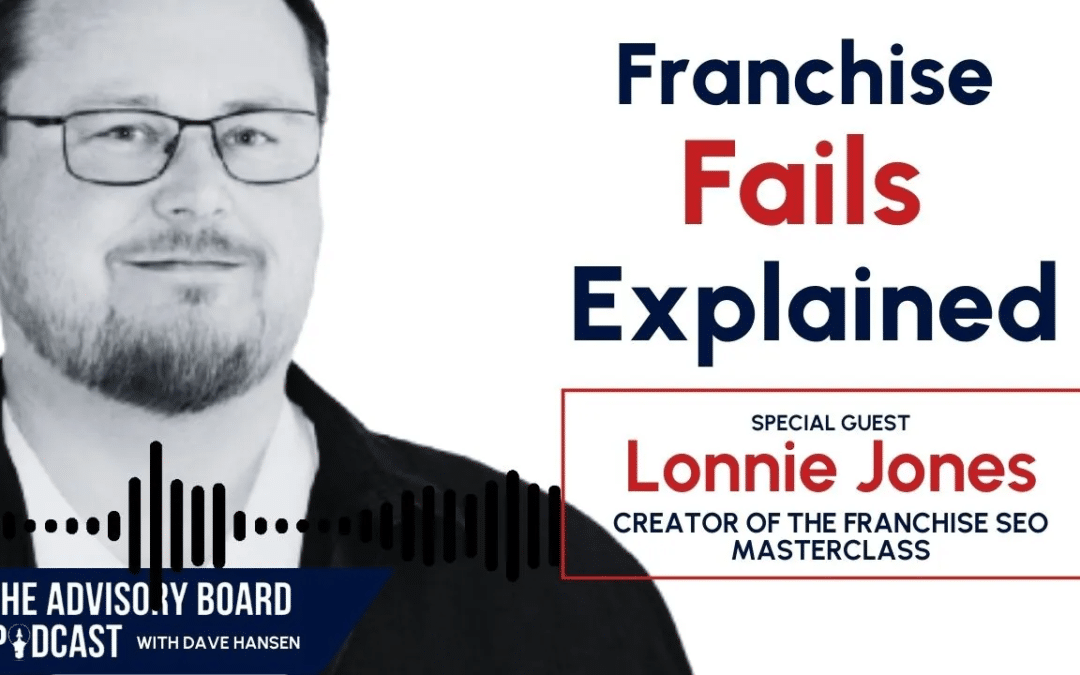
When I sat down with Lonnie Jones for this episode of The Franchise Advisory Board Podcast, I knew we were going to get past surface-level marketing talk pretty quickly.
Lonnie has spent years helping franchise brands compete in categories where average marketing just does not cut it. He works in the kinds of markets where owners cannot afford vague advice, bloated spending, or strategies that sound good in a boardroom but fail in the field.
What made this conversation especially valuable is that we were not talking about theory. We were talking about what actually happens when franchise brands try to grow locally, why so many marketing efforts underperform, and what it looks like to build a smarter, more durable approach.
Meet Lonnie Jones
If you do not know Lonnie Jones yet, you probably should.
He is the founder and CEO of Local SEO Help, and he has built a reputation in franchise marketing by helping brands win in competitive categories. What I appreciate about Lonnie is that he does not come at this like a guy trying to sell tactics for the sake of selling tactics. He comes at it like an entrepreneur who understands budgets, performance, and what owners actually need from their marketing.
That came through early in our conversation when he said, “I’m not the person out there trying to sell you marketing services for the sake of selling you marketing services.” That is part of what makes his perspective so useful here. He is focused on what works, not what is trendy.
Most franchise marketing fails when owners expect one channel to do all the work
One of the clearest themes in this conversation was the false expectation that a single ad campaign should immediately drive meaningful results.
Lonnie said it plainly: “There’s this misconception that they can just go set up Facebook ads… and leads are just gonna… be dying for that product or service. I’m here to tell you that’s never going to happen.”
That is such an important reset for franchise owners. Too many people launch one campaign, give it a short window, and assume the channel itself is broken if leads do not instantly flow. But buyers do not usually work that way. They need multiple touchpoints, repeated exposure, and enough familiarity with a brand to trust it when the buying moment finally arrives.
That is where the idea of stacked marketing becomes so useful. The goal is not just to run ads. The goal is to build enough cumulative influence that when someone is ready to act, your brand is already the one they recognize.
Stacked marketing works because people buy from the brand they have already seen
This was one of the strongest insights Lonnie shared.
He explained that when he applied the same marketing strategy to newer franchisees and more established ones, the older locations often converted at a much higher rate. The reason was not always the campaign itself. It was the market familiarity those older locations had already built.
As Lonnie put it, “Guess which one they’re going to gravitate towards, the one that they’ve seen.”
That is the heart of stacked marketing. People see the trucks. They notice the yard signs. They hear the name. They come across the brand in search, social, or retargeting. Then when the timing is finally right, they move toward the brand that already feels familiar.
That matters a lot for franchise systems. Newer owners often assume poor early performance means the strategy is wrong, when sometimes the real issue is that the market simply has not had enough time or enough touchpoints to build trust yet.
SEO still matters, but the game is shifting with AI search
We also spent time talking about SEO and why it still matters, even as search behavior changes.
Lonnie made a point I strongly agree with: “It’s not dying. It’s just shifting.”
That is exactly right. People are still searching. The platforms are evolving, but discoverability still matters. Whether someone is using Google, ChatGPT, or another AI-powered search experience, the same basic question is being asked behind the scenes: who should be trusted as the authority?
Lonnie put it this way: “They want to know who is the expert.”
That means reviews matter. Backlinks matter. Reputation matters. Content quality matters. The signals that tell search engines and AI tools your business is credible are still incredibly important. If anything, they matter more now because there is so much low-quality content flooding the internet.
Omni-channel does not mean being everywhere. It means being intentional
Another part of this conversation that really stood out was Lonnie’s explanation of omni-channel marketing.
For a lot of people, omni-channel sounds like a mandate to show up on every platform possible. That is not realistic for most franchisees, and it is not what good strategy looks like anyway.
Lonnie said, “Figure out the three to five places that you’re most likely to be in front of the right people.”
That is the better way to think about it.
You start by understanding your customer. Then you map the likely journey. Where do they first become aware of you? Where are they most likely to notice you again? What can you do once they visit your site or engage with your brand to stay in front of them until they are ready to move?
That is what makes omni-channel work. Not random activity. Not being loud in ten places at once. A focused presence in the places that matter most, with enough consistency to create real momentum.
Franchise owners need to trust their marketing partners, but verify them
One of the most practical parts of the episode was around how franchisees should evaluate agencies and campaigns.
Lonnie’s advice was balanced. Trust the brand’s recommended partners, but do not stop there. Ask what other franchisees are seeing. Ask how long it took for results to show up. Ask what success should realistically look like in your market.
His phrase was simple: “Trust but verify.”
I think that is exactly the right mindset. Franchise owners should absolutely learn from the system and from what is already working. But they also need to do their homework, talk to peers, and make sure they are walking into a strategy with the right expectations.
That is especially important because impatience can be expensive. Owners often pull the plug too early, restart with someone new, and lose the advantage of the learning already built into the original campaign.
In competitive categories, specialists matter
Lonnie was also direct about something many brands need to hear: in highly competitive categories, average execution is not enough.
He said, “The only way you’re going to win is by having the best.”
That does not mean chasing the loudest agency or the flashiest pitch. It means recognizing that SEO, paid search, and paid social are all distinct disciplines. In many cases, the people who produce the best outcomes are the people who have gone deep in one lane, tested heavily in one category, and know exactly what signals to watch.
That kind of specialization can make all the difference, especially in categories like roofing, restoration, dental, or other high-competition local markets where weak execution gets exposed quickly.
Wrap Up Thoughts
What I kept coming back to after this conversation is how often franchise growth gets framed too narrowly.
Owners are often told to spend more on ads, try the next channel, or move on quickly if something does not pay off fast enough. But what Lonnie brought into focus is that better growth usually comes from building a real system. One that is rooted in patience, validation, repetition, and strategy.
That resonates with me because franchise growth is rarely about one perfect tactic. It is usually about alignment. The right message, in the right places, in front of the right people, with enough repetition and credibility to turn awareness into action.
That is what smarter local growth looks like.
Listen & Watch the Full Conversation
Watch the full episode on YouTube
Check out the Podcast hub Channel
Connect with Lonnie Jones and visit Local SEO Help